How to Budget for Elevator Maintenance and Repairs for a Commercial Building in Florida
Budgeting for elevator maintenance and repairs in a Florida commercial building requires a structured, compliance-driven approach. Florida property managers and building owners must account for mandatory state inspections, ASME A17.1 code requirements, equipment-specific service needs, and the financial reality that aging systems demand escalating repair investments. This FAQ hub page addresses every cost driver, planning step, and compliance obligation you need to build a defensible elevator budget for the upcoming fiscal year.
What Are the Main Cost Categories I Should Include in an Elevator Budget?
A sound elevator budget for a Florida commercial building consists of four primary cost categories: preventive maintenance contracts, mandatory inspections and permit fees, planned capital expenditures for component replacement, and an unplanned repair contingency reserve.
Each category serves a distinct financial function. The preventive maintenance contract covers routine lubrication, adjustments, safety checks, and minor part replacements on a scheduled basis. Mandatory inspections and permit fees are non-negotiable obligations under Florida law and must appear as a fixed line item. Capital expenditures cover predictable but high-cost replacements such as controllers, door operators, hydraulic cylinders, and cab interiors. The contingency reserve is typically sized as a percentage of the total annual maintenance spend to absorb breakdowns that fall outside the scope of the service contract.
Property managers who separate these four categories gain far better visibility into where elevator costs originate and can defend budget requests to ownership groups with documented, structured reasoning.
What Does Florida Law Require for Elevator Inspections, and What Do They Cost?
Florida law mandates periodic elevator inspections by a licensed elevator inspector under the oversight of the Florida Department of Business and Professional Regulation (DBPR), and these inspections carry permit and certificate fees that must appear in any compliant budget.
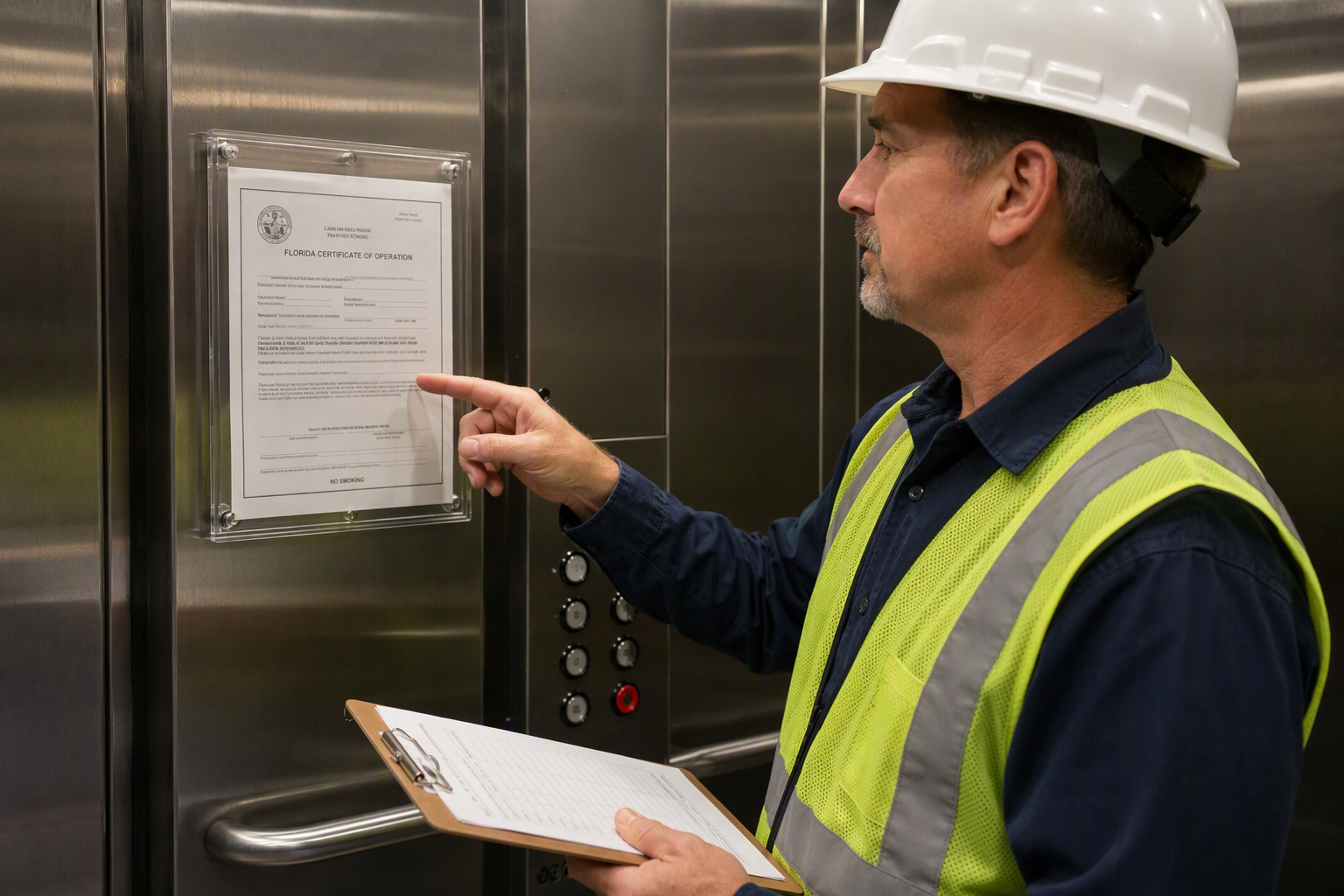
Florida’s elevator safety program is administered by the DBPR’s Building Code Compliance and Mitigation program. Elevators in Florida must receive periodic inspections, and Certificates of Operation must be maintained and prominently displayed in the elevator cab. Inspection intervals and exact fee schedules can vary based on elevator type and the local Authority Having Jurisdiction (AHJ) — in some jurisdictions, the municipality conducts inspections; in others, a third-party licensed inspector is used.
For commercial buildings in Pompano Beach and Sarasota — both markets served by Axxiom Elevator Florida — property managers should confirm the current fee schedule directly with their local AHJ, as Broward County and Sarasota County may each maintain separate permit and inspection fee structures. Budget line items should also include fees for any witness tests that follow a major repair or alteration, since Florida requires re-inspection after significant work.
How Does the ASME A17.1 Safety Code Affect My Maintenance Budget?
The ASME A17.1 Safety Code for Elevators and Escalators sets the minimum maintenance, testing, and inspection standards that directly determine what your service contract must include and what additional tests you are required to fund each year.
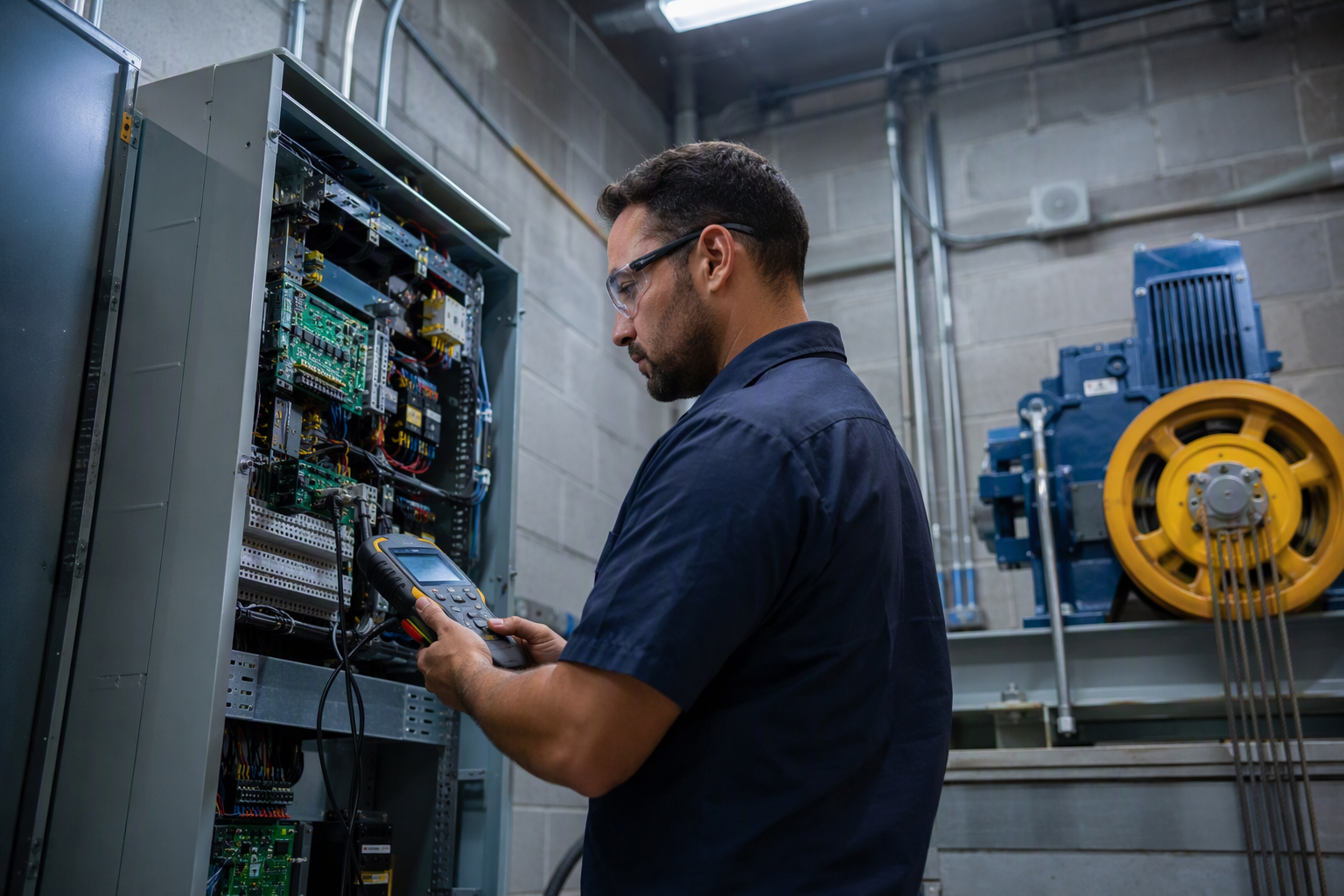
ASME A17.1 establishes requirements for periodic tests such as the Category 1 and Category 5 safety tests for traction elevators, and the annual pressure and safety relief valve tests for hydraulic elevators. These tests must be performed by qualified personnel and documented. Florida has adopted the ASME A17.1 code, meaning these are not optional best practices — they are enforceable legal requirements. When soliciting service contract proposals, building owners should verify that the proposed scope explicitly covers all ASME A17.1 required tests, because contracts that exclude mandatory tests will generate out-of-scope charges that inflate actual annual costs above the contracted amount.
The 2019 edition of ASME A17.1 (and subsequent editions) also addresses periodic maintenance intervals in detail. Understanding which tests are annual, five-year, and on-condition is essential for multi-year capital planning.
What Is a Realistic Annual Spend Range for Elevator Maintenance in Florida?
Annual elevator maintenance costs in Florida vary based on elevator type, age, number of stops, usage intensity, and the scope of the service contract — and rather than citing unverifiable industry averages, the most reliable approach is to use competitive quotes from licensed Florida elevator contractors as your benchmarks.
The table below illustrates the key variables that drive cost differences between elevator types and service configurations. Building owners should use this framework to compare quotes and identify gaps in coverage:
| Variable | Lower Cost Profile | Higher Cost Profile | Budget Impact |
|---|---|---|---|
| Elevator Type | Hydraulic, low-rise | Traction, high-rise, MRL | Traction systems generally require more complex servicing |
| System Age | Under 10 years, modern controls | Over 20 years, obsolete parts | Older systems carry higher repair frequency and parts scarcity premiums |
| Usage Intensity | Low-traffic, office building | High-traffic, hospital, retail | Higher cycle counts accelerate component wear |
| Contract Scope | Exclusion-heavy (“oil and grease”) contract | Full-coverage, parts-and-labor contract | Full-coverage contracts cost more upfront but reduce surprise repair invoices |
| Number of Units | Multiple elevators, same building | Single unit, standalone building | Multi-unit agreements often yield per-unit discounts |
| Inspection Type | Routine periodic inspection only | Witnessing major repair, Category 5 test | Non-routine inspections add permit and labor fees |
What Is the Difference Between a Full-Coverage and an Exclusion-Based Maintenance Contract?
A full-coverage maintenance contract includes parts, labor, and most repair costs within a fixed monthly or annual fee, while an exclusion-based (sometimes called “oil and grease”) contract covers only routine lubrication and adjustments, leaving parts and repairs as additional billable items.
The contract type chosen is one of the most consequential budget decisions a property manager makes. An exclusion-based contract appears less expensive on its face but can produce significant unbudgeted repair invoices throughout the year. A full-coverage contract provides cost predictability, which is especially valuable for older elevator systems where component failure rates are higher. When comparing proposals, building owners should request a written list of all exclusions — items such as vandalism, cab interiors, door frames, and obsolete parts are commonly excluded even from contracts marketed as “full service.” Axxiom Elevator Florida recommends that building owners in Pompano Beach and Sarasota review exclusion lists carefully before executing any multi-year service agreement.
How Should I Budget for Elevator Repairs That Are Not Covered by My Service Contract?
A contingency reserve of meaningful size — determined by elevator age, condition, and contract exclusions — should be established as a dedicated budget line to absorb out-of-contract repair costs without disrupting operating budgets.
The contingency reserve functions like an internal insurance fund. For newer elevators under full-coverage contracts, the reserve can be modest. For aging systems with exclusion-based contracts, the reserve should be substantially larger, reflecting the realistic probability of component failures during the fiscal year. Property managers can right-size the reserve by requesting from their elevator service provider a written condition assessment of each unit, identifying components approaching end of useful life. This assessment, sometimes called an elevator condition report or modernization study, translates mechanical risk into financial exposure and provides the documentation needed to justify reserve amounts to ownership.
What Are the Most Common and Costly Elevator Repairs in Florida Commercial Buildings?
The most common high-cost elevator repairs in Florida commercial buildings include hydraulic cylinder and seal replacement, controller and relay modernization, door operator and sill replacement, and hoist rope renewal for traction systems — all of which should be assessed annually and planned for in a multi-year capital budget.
Florida’s climate introduces specific failure risks that property managers in other regions may not prioritize. High humidity accelerates corrosion of hydraulic components and electrical contacts. Coastal exposure in markets like Pompano Beach adds salt-air corrosion risk to exposed mechanical parts. Underground hydraulic cylinders in older single-bottom hydraulic elevators are a significant liability item: Florida required the replacement of single-bottom cylinders through its adoption of ASME A17.3, the Safety Code for Existing Elevators and Escalators, and any remaining non-compliant cylinders represent both a safety hazard and a major unbudgeted capital exposure if not already addressed.
Door system failures — including door operators, gibs, sills, and safety edges — are among the most frequent service calls in any commercial building and should be treated as a recurring, predictable cost rather than a surprise repair.
How Does ADA Compliance Factor Into Elevator Budget Planning?
The Americans with Disabilities Act (ADA) imposes accessibility requirements on commercial elevators that may require capital expenditures when equipment is altered, when a building undergoes renovation, or when a compliance gap is identified during an accessibility audit.
ADA requirements for elevators cover cab dimensions, door widths, control panel button size and placement, Braille and raised character signage, audible and visible signals, and floor designation announcements. For buildings constructed or last renovated before the ADA’s requirements took full effect, a gap assessment may identify deficiencies. While routine maintenance does not typically trigger ADA upgrade obligations, any alteration to the elevator or surrounding area can create a path-of-travel obligation that draws the elevator into scope. Budget planners should consult with a qualified elevator contractor and legal counsel to assess whether any planned building renovations will trigger ADA-related elevator expenditures during the fiscal year.
What Is a Multi-Year Capital Reserve Plan and Does My Building Need One?
A multi-year capital reserve plan is a forward-looking financial schedule that identifies predictable high-cost elevator investments — modernizations, major component replacements, and code-driven upgrades — over a five-to-twenty-year horizon, and it is an essential planning tool for any commercial building with elevators in Florida.
Reserve studies for commercial buildings typically include elevator systems as a major capital asset category, with replacement costs and expected remaining useful life assigned to each component. For condominium associations in Florida, reserve funding requirements are governed by Florida Statutes, and elevators are a standard component in professionally prepared reserve studies. Commercial property owners without statutory reserve obligations nonetheless benefit from the same planning discipline, as it prevents the financial disruption of large, unplanned modernization costs. Axxiom Elevator Florida provides elevator condition assessments that can be incorporated into capital reserve planning for commercial properties in the Sarasota and Pompano Beach markets.
When Should I Budget for a Full Elevator Modernization Rather Than Continued Repairs?
A full elevator modernization should be budgeted when cumulative annual repair costs approach or exceed a meaningful fraction of the modernization cost, when critical parts are no longer available, when the system fails to meet current code requirements, or when downtime is materially affecting building operations or tenant satisfaction.
The decision between continued repair and modernization is financial as well as technical. An elevator contractor can model the comparative cost of ongoing repairs against a modernization investment over a defined period. Modernization typically addresses the controller, operating system, door equipment, fixtures, and cab finishes — restoring reliability, improving energy efficiency, and resetting the maintenance cost curve. Under ASME A17.3, existing elevators undergoing alteration must be brought into conformance with applicable requirements, so a partial modernization can sometimes create compliance obligations for connected systems.
What Should I Look for When Comparing Elevator Service Contractor Proposals?
When comparing elevator service contractor proposals, evaluate scope of coverage, exclusion lists, response provisions, technician qualifications, parts sourcing policies, documentation practices, and whether the contractor is licensed under Florida’s elevator contractor licensing requirements.
Florida requires elevator contractors to be licensed through the DBPR. Verifying current licensure is a non-negotiable first step when evaluating any service provider. Beyond licensure, building owners should assess whether the contractor’s technicians hold QEI (Qualified Elevator Inspector) certifications or equivalent credentials, whether the company maintains an inventory of common parts for the specific elevator brands in the building, and whether service records and inspection documentation are provided in a format compatible with the building’s property management systems. Axxiom Elevator Florida serves commercial properties across Pompano Beach and Sarasota with licensed, documented service programs designed to support both compliance and budget predictability.
How Do I Establish a Baseline Elevator Budget If I Have No Prior Cost History?
To establish a baseline elevator budget with no prior cost history, begin with a professional condition assessment of each elevator, obtain at least three competitive service contract proposals, identify any outstanding code deficiencies, and construct the budget from documented costs rather than industry averages.
- Commission a written elevator condition assessment from a licensed Florida elevator contractor, identifying the current state of all major components and any code deficiencies.
- Request itemized service contract proposals from at least three licensed Florida elevator contractors, specifying identical scope so proposals are directly comparable.
- Obtain a list of any open violations or required upgrades from your local AHJ or the Florida DBPR, and obtain repair or upgrade pricing for each item.
- Identify the five most wear-prone components based on the condition assessment and request budgetary pricing for replacement of each.
- Add inspection and permit fees based on your local AHJ’s published fee schedule or a quote from your chosen service contractor.
- Establish a contingency line based on the risk profile identified in the condition assessment — higher risk systems warrant a larger contingency.
- Compile all items into a single elevator budget document with line-item descriptions, supporting quotes, and the basis for each estimate.
How Does Elevator Age Affect My Annual Maintenance Budget in Florida?
Elevator age is one of the strongest predictors of annual maintenance cost, because older systems experience higher component failure rates, face parts availability challenges, and are more likely to carry code deficiencies requiring corrective investment under ASME A17.3.
As elevator systems age past the 20-year mark, the availability of original equipment manufacturer (OEM) parts typically declines, driving up per-part costs or requiring the use of third-party alternatives. Controllers that rely on relay logic or early microprocessor technology may have no new-part supply chain at all, making obsolescence-driven modernization a budget necessity rather than a preference. In Florida’s climate, corrosion of hydraulic components, electrical connections, and mechanical hardware compounds the aging process, making condition assessments more frequent for older systems than for modern installations.
What OSHA Requirements Apply to Elevator Maintenance Workers, and How Do They Affect My Budget?
While OSHA requirements primarily govern the safety of elevator maintenance workers rather than building owners directly, choosing a service contractor with strong OSHA compliance practices protects building owners from liability and is an indirect budget consideration.
OSHA’s general industry standards require that elevator maintenance personnel work under lockout/tagout procedures, use appropriate personal protective equipment, and receive training commensurate with the hazards of elevator work. Building owners are not responsible for their contractor’s internal OSHA compliance, but they bear indirect exposure if a contractor employee is injured on the property due to inadequate safety practices. When evaluating service contractors, asking about safety training programs and incident history is a legitimate due diligence step. Contractors with strong safety cultures also tend to produce more consistent, higher-quality work — which reduces the frequency of re-work and callbacks that generate additional billable costs.
How Should I Budget for Emergency Service and After-Hours Elevator Calls?
Emergency and after-hours elevator service calls should be budgeted as a discrete line item, because most maintenance contracts specify that emergency response outside normal business hours carries premium labor rates that are not included in the base contract fee.
Building owners should review their service contract’s definition of emergency response, the premium multiplier applied to after-hours labor, and any provisions for passenger entrapment situations. Passenger entrapments in particular require prompt response and may involve coordination with local fire rescue — in Florida, elevator entrapments are treated as life-safety emergencies. For buildings with high occupancy or extended operating hours, the probability of after-hours emergency calls is higher, and the emergency service budget line should reflect realistic call frequency. Some full-coverage contracts include after-hours response without premium charges — this provision has significant budget value for high-traffic commercial buildings.
What Permit and Certificate Fees Should I Include as Fixed Budget Line Items?
Fixed permit and certificate fees that should appear in every Florida commercial elevator budget include the annual Certificate of Operation renewal fee, periodic inspection fees, and any permit fees required for repair or alteration work performed during the year.
Certificate of Operation fees in Florida are paid to the DBPR or to the local AHJ, depending on the jurisdiction. Both Broward County (which covers Pompano Beach) and Sarasota County have local elevator programs with specific fee structures. Property managers should obtain the current fee schedule from their local AHJ at the beginning of each budget cycle, as fees can be adjusted annually. Permits are required for any alteration, repair, or installation work beyond routine maintenance — including controller replacements, cylinder replacements, cab alterations, and safety device repairs. Failing to obtain required permits exposes the building owner to fines and can result in the elevator’s Certificate of Operation being suspended.
How Do I Document Elevator Maintenance Costs to Support Future Budget Requests?
Maintaining a complete, chronological elevator maintenance log — including service records, inspection reports, invoices, parts replaced, and downtime incidents — provides the evidentiary foundation needed to justify future budget requests and demonstrates due diligence to regulators, insurers, and legal counsel.
Florida’s DBPR requires that maintenance records be maintained by the elevator contractor and be available for inspection. Building owners benefit from maintaining their own parallel records, separate from those held by the service contractor, to ensure continuity if the service provider changes. A well-organized maintenance history also enables meaningful year-over-year cost trend analysis, making budget projections for subsequent fiscal years more accurate and defensible. When a building changes ownership or management, comprehensive elevator records are a material asset that supports due diligence and reduces transition risk.
What Are the Consequences of Underfunding Elevator Maintenance in a Florida Commercial Building?
Underfunding elevator maintenance in a Florida commercial building creates compounding financial, legal, and operational risks — including DBPR enforcement actions, elevator shutdowns, accelerated equipment deterioration, tenant complaints, ADA liability exposure, and personal injury claims.
The DBPR has authority to require the immediate shutdown of an elevator that fails inspection or lacks a valid Certificate of Operation. For a commercial building dependent on vertical transportation — a medical office, a multi-story retail center, or a residential tower — an elevator shutdown is both a revenue and a liability event. The cost of an emergency shutdown, including expedited repair premiums, re-inspection fees, and business disruption, routinely exceeds the cost of the deferred maintenance that caused it. From an insurance perspective, a documented history of deferred maintenance can affect coverage determinations following an incident. Proper budgeting is not a cost center — it is a risk management strategy.
How Should I Approach Elevator Budget Planning for a Multi-Building Commercial Portfolio in Florida?
For a multi-building commercial portfolio in Florida, elevator budget planning should be centralized using a portfolio-wide condition database, standardized contract terms negotiated across all properties, and a tiered capital allocation approach that prioritizes investment based on risk, regulatory exposure, and asset strategy.
Portfolio owners benefit from negotiating multi-unit or multi-property service agreements that may yield favorable pricing compared to single-unit contracts. A centralized elevator asset register — recording each unit’s type, age, inspection history, contract terms, and outstanding deficiencies — enables the portfolio manager to allocate capital where risk is highest rather than distributing budget uniformly across all properties regardless of condition. Properties approaching certificate renewal with unresolved deficiencies should receive priority capital allocation to avoid regulatory disruption. Axxiom Elevator Florida works with commercial portfolio owners across Pompano Beach and Sarasota to develop service programs that support multi-property budget planning and compliance management.
How Far in Advance Should I Begin the Elevator Budget Planning Process for the Upcoming Fiscal Year?
Elevator budget planning for the upcoming fiscal year should begin at least 90 days before the budget submission deadline, allowing time to obtain a current condition assessment, solicit competitive service contract proposals, research permit fee updates from the local AHJ, and identify any code-required work that must be completed during the plan year.
Beginning the process 90 days out provides enough lead time to obtain multiple competitive proposals — which typically take two to three weeks each — without compressing the evaluation period. It also allows time to schedule a condition assessment before proposals are solicited, ensuring that all prospective contractors are quoting against the same documented scope. For properties with elevators approaching major test intervals (such as a five-year Category 5 test under ASME A17.1), confirming the test date and associated costs during the planning window prevents the test from arriving as an unbudgeted expense. Axxiom Elevator Florida recommends initiating the assessment process in the third quarter of the prior fiscal year for most commercial building clients in the Florida markets it serves.
Need elevator service you can rely on? Axxiom Elevator Florida is ready to help.