How Much Does Elevator Maintenance Cost Per Month for a Commercial Building in Florida?
Florida building owners and property managers face a consistent challenge: budgeting accurately for elevator maintenance while keeping up with state inspection requirements and federal accessibility standards. This page breaks down the real cost drivers, contract types, compliance obligations, and questions to ask any elevator service provider — all grounded in verifiable sources and Florida-specific rules.
What Are the Main Factors That Determine Monthly Elevator Maintenance Cost in Florida?
No two commercial elevators carry the same monthly maintenance price tag. Several variables directly influence what a Florida property owner pays:
- Elevator type: Hydraulic elevators, traction (cable-driven) elevators, and machine-room-less (MRL) elevators each carry different maintenance demands. Traction systems with more mechanical complexity generally require more labor hours per visit.
- Building usage and traffic: A high-rise office tower with hundreds of daily riders creates far more wear than a low-rise medical office building. Higher usage accelerates component wear and increases the frequency of call-backs.
- Age and condition of equipment: Older elevators require more parts, more diagnostic time, and more frequent modernization discussions. Equipment manufactured before current ASME A17.1 Safety Code for Elevators and Escalators editions may require additional upgrades to remain compliant.
- Contract type: Oil-and-grease (lubrication-only) contracts cover the least, while full-service contracts cover most parts and labor. The gap between these contract tiers represents a significant monthly cost difference.
- Number of units: Multi-elevator buildings can often negotiate per-unit discounts, bringing the average monthly cost per elevator down compared to a single-unit property.
- Location within Florida: Urban markets such as Miami, Orlando, and Tampa may carry different labor cost structures than rural or coastal markets due to technician availability and travel time.
- Vendor proprietary parts: Some original equipment manufacturers (OEMs) design systems that require proprietary parts, restricting the competitive bidding market and potentially increasing costs.
What Types of Elevator Maintenance Contracts Are Available in Florida?

Understanding contract structures is essential to comparing quotes accurately. Florida commercial building owners typically encounter three tiers:
Oil-and-Grease (Lubrication-Only) Contracts
The entry-level option. The service provider performs scheduled lubrication, basic adjustments, and safety checks. Parts, repairs, and call-backs for breakdowns are billed separately. This contract type carries the lowest monthly premium but the highest exposure to unpredictable repair invoices.
Partial or Mid-Tier Maintenance Contracts
These cover lubrication plus a defined list of parts and limited labor for covered repairs. Exclusions vary widely by vendor. Property managers should request a written exclusion list before signing, as the difference between what is “covered” and what is “billable” determines the true monthly cost of ownership.
Full-Service (Comprehensive) Contracts
The most inclusive option covers most parts, labor, call-backs, and in some cases modernization work toward the end of a negotiated term. Monthly premiums are the highest of the three tiers, but budget predictability is strongest. For high-traffic commercial buildings in Florida where downtime is costly, full-service agreements are often the most financially rational choice.
Time-and-Materials (No Contract)
Some building owners elect to pay for each service visit individually. This approach may work for newer equipment under manufacturer warranty, but it exposes the building to market-rate pricing on emergency repairs and offers no scheduling priority.
What Does Florida Law Require for Commercial Elevator Inspections and Maintenance?
Florida’s elevator safety program is administered by the Florida Department of Business and Professional Regulation (DBPR), which oversees elevator installation, alteration, and periodic inspection requirements for the state. Commercial building owners must maintain their elevators in a safe operating condition and ensure that required periodic inspections are completed on schedule.
Federal standards also apply. The ASME A17.1 Safety Code for Elevators and Escalators establishes the national baseline for new elevator construction and safety features, while ASME A17.3 covers safety requirements for existing elevators — meaning older Florida elevators must meet retroactive safety standards as editions are adopted.
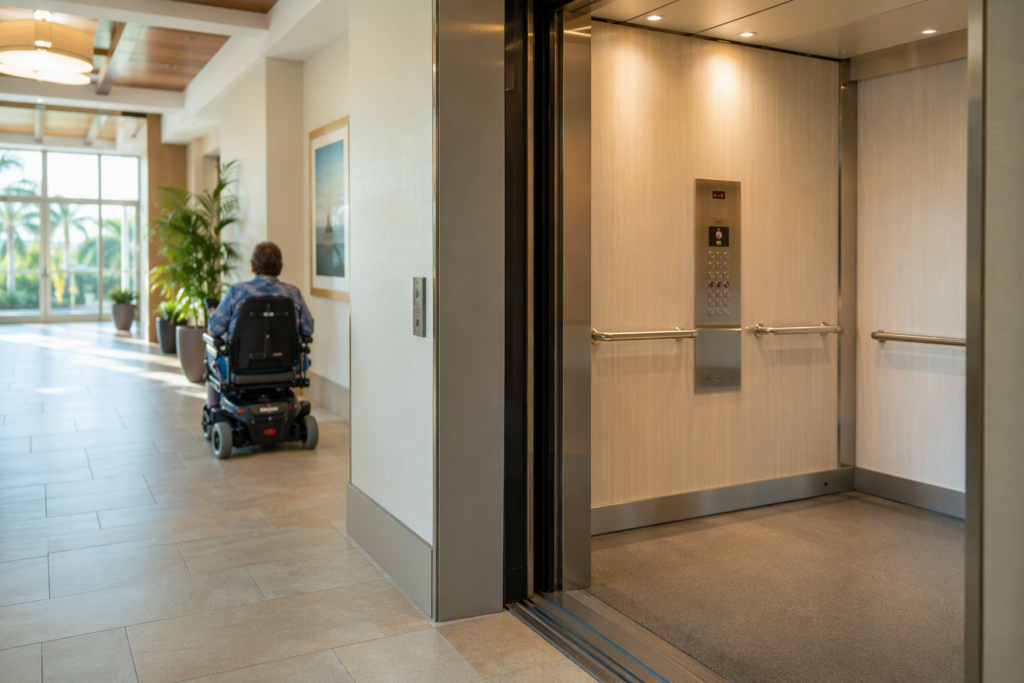
From an accessibility standpoint, commercial elevators serving the public must comply with Americans with Disabilities Act (ADA) requirements, which govern cab dimensions, door timing, control button placement, audible signals, and Braille markings. Non-compliant features can expose Florida property owners to federal enforcement action and civil litigation.
Workplace safety obligations under OSHA also extend to elevator machine rooms and service work, requiring that maintenance technicians follow lockout/tagout procedures and that employers maintain safe working environments around elevator equipment.
Failing to maintain required inspection certificates — which must typically be posted in the elevator cab — can result in the elevator being placed out of service by the Authority Having Jurisdiction (AHJ), creating immediate revenue and operational consequences for the building.
How Do Inspection Fees Factor Into Monthly Elevator Maintenance Costs?
Periodic inspection fees charged by the state or a third-party Qualified Elevator Inspector (QEI) are a real cost line that some building owners overlook when calculating monthly elevator expenses. These fees vary based on elevator type, the number of units, and whether the inspection reveals items requiring re-inspection. The most accurate figures come from the Florida DBPR fee schedule, which is updated periodically and should be verified directly with the agency.
Beyond the state fee, many maintenance contracts do not include the cost of annual or periodic third-party inspection — that expense falls separately on the property owner. When comparing maintenance quotes, building managers should clarify in writing whether inspection coordination and any resulting correction work are included in the monthly agreement.
What Repairs and Replacements Are Most Likely to Increase Monthly Costs?
Even under comprehensive maintenance agreements, certain high-cost repairs and modernization items are frequently excluded or carry extra charges. Florida building owners should plan capital reserves for:
- Controller modernization: Aging relay-logic controllers are increasingly difficult to source parts for and are often replaced entirely as part of a modernization project.
- Door operator and door equipment: Door malfunctions are among the most common causes of elevator outages. Door operator replacements, sill replacements, and cab door hanger repairs are frequent repair line items.
- Hydraulic jack and cylinder: Florida’s warm, humid climate and high water table can accelerate corrosion of underground hydraulic cylinders. A single-bottom hydraulic jack replacement is a major capital expense.
- Rope and sheave replacement: For traction elevators, hoist ropes have defined service life limits under ASME standards and must be replaced before they reach discard criteria.
- Motor and drive replacement: Variable-frequency drives and motor replacements represent significant unplanned costs, particularly in buildings where equipment is approaching or past its design life.
- ADA retrofit upgrades: Buildings undergoing renovation triggers may require ADA-compliant upgrades to elevator controls, signage, or cab fixtures.
How Does Building Type Affect Monthly Elevator Maintenance Costs in Florida?
The commercial category of a Florida building directly shapes both usage patterns and compliance requirements:
- Office buildings: Peak-hour traffic creates predictable but intense wear patterns. Multi-unit buildings with destination dispatch systems require specialized maintenance expertise.
- Retail and mixed-use properties: Freight and passenger elevators in retail environments carry heavier loads and are subject to more physical abuse, increasing maintenance frequency.
- Healthcare and medical office buildings: Hospitals and medical facilities operate elevators around the clock. Downtime is clinically unacceptable, making full-service contracts with guaranteed response terms standard practice.
- Hospitality (hotels and resorts): Florida’s tourism-driven hospitality sector demands elevators that perform reliably during peak seasons. Aesthetic maintenance of cabs is also a cost factor hotels absorb.
- Residential high-rises (condominiums): While technically residential, Florida condominium associations managing commercial-grade elevators face the same maintenance cost structure as commercial property owners and are subject to the same DBPR oversight.
- Industrial and warehouse facilities: Freight elevators and dock lifts in industrial facilities carry different maintenance profiles, with heavier emphasis on structural inspection and capacity verification.
What Should a Florida Building Owner Look for When Comparing Elevator Maintenance Vendors?
Not all maintenance contracts or service providers are equal. The following evaluation criteria help protect Florida property owners from under-service or hidden cost exposure:
- Verify Florida DBPR licensure: Any company or individual performing elevator work in Florida must hold the appropriate state license issued through the DBPR. Request license numbers and verify them directly on the DBPR website before signing a contract.
- Request a full written scope of services: The contract must define specifically what is covered, what is excluded, how call-backs are handled, and what the billing process is for out-of-scope work.
- Ask about parts sourcing: Vendors who stock commonly needed parts locally can resolve outages faster than those who rely on national warehouses. Part availability has a direct effect on elevator downtime.
- Review escalation clauses: Many multi-year contracts include annual price escalation provisions tied to labor indices. Uncapped escalation clauses can significantly increase monthly costs over a five-year term.
- Understand callback response expectations: The contract should define what constitutes an emergency callback and what the expected response process is — particularly important for healthcare and hospitality clients.
- Check for proprietary lock-in provisions: Some contracts include clauses that prevent the building owner from switching vendors without paying penalties or surrendering equipment components. These terms deserve careful legal review.
- Confirm inspection coordination: Ask explicitly whether the vendor coordinates state-required periodic inspections and whether correction-of-deficiency work is included in the contract price.
How Do Elevator Maintenance Costs Compare to the Cost of Deferred Maintenance?
Deferred or inadequate maintenance is among the most expensive decisions a Florida commercial property owner can make. The downstream consequences include:
- Emergency repair premiums that routinely exceed the annual cost of a proper maintenance contract
- Regulatory shutdown orders from the AHJ that halt building operations until deficiencies are corrected
- ADA enforcement complaints and litigation costs when accessibility features fall out of compliance
- Tenant complaints, lease disputes, and reputational damage in competitive Florida commercial real estate markets
- Accelerated equipment degradation that moves modernization timelines forward by years, triggering capital expenditures earlier than planned
The financial logic is straightforward: consistent, properly scoped maintenance is a cost-control strategy, not merely a regulatory obligation.
What Industry Trends Are Shaping Elevator Maintenance Costs in Florida for 2025–2026?
Several forces are shaping the elevator maintenance market in Florida heading into 2026:
Remote monitoring and predictive maintenance technology is becoming more prevalent. Building owners and service providers are increasingly deploying IoT sensors and cloud-based monitoring platforms that track door cycles, motor temperatures, and call patterns. This technology allows service teams to address developing issues before they become emergency outages, improving reliability and potentially reducing unplanned repair costs over time.
Skilled technician availability remains a market constraint in many Florida metros. The demand for qualified elevator mechanics — particularly those trained on modern MRL and hydraulic systems — continues to outpace supply in some regions, which affects both service response capacity and labor cost structures within maintenance contracts.
Code edition updates continue to evolve. As Florida adopts updated editions of the ASME A17.1 and A17.3 standards, building owners with aging equipment may face required safety upgrades that add to the total cost of elevator ownership. Staying ahead of these transitions — rather than responding reactively — is the financially prudent approach.
Energy efficiency considerations are playing a larger role in Florida commercial real estate. Regenerative drives, LED cab lighting, and sleep-mode controls are increasingly standard topics in modernization discussions, as building owners seek to reduce operating costs and meet sustainability benchmarks.
Insurance and risk management pressures are also influencing maintenance decisions. Florida commercial property insurers are paying closer attention to elevator maintenance documentation as part of underwriting and claims processes, adding another incentive for rigorous recordkeeping and compliant service contracts.
What Questions Should a Property Manager Ask Before Signing an Elevator Maintenance Contract in Florida?
- Is your company currently licensed by the Florida DBPR to perform elevator work in this jurisdiction?
- What specific components and repair categories are covered under this contract tier?
- What is explicitly excluded, and how are out-of-scope repairs priced?
- Does the contract include coordination and follow-up for state-required periodic inspections?
- Are there annual price escalation clauses, and if so, are they capped?
- How does the contract handle proprietary parts or equipment the OEM restricts access to?
- What is the process for emergency callbacks, and how is that work billed?
- Does the contract include any modernization consultation or upgrade planning services?
- How is maintenance documentation maintained, and can the property owner access service records on demand?
- What are the contract termination provisions, and are there any vendor lock-in penalties?
How Can a Florida Building Owner Reduce Monthly Elevator Maintenance Costs Without Sacrificing Compliance?
Cost management strategies that do not compromise safety or regulatory standing include:
- Bundle multiple units: Buildings with two or more elevators can often negotiate per-unit discounts, particularly when all units are awarded to a single vendor.
- Invest in modernization strategically: Upgrading aging components proactively — rather than waiting for failure — reduces emergency repair frequency and can lower the risk premium embedded in a maintenance contract price.
- Maintain thorough service records: Well-documented maintenance history gives vendors clearer baseline data, which can reduce diagnostic time during service calls.
- Re-bid contracts periodically: Maintenance contracts for commercial elevators in Florida should be competitively re-bid at each renewal term to ensure market alignment.
- Align contract scope with actual risk: A newer elevator in a low-traffic professional office building may not require the most expensive full-service tier. A realistic risk assessment supports smarter contract selection.
Why Work With Axxiom Elevator Florida for Elevator Maintenance?
Axxiom Elevator Florida operates exclusively within the state of Florida, bringing a Florida-focused understanding of DBPR requirements, local AHJ expectations, and the specific environmental factors — humidity, coastal air, water table depth — that affect elevator equipment performance in this market.
As a data-driven service provider, Axxiom Elevator Florida approaches maintenance planning with a systematic assessment process designed to give commercial property owners an accurate, transparent picture of their elevator’s current condition, compliance standing, and cost trajectory. Rather than offering generic contracts, Axxiom Elevator Florida works to match the scope of service to the specific risk profile of each building.
Florida commercial property owners benefit from working with a provider who understands that elevator maintenance is not a commodity — it is a compliance obligation, a liability management tool, and a capital planning input that affects the financial performance of the building over time.
What Are the Most Important Steps a Florida Building Owner Should Take Right Now to Manage Elevator Maintenance Costs?
- Pull your current maintenance contract and identify the exact scope of coverage, exclusions, escalation clauses, and termination terms.
- Confirm your elevator’s current inspection certificate status is valid and posted in the cab as required by Florida DBPR.
- Review any open deficiency items from the most recent state inspection and confirm they have been addressed and documented.
- Assess the age and condition of your equipment to determine whether a modernization discussion is warranted in the current budget cycle.
- Request competing bids from Florida-licensed elevator maintenance companies, ensuring each bid covers the same defined scope for accurate comparison.
- Verify ADA compliance status of your elevator controls, signage, and cab features, particularly if the building has undergone renovations that may have triggered upgrade obligations under ADA guidelines.
- Establish a capital reserve line for elevator repairs and modernization, based on the equipment age and a realistic component replacement schedule.
- Contact Axxiom Elevator Florida for a free elevator assessment to establish a clear, current baseline for your maintenance cost planning.
Need elevator service you can rely on? Axxiom Elevator Florida is ready to help.