Best Elevator Maintenance Company in Pompano Beach, FL: Complete FAQ Guide
What Makes an Elevator Maintenance Company the Best Choice in Pompano Beach?
The best elevator maintenance company in Pompano Beach combines state-required licensing, demonstrated knowledge of ASME A17.1 Safety Code for Elevators and Escalators, and a documented preventive maintenance program that keeps equipment compliant with Florida-specific regulations.
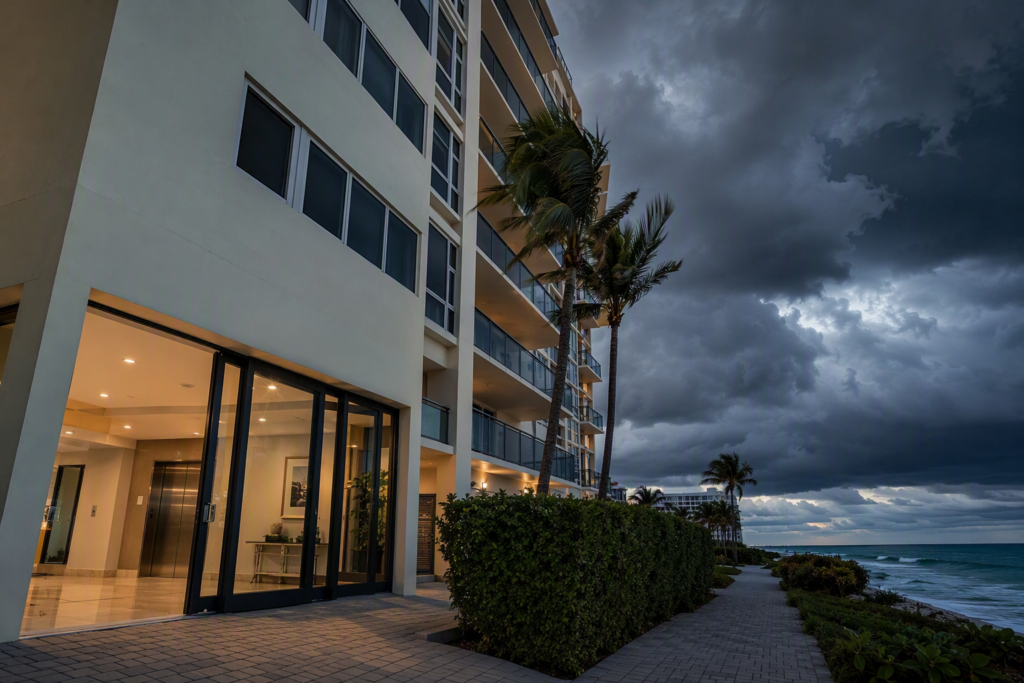
Pompano Beach property managers and building owners face a distinct set of challenges: coastal humidity that accelerates corrosion of mechanical components, high-rise residential towers with heavy traffic demands, and Florida’s strict elevator inspection requirements enforced through the Department of Business and Professional Regulation (DBPR). A maintenance provider that understands these local conditions — not just a national chain applying a generic checklist — is the difference between a reliable vertical transportation system and repeated costly breakdowns.
Axxiom Elevator Florida serves the Pompano Beach market with maintenance programs tailored to South Florida’s environment, including corrosion-resistant lubrication protocols, humidity-aware electrical inspections, and familiarity with local inspection scheduling through the Florida DBPR.
What Are the Legal Elevator Inspection Requirements in Florida?
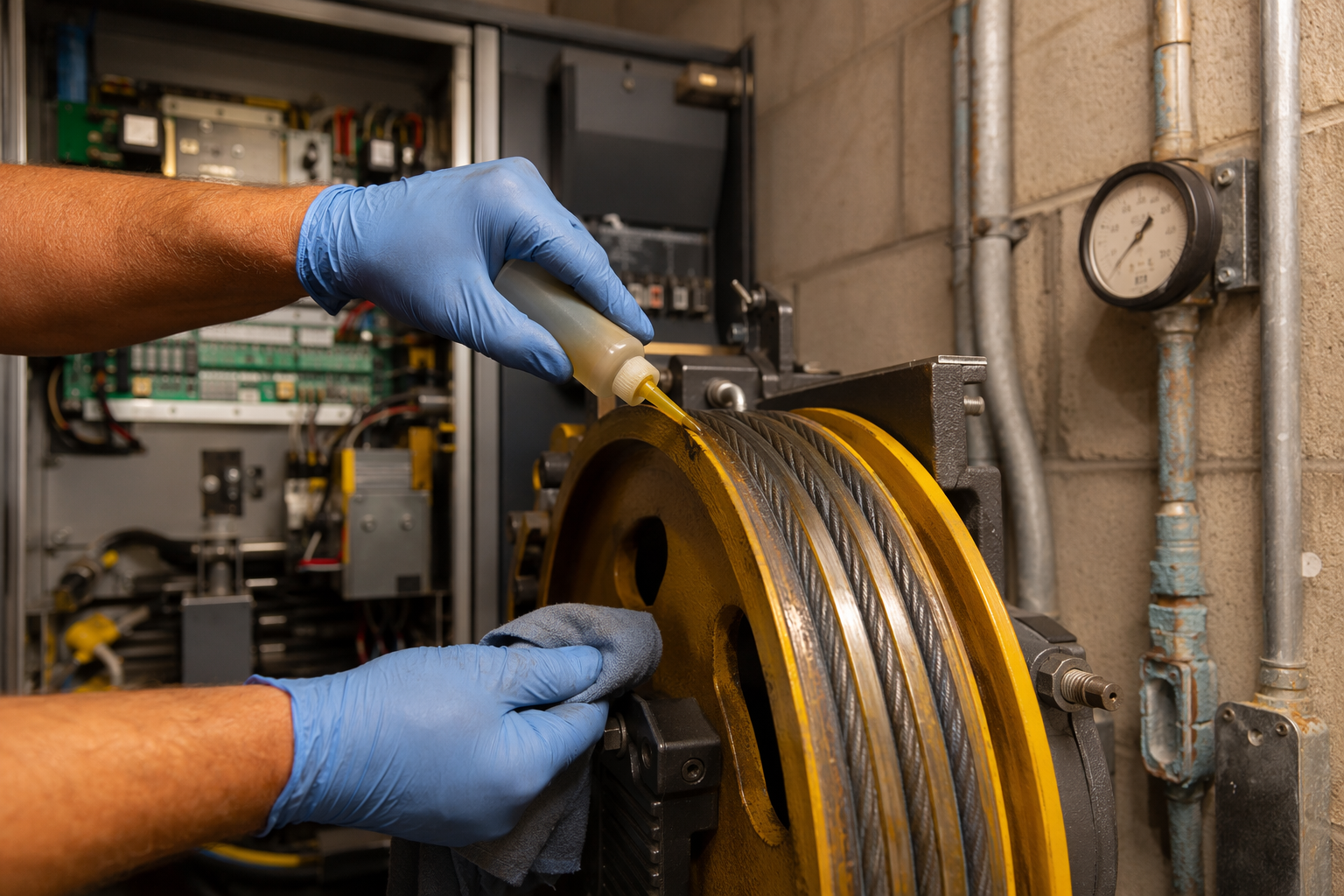
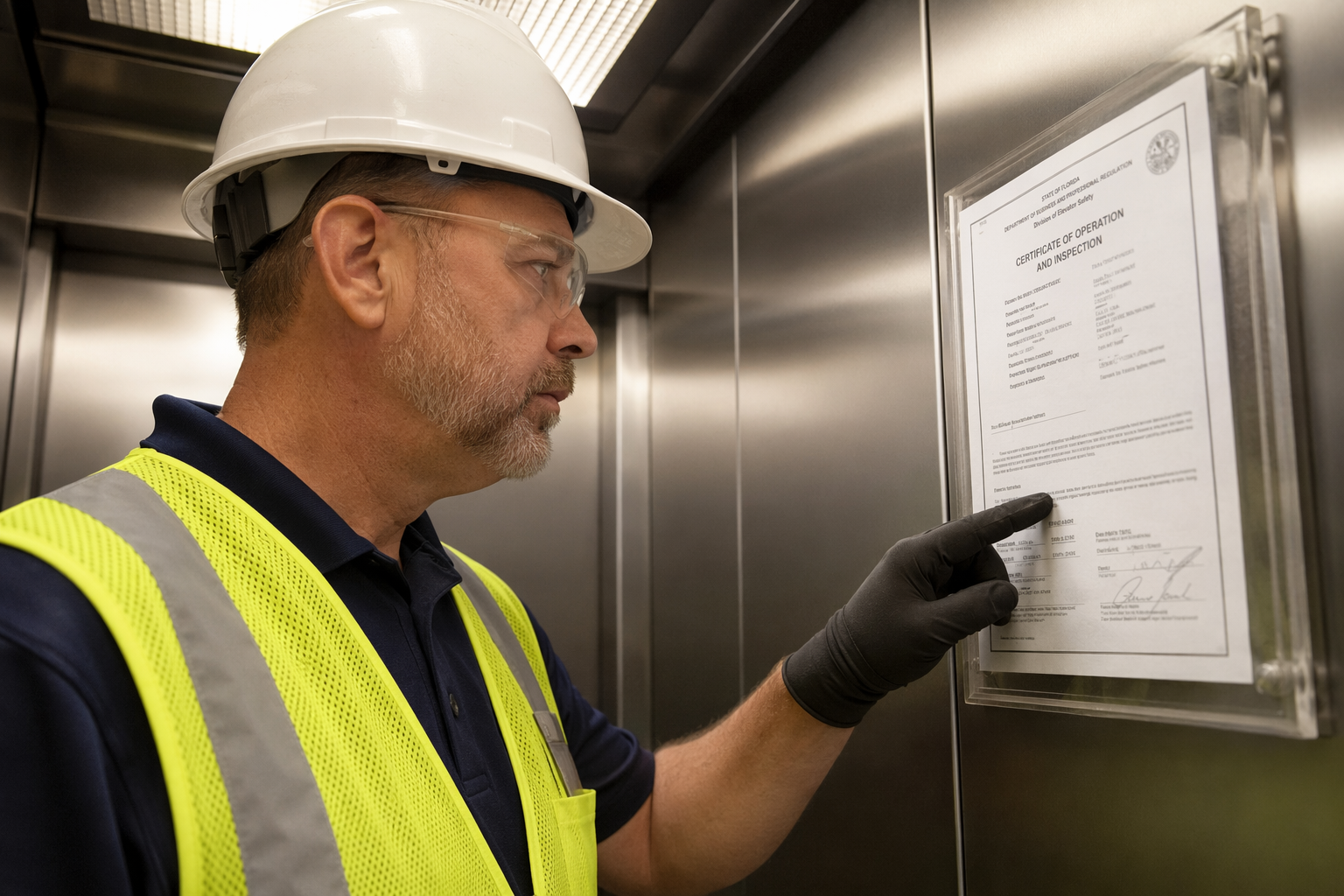
Florida law requires that all public and commercial elevators be inspected by a licensed elevator inspector at intervals established under Chapter 399, Florida Statutes, and that certificates of operation be current and posted inside the elevator cab.
Florida’s elevator law is administered by the DBPR’s Bureau of Elevator Safety. Property owners are legally responsible for maintaining a current certificate of operation, which is issued only after a successful inspection by a licensed inspector. Inspections must be conducted at least annually for most elevator types, though high-use facilities may require more frequent evaluations depending on the equipment classification.
Maintenance providers must also comply with ASME A17.1 Safety Code for Elevators and Escalators, which Florida has adopted as the foundational technical standard. The 2019 edition of ASME A17.1 (and subsequent updates) defines minimum safety requirements for construction, installation, operation, inspection, testing, maintenance, alteration, and demolition of elevators and escalators. Building owners who allow certificates to lapse face fines, mandatory shutdown orders, and potential liability exposure.
How Often Should Elevator Maintenance Be Performed in Pompano Beach?
Most commercial elevator systems in Pompano Beach require monthly preventive maintenance visits at minimum, though the exact frequency depends on elevator type, passenger volume, building height, and the manufacturer’s recommended service intervals.
The ASME A17.1 Safety Code for Elevators and Escalators establishes maintenance as a continuous obligation, not an event-driven one. High-traffic elevators in hotels, medical facilities, or mixed-use towers along Pompano Beach’s A1A corridor may warrant bi-weekly or even weekly service checks due to accelerated wear on door operators, roller guides, and brake assemblies.
| Elevator Type | Typical Traffic Volume | Recommended Maintenance Frequency | Minimum Annual Inspection |
|---|---|---|---|
| Commercial (Office/Retail) | Medium–High | Monthly | Yes (Florida DBPR) |
| Residential High-Rise | Medium | Monthly | Yes (Florida DBPR) |
| Hospital / Medical Facility | Very High | Bi-Weekly or Weekly | Yes (Florida DBPR) |
| Hotel / Hospitality | High | Monthly to Bi-Weekly | Yes (Florida DBPR) |
| Private Residential (Home Elevator) | Low | Bi-Annual or Quarterly | Varies by county |
| Hydraulic (Low-Rise Commercial) | Low–Medium | Quarterly to Monthly | Yes (Florida DBPR) |
What Does a Professional Elevator Maintenance Program Include?
A comprehensive elevator maintenance program covers systematic inspection and servicing of all major mechanical, electrical, and safety systems — including the machine room, hoist ropes or hydraulic cylinder, door operators, safety devices, controller, and cab interior.
A professionally structured maintenance visit typically covers the following core areas:
- Machine Room: Motor and drive unit inspection, brake adjustment, lubrication of moving parts, controller board diagnostics, and temperature/humidity assessment.
- Hoistway: Rail lubrication, guide shoe or roller guide inspection, limit switch testing, buffer condition check, and rope or chain tension verification.
- Door System: Door operator adjustment, clutch and coupler inspection, door speed testing, reversal device testing, and sill cleaning.
- Cab and Hall Fixtures: Button functionality, lighting verification, emergency phone test, certificate of operation confirmation, and leveling accuracy check.
- Safety Devices: Governor and safety gear inspection, overspeed testing on the required cycle, pit stop switch functionality, and oil buffer testing for hydraulic units.
In coastal markets like Pompano Beach, maintenance programs should also include corrosion inspection of fasteners, terminal contacts, and structural components — a step often omitted by companies without local coastal experience.
What Is the Difference Between Elevator Maintenance and Elevator Repair?
Elevator maintenance is scheduled, preventive work performed to keep a system operating safely and efficiently, while elevator repair is reactive work performed after a component failure, malfunction, or safety shutdown has already occurred.
The distinction matters financially and operationally. Preventive maintenance programs are designed to identify worn components — such as fraying hoist ropes, degrading brake linings, or failing door contacts — before they cause an outage or a safety incident. Repairs, by contrast, often involve premium labor rates, expedited parts sourcing, and lost revenue from elevator downtime. Buildings in Pompano Beach that rely on reactive repair rather than preventive maintenance typically experience higher overall costs and more frequent regulatory compliance issues.
Axxiom Elevator Florida structures maintenance agreements to reduce the likelihood of unplanned repairs by aligning service intervals with the specific usage patterns and equipment age of each installation.
Are Elevator Maintenance Companies Required to Be Licensed in Florida?
Yes — Florida law requires that elevator contractors and their mechanics hold licenses issued through the DBPR’s Bureau of Elevator Safety before performing any installation, alteration, or maintenance work on conveyances regulated under Chapter 399, Florida Statutes.
Property owners should always verify that a prospective maintenance company holds a current, active Florida elevator contractor license before signing any service agreement. Unlicensed work not only violates state law but can also void equipment warranties, invalidate insurance claims, and create personal liability exposure for building owners if an incident occurs. License status can be verified directly through the Florida DBPR’s online licensing portal.
How Does ADA Compliance Affect Elevator Maintenance in Pompano Beach?
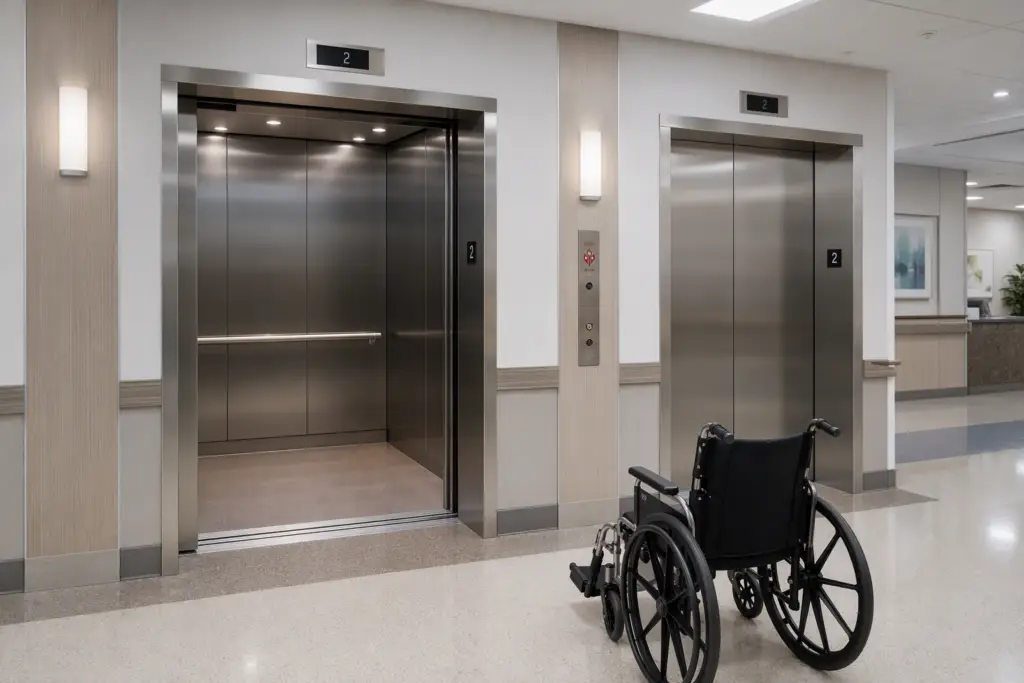
Under the Americans with Disabilities Act (ADA), elevators serving buildings that require accessible vertical access must be maintained in working order so that accessibility features remain functional and available to people with disabilities at all times.
ADA compliance in elevator maintenance encompasses several specific obligations. Control buttons must be within reach range, maintain tactile indicators, and include Braille labeling. The cab must maintain minimum interior dimensions for wheelchair access. Door reopening devices must function properly to prevent door closure on a passenger who triggers the safety edge. Audible and visual signals must operate correctly at each floor stop. Failure to maintain these features is not only an ADA violation — it is also a Florida civil rights issue that can trigger complaints, Department of Justice investigations, and civil litigation.
A maintenance provider unfamiliar with ADA technical requirements may perform mechanically adequate service while leaving the building owner exposed to accessibility-related legal risk. The full technical specifications for elevator accessibility appear in the ADA Standards for Accessible Design.
What Should Property Owners Look for When Comparing Elevator Maintenance Companies?
Property owners evaluating elevator maintenance companies in Pompano Beach should compare licensing status, the scope of services included in maintenance agreements, familiarity with local environmental conditions, documented inspection and reporting processes, and the breadth of elevator types and brands serviced.
A rigorous vendor evaluation should address these key factors:
- Licensing Verification: Confirm an active Florida elevator contractor license through the DBPR.
- Code Knowledge: Ask specifically about the company’s familiarity with the current edition of ASME A17.1 and Florida’s Chapter 399 requirements.
- Scope of Maintenance Agreement: Understand exactly which components are covered, which are excluded, and how major repairs are priced.
- Documentation: Request sample maintenance logs and inspection reports to evaluate the quality and detail of their recordkeeping.
- Equipment Compatibility: Confirm the company services the specific brand, drive type, and control system installed in your building.
- Coastal Experience: For Pompano Beach properties, ask about corrosion mitigation protocols and experience with salt-air environments.
- References: Request verifiable references from comparable properties in Broward County or South Florida.
What Types of Elevators Does Axxiom Elevator Florida Service in Pompano Beach?
Axxiom Elevator Florida services a broad range of elevator types across the Pompano Beach market, including traction elevators, hydraulic elevators, machine-room-less (MRL) systems, and limited-use/limited-application (LULA) elevators.
Each elevator type carries distinct maintenance requirements. Traction elevators — common in mid- and high-rise buildings — require periodic rope inspection, sheave groove measurement, and drive machine lubrication. Hydraulic elevators require jack unit inspection, oil purity testing, and underground cylinder monitoring where applicable. MRL systems rely on compact gearless machines mounted in the hoistway overhead and require specialized diagnostic tools. LULA elevators, often used to provide ADA-compliant access in low-rise buildings, follow a separate set of code requirements under ASME A17.1.
What Are the Most Common Elevator Problems in Pompano Beach Buildings?
The most frequently observed elevator problems in Pompano Beach include door-related malfunctions, leveling issues, hydraulic oil contamination, corrosion of electrical contacts and fasteners, and controller faults — many of which are aggravated by the coastal humidity and salt-air environment.
Door problems account for the largest share of elevator service calls industry-wide. In coastal South Florida, salt air and humidity accelerate wear on door rollers, hangers, and operator clutch mechanisms. Leveling drift — where the cab floor fails to align flush with the landing — is a common sign of rope stretch in traction units or oil temperature effects in hydraulic systems. Hydraulic oil contamination is particularly relevant to older underground cylinder installations, where fluid can degrade and introduce system inefficiencies. Corrosion of terminal blocks and relay contacts in control panels is an ongoing concern in any building within several miles of the Atlantic coast.
What Should Building Managers Do If an Elevator Breaks Down or Traps Passengers?
If an elevator traps passengers or experiences a sudden breakdown, building management must follow a clear safety protocol to protect occupants and comply with legal obligations before attempting any mechanical intervention.
- Call emergency services immediately if passengers are trapped and show signs of distress, medical emergency, or if the entrapment cannot be resolved promptly through the elevator’s intercom system.
- Communicate with trapped passengers via the emergency telephone or intercom to confirm their safety, assure them help is coming, and instruct them not to attempt to force doors open or exit between floors.
- Contact your elevator maintenance contractor to dispatch a licensed mechanic for emergency response.
- Do not allow untrained personnel to manually lower hydraulic units, release brakes, or force hoistway doors — these actions can be fatal.
- Document the incident including time of entrapment, duration, number of passengers, elevator ID number, and any error codes visible on the controller panel.
- File an incident report with the Florida DBPR if the event involved injury, equipment failure, or a safety device activation, as required under Chapter 399.
- Do not return the elevator to service until the licensed mechanic has cleared it, confirmed the cause, and documented the corrective action taken.
OSHA also has general duty requirements for workplace safety that apply to elevator entrapment situations in commercial settings, particularly where employees may be involved.
How Are Elevator Maintenance Contracts Typically Structured?
Elevator maintenance contracts are generally offered in three structures: full-service (comprehensive) agreements that cover labor and most parts, oil-and-grease (limited) agreements that cover only labor and consumables, and examination-only agreements where the contractor inspects but the owner handles all repairs separately.
For most Pompano Beach commercial property owners, a full-service maintenance agreement provides the most predictable cost structure and the strongest protection against unplanned repair expenditures. These agreements typically define the scope of covered components, exclusions (such as vandalism damage or cab interior cosmetics), documentation requirements, and the process for handling major repair work that exceeds the agreement’s scope. Property owners should read contract exclusions carefully and ask specifically whether hydraulic oil replacement, rope replacement, and control modernization are included or billed separately.
When Should a Building Consider Elevator Modernization Instead of Ongoing Maintenance?
Buildings with aging elevator systems — typically those with original equipment more than 20 to 25 years old — should evaluate modernization when recurring repair costs begin to approach or exceed the cost of a systematic upgrade, or when achieving code compliance requires significant component replacement.
Modernization is not always a complete replacement. Partial modernization — upgrading the controller, drive system, or door operator while retaining the structural components — can extend equipment life, improve energy efficiency, enhance ride quality, and bring the installation into compliance with current ASME A17.1 requirements. In Florida, certain safety upgrades may be mandated when the scope of modernization work triggers a “full code compliance” review under Chapter 399. A qualified maintenance company can evaluate the existing system and provide a documented recommendation on whether continued maintenance or a modernization path represents better long-term value.
How Does Preventive Maintenance Affect Elevator Safety and Liability in Florida?
Documented preventive maintenance is one of the most important defenses a property owner has against elevator-related liability claims in Florida, because it demonstrates that the building operator exercised reasonable care to identify and correct hazardous conditions before an injury could occur.
Florida premises liability law places a duty of care on property owners to maintain their facilities in a reasonably safe condition for invited guests, tenants, and the public. Elevator incidents — whether a leveling failure that causes a trip hazard, a door that closes prematurely, or a sudden drop — can generate significant personal injury claims. A complete, chronologically organized maintenance log showing regular inspections, prompt response to identified deficiencies, and current certifications is material evidence that the property owner met their duty of care. Conversely, gaps in maintenance records, lapsed certificates of operation, or documented deficiencies that were not corrected can substantially increase liability exposure in litigation.
Axxiom Elevator Florida provides detailed, date-stamped maintenance documentation for every service visit, supporting property owners’ compliance records and liability defense posture.
What Questions Should a Property Owner Ask Before Signing an Elevator Maintenance Agreement?
Before signing any elevator maintenance agreement in Pompano Beach, property owners should ask about license status, the specific scope of covered and excluded components, documentation practices, how non-covered repair work is priced, and the process for scheduling required annual inspections.
A thorough pre-contract conversation should also cover:
- What specific testing is performed on safety devices, and how frequently?
- How are maintenance records delivered — paper, digital portal, or both?
- Is the annual Florida DBPR inspection coordinated by the contractor or managed by the building?
- What is the process if an inspector cites a deficiency on the annual inspection report?
- Are replacement parts OEM (original equipment manufacturer) or third-party, and does this affect warranty coverage?
- What is the escalation process if the elevator is taken out of service for a safety reason?
Does Axxiom Elevator Florida Also Serve Buildings in Sarasota?
Yes — Axxiom Elevator Florida provides the same comprehensive maintenance, inspection, and repair services to building owners and property managers in Sarasota, FL, applying Florida code standards and locally informed maintenance practices to the Gulf Coast market as well.
Sarasota’s elevator market includes a mix of high-rise condominiums along the waterfront, medical office buildings, hospitality properties, and institutional facilities. The regulatory framework — Florida Chapter 399, ASME A17.1, and ADA compliance obligations — applies uniformly across the state, though local environmental factors in Sarasota (including humidity and proximity to the Gulf of Mexico) share many characteristics with the Pompano Beach coastal environment. Axxiom Elevator Florida’s service programs are structured to address both markets with consistent technical standards.
What Role Does OSHA Play in Elevator Maintenance and Workplace Safety?
The Occupational Safety and Health Administration (OSHA) establishes workplace safety requirements that apply to elevator mechanics performing maintenance work, as well as general duty standards relevant to elevator safety in commercial workplaces.
OSHA’s standards address lockout/tagout (LOTO) procedures that elevator mechanics must follow when working on powered equipment to prevent accidental energization during maintenance. Employers — both elevator contractors and building owners — have obligations under OSHA’s General Duty Clause to provide a workplace free from recognized hazards. For elevator mechanics, this includes proper fall protection in hoistways, pit safety protocols, and electrical safety procedures when working on control panels. Building owners who direct maintenance work or provide tools and equipment may share OSHA compliance responsibility with the contracting company.
How Can Building Owners Prepare for the Annual Florida Elevator Inspection?
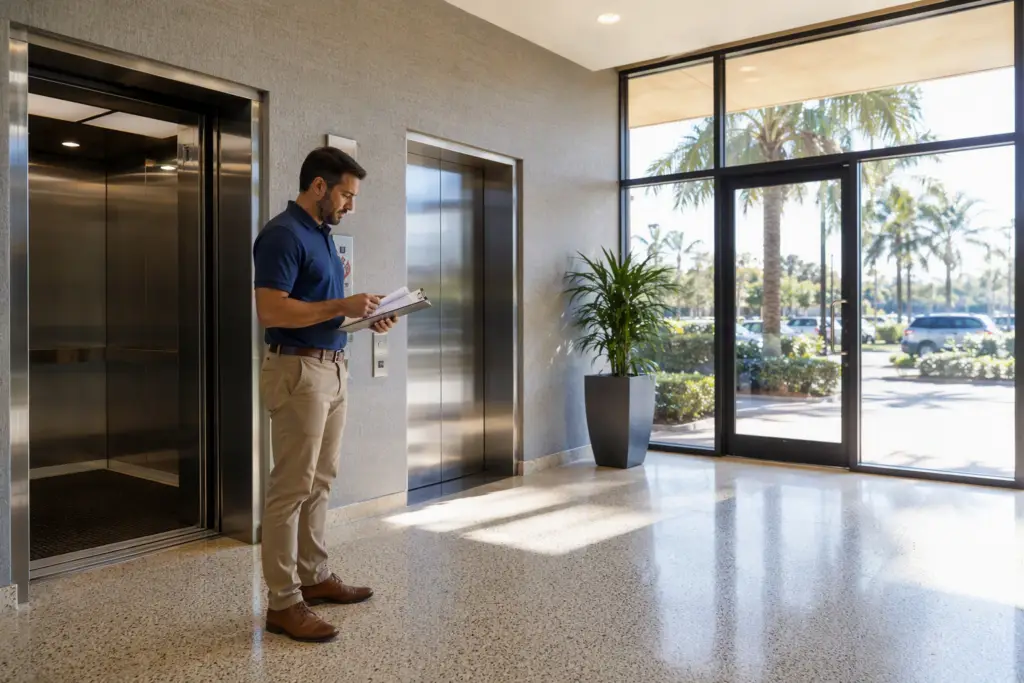
Preparing for the annual Florida elevator inspection requires ensuring that all maintenance work is current and documented, that known deficiencies have been corrected, that the machine room is accessible and properly maintained, and that required safety test documentation is available for the inspector’s review.
A structured pre-inspection checklist should include:
- Review maintenance logs to confirm all scheduled service visits were completed and recorded for the inspection period.
- Verify certificate of operation is posted in the elevator cab and confirm the inspection scheduling date with the Florida DBPR or the licensed inspection entity.
- Complete any outstanding repairs identified during routine maintenance before the inspection date — cited deficiencies found during inspection may result in conditional certificates or shutdown orders.
- Ensure machine room access is clear, properly lit, and that fire extinguisher, temperature controls, and housekeeping standards meet code requirements.
- Confirm required five-year tests are current — ASME A17.1 requires full-load safety tests and other periodic tests on defined cycles, and inspectors will verify test records.
- Test emergency systems including the emergency telephone, emergency lighting, and alarm bell to confirm operability before the inspector arrives.
- Coordinate with your maintenance contractor to have a licensed mechanic available or on call during the inspection to address any questions or minor adjustments the inspector identifies.
What Is the Significance of the ASME A17.1 Code for Elevator Maintenance?
The ASME A17.1 Safety Code for Elevators and Escalators is the foundational technical standard governing elevator design, installation, operation, maintenance, inspection, testing, and alteration across the United States, and Florida’s adoption of this code makes compliance legally mandatory for all regulated conveyances in the state.
ASME A17.1 is maintained by the American Society of Mechanical Engineers and is updated on a regular revision cycle. The code specifies, among many other requirements, the frequency and method of periodic safety tests (including governor, safeties, and buffers), the record-keeping obligations for maintenance personnel, the qualifications required for individuals performing maintenance and inspection, and the technical parameters for acceptable component condition. For building owners, understanding that their maintenance provider operates in accordance with this code — rather than a proprietary or ad hoc standard — is a key indicator of professional competence. The 2019 edition and its subsequent addenda represent the current benchmark referenced in Florida regulatory enforcement as of 2026.
Why Should Pompano Beach Building Owners Choose a Local Elevator Maintenance Company?
A locally based elevator maintenance company in Pompano Beach offers advantages in environmental familiarity, knowledge of local inspection authority procedures, established parts supply relationships in South Florida, and the ability to respond to service needs without the scheduling constraints that affect large national contractors operating from distant dispatch centers.
National elevator service companies manage large geographic territories, which can mean longer intervals between routine visits and slower response when a building needs attention outside the standard schedule. A Pompano Beach-based provider understands Broward County’s inspection landscape, has established relationships with local parts distributors, and is directly familiar with the specific environmental stressors — coastal humidity, salt air, seasonal storm impacts — that affect elevator systems along Florida’s southeastern coast.
Axxiom Elevator Florida is locally operated and specifically positioned to serve the Pompano Beach market, bringing the technical depth of a specialized elevator company with the responsiveness of a locally rooted service organization. Property owners seeking a maintenance partner aligned with their specific building’s needs and Florida’s regulatory environment are encouraged to contact Axxiom Elevator Florida for a professional assessment.
Get a Free Elevator Assessment for Your Pompano Beach or Sarasota Property
Whether your building has a single hydraulic elevator or a bank of high-rise traction units, Axxiom Elevator Florida provides thorough, code-compliant maintenance programs tailored to South Florida’s environment and Florida’s regulatory requirements. Don’t wait for a breakdown or a failed inspection to take action — proactive maintenance protects your tenants, your liability position, and your investment.
Contact Axxiom Elevator Florida for a free elevator assessment today.
Call us at to schedule your consultation.