Choosing the wrong elevator service contract can mean unexpected repair bills, compliance gaps, and elevator downtime that frustrates tenants and exposes building owners to liability. This guide breaks down every meaningful difference between full maintenance and parts and labor elevator contracts so Florida property owners and facility managers can make a confident, informed decision.
What Is a Full Maintenance Elevator Contract?
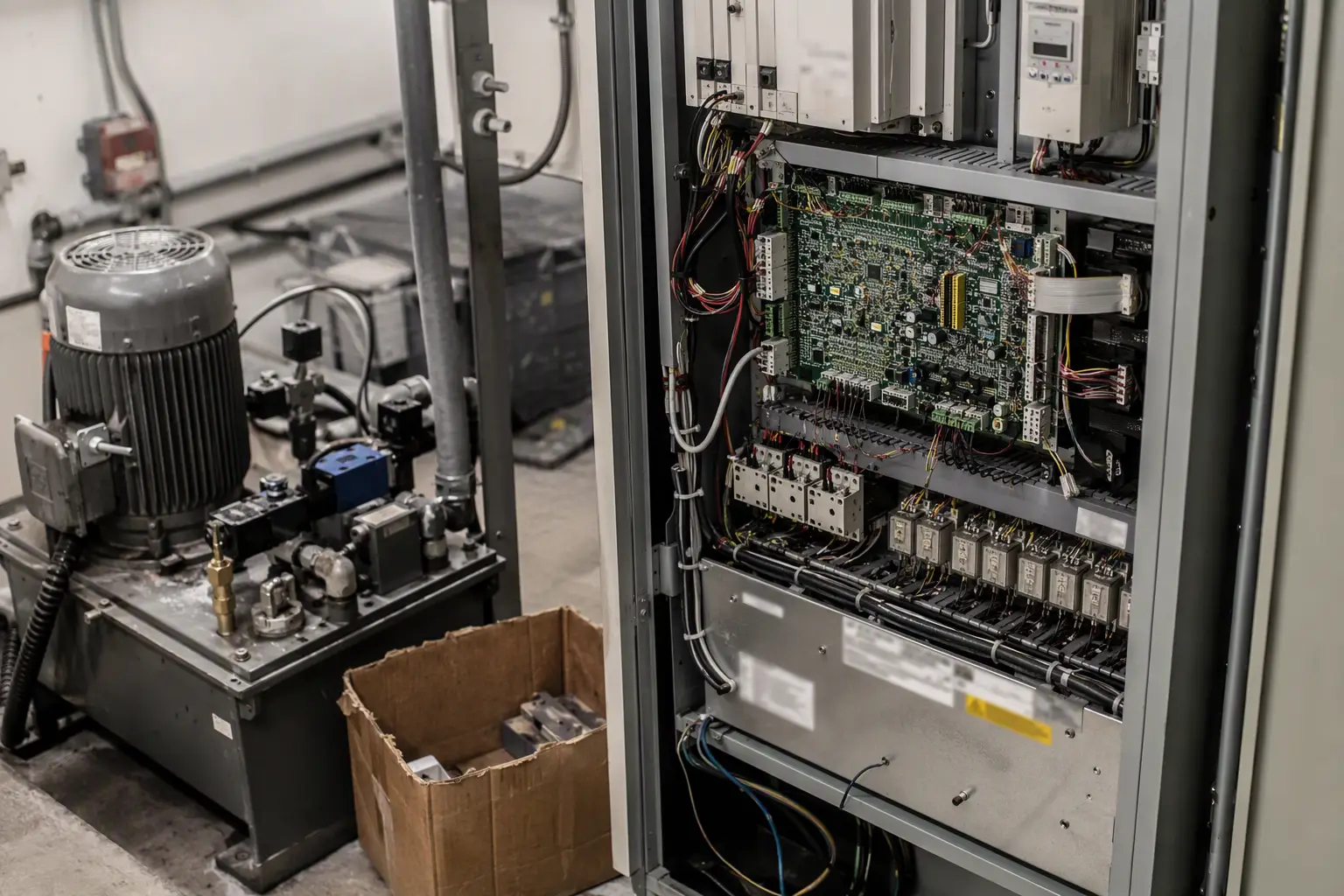
A full maintenance (FM) contract — sometimes called a comprehensive contract — is an all-inclusive elevator service agreement in which the service provider takes responsibility for scheduled preventive maintenance, emergency callbacks, routine adjustments, and the cost of parts and labor needed to keep the elevator in safe, code-compliant operation. The building owner pays a flat recurring fee, and the contractor absorbs the cost of most repairs and replacements that arise from normal wear.
Full maintenance contracts typically exclude damage caused by vandalism, misuse, or Acts of God, and they rarely cover major modernization components such as complete cab interiors, structural building work, or proprietary upgrades. Reading the exclusions section carefully is essential before signing any agreement.
What Is a Parts and Labor Elevator Contract?
A parts and labor (P&L) contract — also called a maintenance-only or lubrication-and-adjustment contract — covers the technician’s time for scheduled visits and emergency callbacks, but the building owner is billed separately for any replacement parts. Some variations of this contract type cover labor only, with parts invoiced at list price or a negotiated rate.
Parts and labor contracts are lower in monthly cost but transfer the financial risk of component failures to the property owner. A single major part failure — a controller board, a hydraulic pump, a traction motor — can generate an invoice that exceeds an entire year of FM contract premiums.
Side-by-Side Comparison: Full Maintenance vs. Parts and Labor
| Factor | Full Maintenance Contract | Parts & Labor Contract |
|---|---|---|
| Monthly Cost | Higher fixed fee | Lower fixed fee |
| Parts Coverage | Included (subject to exclusions) | Billed separately at repair time |
| Labor Coverage | Included for routine and emergency visits | Included for scheduled visits; callbacks may be extra |
| Preventive Maintenance | Scheduled and managed by contractor | Scheduled visits included; scope varies |
| Budget Predictability | High — one flat rate | Low — repair invoices are variable |
| Financial Risk to Owner | Low | High (especially on older units) |
| Best Fit | High-traffic, older, or mission-critical elevators | Low-use, newer elevators with healthy capital reserves |
| Contractor Incentive | Proactive maintenance (saves contractor money) | Reactive repairs (parts are revenue) |
| Compliance Support | Contractor typically coordinates inspection readiness | Owner bears more responsibility for compliance prep |
| Contract Length | Often multi-year (1–5 years) | Often shorter or month-to-month options available |
| Termination Flexibility | Penalties common for early exit | Generally easier to exit |
| Ideal for Florida Buildings | Residential towers, hotels, hospitals, busy commercial | Low-rise offices, warehouses, newer builds |
Pros and Cons at a Glance
| Full Maintenance — Pros | Full Maintenance — Cons | |
|---|---|---|
| Predictable operating costs | Higher baseline monthly expense | |
| Reduced risk of large surprise repair bills | Multi-year lock-in common | |
| Contractor motivated to maintain proactively | Exclusions can limit true “full” coverage | |
| Easier compliance management | May overpay if elevator rarely needs repairs |
| Parts & Labor — Pros | Parts & Labor — Cons | |
|---|---|---|
| Lower fixed monthly cost | Unpredictable annual spend | |
| More flexibility to switch providers | Parts markup can be significant | |
| May suit newer equipment with low failure rates | Contractor has less incentive for proactive care | |
| Owner controls parts sourcing (in some agreements) | High financial exposure on aging systems |
Which Contract Type Is Right for Your Florida Building?
The right contract type depends on four key variables: the age and condition of the elevator, the volume of daily use, the building owner’s tolerance for financial risk, and the remaining useful life of major components.
- Choose Full Maintenance if: the elevator is more than 10–15 years old, serves a high volume of daily passengers, operates in a building where downtime directly affects tenants or revenue (hotel, hospital, residential tower), or the property management team lacks in-house technical expertise to evaluate repair invoices critically.
- Choose Parts & Labor if: the elevator was installed recently and is still under a manufacturer’s parts warranty, operates in a low-traffic facility (warehouse, small professional office), and the building owner maintains a capital reserve fund specifically for mechanical equipment repairs.
In either case, independent service providers — rather than manufacturers’ proprietary service arms — often deliver more competitive pricing, faster parts sourcing, and greater transparency on invoices. Axxiom Elevator Florida is a certified independent elevator service company serving Florida property owners with both full maintenance and parts and labor contract options, allowing clients to match the agreement type to the actual risk profile of their equipment.
How Does Florida Law Affect Your Elevator Service Contract?
Florida elevator regulation is governed by Chapter 399, Florida Statutes (the Elevator Safety Act), enforced by the Florida Department of Business and Professional Regulation (DBPR), Division of Hotels and Restaurants, Bureau of Elevator Safety, and implemented through Chapter 61C-5, Florida Administrative Code. Florida has adopted the ASME A17.1/CSA B44 Safety Code for Elevators and Escalators, 2019 edition, effective December 31, 2023.
Key Florida compliance facts every building owner should understand before signing a service contract:
- Florida requires annual inspection of most elevators by a certified elevator inspector; a Florida certificate of operation is valid for no more than two years.
- A Florida certificate of operation can be renewed only when a satisfactory inspection is on file — operating on an expired certificate violates state law.
- The certificate of operation must be posted in the elevator in a frame with a transparent cover.
- Once a certificate of operation is issued, the elevator owner — not the service contractor — is legally responsible for safe operation, proper maintenance, inspection, and correction of any code deficiencies.
- Any elevator accident must be reported to the state within five working days.
- Florida registered elevator companies must register with the state annually and maintain general liability insurance.
- Florida certified elevator technicians must also register annually, carry general liability insurance, and renew their certificate of competency — which requires eight hours of continuing education each year.
Important exemption: Under Florida Statutes, an elevator that serves only two adjacent floors (and is not an escalator or dumbwaiter) and is covered by a service maintenance contract is exempt from the annual inspection requirement while that contract remains active. This exemption is one reason some two-floor building owners prioritize maintaining an active service contract at all times.
Local enforcement varies by jurisdiction. Broward County Building Code Division enforces Chapter 399 through its own elevator inspectors. Miami-Dade County Office of Elevator Safety covers most Miami-Dade municipalities (excluding the City of Miami and City of Miami Beach). The City of Miami Beach Elevator Safety Division holds delegated authority for permits, inspections, and certificates within Miami Beach. The City of Miami Building Department Elevator Division reviews annual inspection reports and issues the Annual Elevator Certificate within the City of Miami.
Any service contract a Florida building owner signs should explicitly address how the service provider supports compliance with these requirements, including inspection coordination, certificate posting, and technician credentialing.
What Should a Full Maintenance Contract Actually Include?
Not all full maintenance contracts offer the same scope. Before signing, confirm the agreement explicitly covers:
- Scheduled preventive maintenance visits at defined intervals
- Emergency callback service with defined parameters
- All labor for adjustments, lubrication, and minor repairs
- Parts replacement for components that fail under normal wear (with a clear exclusions list)
- Annual inspection coordination or support
- Code deficiency correction (clarify whether this is included or separately billed)
- Documentation provided to the building owner for compliance records
- Clear definitions of what constitutes “vandalism” or “misuse” to avoid disputed exclusions
What Should a Parts and Labor Contract Include?
A well-structured parts and labor contract should define:
- Scheduled maintenance visit frequency and scope (lubrication, adjustments, safety tests)
- Whether emergency callbacks are included or billed separately at an hourly rate
- Parts billing method — list price, cost-plus, or negotiated rate
- Whether the owner may source their own parts or must use contractor-supplied parts
- Technician credentialing and Florida registration status
- Inspection coordination responsibilities
- Notice requirements if the contractor identifies a repair the owner should budget for
- Terms for contract termination and equipment records transfer
Does the Type of Elevator Affect Which Contract Makes More Sense?
Yes. Hydraulic elevators, traction elevators, and MRL (machine-room-less) traction elevators have meaningfully different maintenance profiles and parts cost structures.
- Hydraulic elevators are common in low-rise Florida buildings. They involve a pump unit, hydraulic fluid, and cylinders — parts that can be expensive to replace but are often reliable with consistent preventive maintenance. Full maintenance contracts are frequently cost-effective here over a multi-year horizon.
- Traction elevators in taller buildings involve sheaves, cables, counterweights, and controllers. Major component costs can be substantial, making full maintenance coverage attractive for older traction systems.
- Newer MRL systems with active manufacturer warranties may be well-suited to a parts and labor arrangement during the early years of service life, when warranty coverage absorbs parts risk.
How Do Multi-Year Contract Terms Affect My Rights as a Florida Building Owner?
Full maintenance contracts are commonly structured as multi-year agreements — often ranging from one to five years — with automatic renewal clauses. Florida building owners should review contracts carefully for:
- Early termination fees and notice periods
- Automatic renewal clauses and required opt-out windows
- Price escalation provisions (annual increases tied to an index)
- Equipment records and proprietary software: some contractors retain elevator control codes or diagnostic tools that make switching providers difficult — this is sometimes called a “proprietary lock.” Independent service providers like Axxiom Elevator Florida can advise on whether existing equipment has proprietary restrictions before a building owner signs or renews a long-term contract.
What Happens to Compliance Obligations If My Elevator Contract Lapses?
Under Florida law, the certificate of operation holder — the building owner — remains responsible for the elevator’s safe and code-compliant operation regardless of the status of a service contract. If a contract lapses:
- The building owner must ensure the elevator is still inspected on the schedule required by the Bureau of Elevator Safety.
- Any code deficiencies identified must still be corrected promptly.
- The certificate of operation remains the owner’s responsibility to keep current and properly posted.
- The two-adjacent-floor inspection exemption is lost if no qualifying service maintenance contract is active.
- Accident reporting obligations under Chapter 399 continue regardless of contractor involvement.
Allowing a service contract to lapse without immediately engaging a new qualified provider can create compliance exposure. Building owners in this situation should contact a Florida-registered elevator company promptly.
Can an Independent Elevator Service Company Perform Full Maintenance on Any Brand of Elevator?
In most cases, yes. Florida-registered independent elevator service companies are authorized to maintain and repair elevators of various manufacturers, provided their certified technicians have the appropriate training for the equipment type. The primary exception involves systems with proprietary software locks where the original manufacturer controls diagnostic access — a practice that has been scrutinized by building owners and regulators alike.
Axxiom Elevator Florida is a Florida-registered independent elevator service company. Building owners evaluating a switch from a manufacturer’s service arm to an independent provider should request a pre-contract equipment assessment to identify any proprietary access issues before committing to a new service agreement.
How Should a Florida Building Owner Compare Bids for Elevator Service Contracts?
When soliciting bids for either contract type, an apples-to-apples comparison requires aligning on a defined scope. Use this process:
- Obtain the current maintenance records and inspection history for the elevator.
- Identify the elevator’s age, model, type, and any known deficiencies.
- Draft a written scope of work that specifies visit frequency, callback terms, parts coverage expectations, and documentation requirements.
- Request line-item proposals from at least two or three Florida-registered elevator companies using that same scope.
- Verify that each bidding company is currently registered with the Florida DBPR and that technicians hold valid Florida certificates of competency.
- Review exclusions clauses carefully — the lowest FM contract bid may have the broadest exclusions list.
- Ask each bidder how they handle proprietary access if replacing the incumbent manufacturer’s service arm.
- Clarify how inspection coordination is handled under each proposed contract type.
Is ADA Compliance Related to My Elevator Service Contract?
The Americans with Disabilities Act (ADA) requires that elevators in facilities covered by the ADA remain accessible and operational. While the ADA does not mandate a specific type of elevator service contract, it does require that owners maintain accessible features in operable condition. Prolonged elevator outages in ADA-covered buildings can raise accessibility compliance concerns. A full maintenance contract — with its proactive approach to preventing failures — supports ADA operational continuity goals better than a reactive parts-and-labor-only approach in high-use buildings.
Summary: Decision Framework for Florida Building Owners
| Building Profile | Recommended Contract Type | Key Reason |
|---|---|---|
| High-rise residential tower, hotel, hospital | Full Maintenance | High traffic, downtime impact, complex systems |
| Mid-rise mixed-use with older hydraulic elevator | Full Maintenance | Age-related parts risk, budget predictability |
| Low-rise office, newer MRL under warranty | Parts & Labor | Low failure risk, manufacturer warranty absorbs parts cost |
| Warehouse or industrial facility, low daily use | Parts & Labor | Lower usage means lower failure frequency |
| Two-floor building seeking inspection exemption | Either (active contract required) | Florida’s two-floor exemption requires active service contract |
| Building with upcoming modernization | Parts & Labor (short-term) | Avoid long FM commitment before major upgrade |
Why Choose Axxiom Elevator Florida as Your Independent Service Provider?
Axxiom Elevator Florida is a Florida-registered independent elevator service company offering both full maintenance and parts and labor agreements tailored to Florida building owners and property managers. As an independent provider, Axxiom Elevator Florida is not tied to a single manufacturer’s equipment line, which enables objective recommendations about contract type, parts sourcing, and compliance strategy based on the actual condition and risk profile of each elevator.
Every technician working under Axxiom Elevator Florida holds a valid Florida certificate of competency, and the company maintains current state registration and general liability insurance in compliance with Florida law. Florida property owners can request a no-obligation elevator assessment to understand the current condition of their equipment, any outstanding code deficiencies, and which contract structure best fits their building’s usage pattern and budget.
Get a Free Elevator Assessment for Your Florida Property
Not sure whether a full maintenance or parts and labor contract is the right fit for your elevator? Contact Axxiom Elevator Florida for a free elevator assessment. A Florida-registered technician will evaluate your equipment, review your compliance status, and provide a clear recommendation — with no obligation.
Call Axxiom Elevator Florida: 954-970-0020
Serving Florida property owners and facility managers across the state.
Need elevator service you can rely on? Axxiom Elevator Florida is ready to help.