Questions to Ask an Elevator Company Before Signing a Modernization Contract — Healthcare Facilities Guide
Direct Answer: Before signing an elevator modernization contract for a healthcare facility in Florida, ask the contractor about their state registration status, permit responsibilities, compliance with ASME A17.1-2019, ADA obligations, inspection timelines, and how they handle the certificate of operation — these questions protect patients, staff, and the facility from costly compliance gaps.
Healthcare facilities in Pompano Beach, Sarasota, and throughout Florida depend on elevators for more than convenience. Patient transport, medical equipment movement, emergency response, and accessibility for individuals with disabilities all run through vertical transportation systems. A modernization project gone wrong — delayed inspections, missing permits, or non-compliant equipment — can disrupt patient care, trigger regulatory action, and expose facility management to liability. Asking the right questions before the contract is signed is not optional; it is part of responsible healthcare facility management.
Is the Elevator Company Registered with the State of Florida?
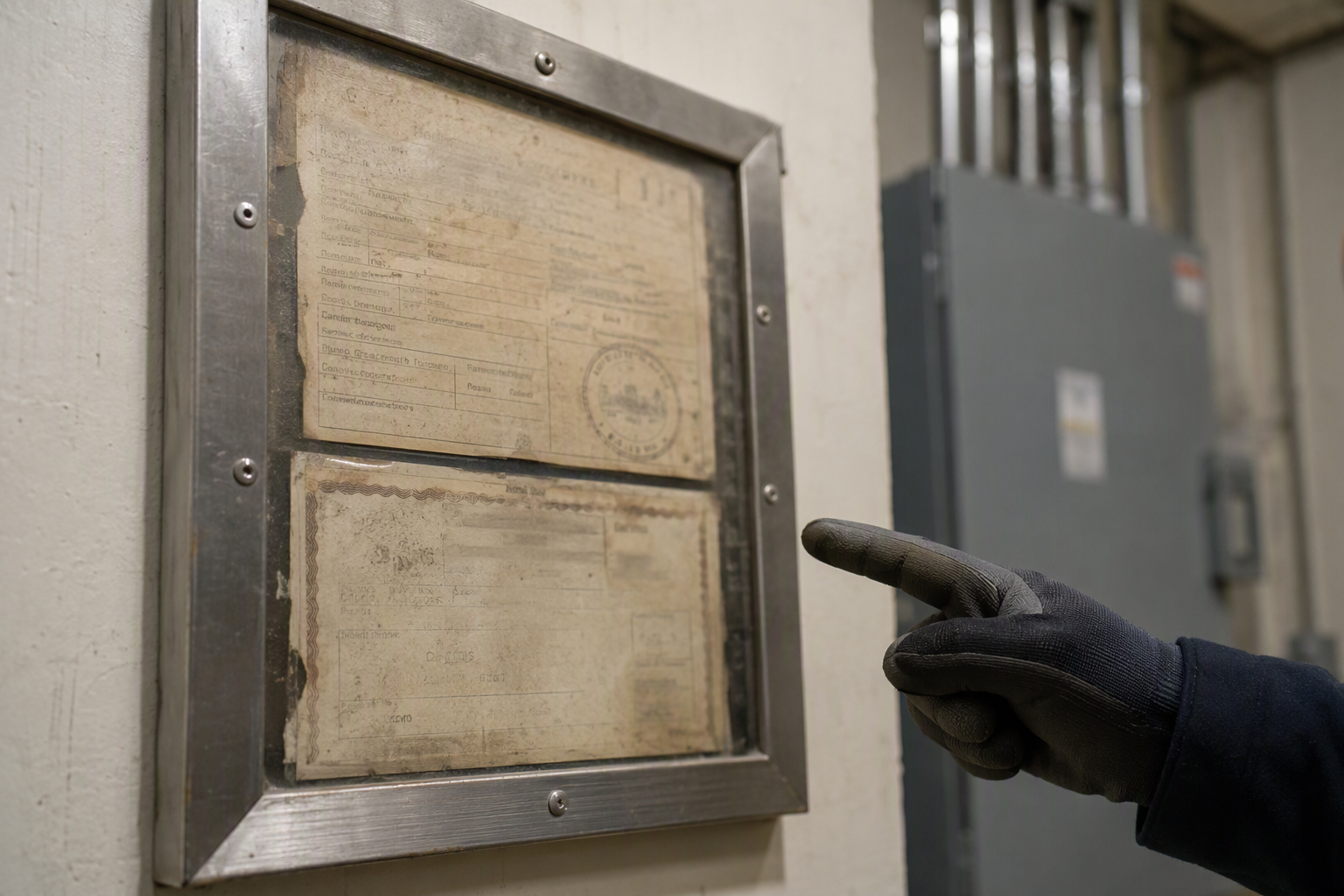
Florida law requires that all elevator modernization and installation work be performed by a registered elevator company under Chapter 399, Florida Statutes (the Elevator Safety Act). That registration must be renewed annually, and the company must carry general liability insurance as a condition of maintaining it.
Before signing anything, ask the contractor to confirm their active registration with the Florida Department of Business and Professional Regulation (DBPR), Division of Hotels and Restaurants, Bureau of Elevator Safety. A company that cannot immediately produce evidence of current registration should not be permitted to touch a healthcare elevator. The contract itself should specify that all work will be performed by properly registered personnel.
Axxiom Elevator Florida maintains its state registration and insurance in compliance with Florida’s annual renewal requirements, making it straightforward for healthcare facility managers to verify standing before work begins.
Will the Contractor Pull the Required State Permit?
Under Chapter 399, Florida Statutes, a state permit must be applied for — by a registered elevator company — before any conveyance is installed or altered. In a modernization project, “alteration” almost always triggers this requirement. Failure to obtain the permit before work begins places the facility in violation of state law, regardless of who initiated the oversight.
Healthcare facility managers should ask the contractor:
- Will you apply for the state modernization permit before any work begins?
- Which authority having jurisdiction (AHJ) will issue the permit — the DBPR directly, or the local delegated authority?
- Will the permit documentation be provided to the facility for its records?
For facilities in Pompano Beach, the relevant local authority is the Broward County Building Code Division, which enforces Florida’s elevator law through its own certified elevator inspectors. For facilities in Sarasota, contact the DBPR directly for permit and inspection jurisdiction. Make sure the contractor is familiar with the correct AHJ for your specific location.
Are Your Technicians Certified Under Florida’s Elevator Certificate of Competency?
Florida law authorizes only a certified elevator technician — one who holds a valid Florida elevator certificate of competency — to construct, install, maintain, or repair conveyances. That certificate expires annually and must be renewed with proof of continuing education. Every technician performing hands-on modernization work at a healthcare facility should hold a current certificate.
Ask the contractor to confirm that every technician assigned to the project holds a current Florida elevator certificate of competency. A healthcare facility cannot assume competency based on a company’s reputation alone; individual technician credentials should be verified before work starts.
How Will the Modernization Maintain ASME A17.1-2019 Compliance?
Florida adopted the ASME A17.1/CSA B44, 2019 edition (effective December 31, 2023) as its governing elevator safety code under Chapter 61C-5, Florida Administrative Code. Any modernization project must bring the elevator into conformance with this edition’s requirements.
For healthcare facilities, ASME A17.1-2019 compliance is especially critical because patient-use elevators typically carry non-ambulatory individuals, medical equipment, and staff in time-sensitive situations. Ask the contractor:
- Which components of the modernization are being upgraded to meet ASME A17.1-2019?
- Will the scope include the controller, door operator, drive system, or cab features — and how does each relate to code compliance?
- Are there any existing conditions that will require a variance or engineering review?
How Does the Modernization Address ADA Accessibility Requirements?
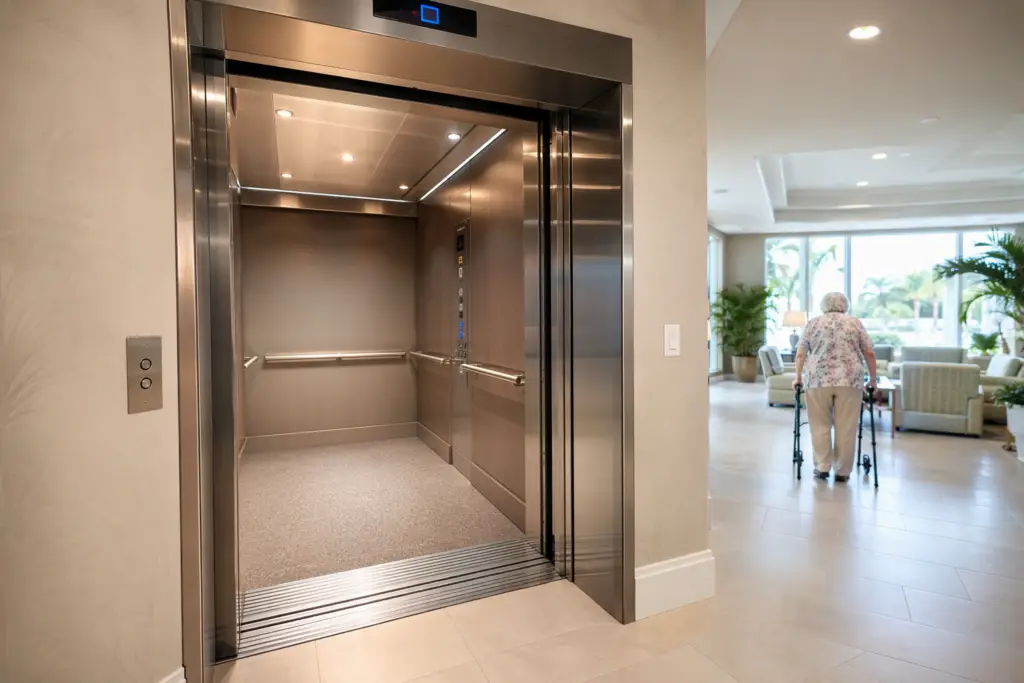
Healthcare facilities are among the most heavily scrutinized environments under the Americans with Disabilities Act (ADA). Patients in wheelchairs, individuals using mobility aids, and those with visual or hearing impairments rely on elevators that meet ADA standards for cab dimensions, door timing, call button placement, visual indicators, and audible signals.
A modernization project is an opportunity to correct any existing accessibility gaps. Ask the contractor to identify all ADA-relevant components in their scope — and to document what will and will not be addressed. Any known accessibility deficiencies that fall outside the contract scope should be disclosed in writing so the facility can plan a separate remediation path. Gaps discovered during a post-modernization inspection can result in complaints or legal exposure that far exceed the cost of addressing them proactively.
Who Schedules the Post-Modernization Inspection and Issues the New Certificate of Operation?
Under Florida law, before a modernized or newly altered conveyance is returned to service, it must be inspected by a certified elevator inspector who has no employment relationship, association, or conflict of interest with the permit holder or the elevator owner. The facility cannot skip this step, and the contractor cannot self-certify the work.
A Florida certificate of operation is valid for no more than two years and may only be renewed for a conveyance that has received a current satisfactory inspection. Operating on an expired certificate violates state law — a serious risk in a licensed healthcare environment. Ask the contractor:
- Who coordinates the post-modernization inspection?
- How long after project completion should the facility expect the new certificate of operation?
- Who is responsible if the inspection reveals code deficiencies that require remediation before the certificate is issued?
Florida law places responsibility for safe operation, maintenance, and correction of code deficiencies on the elevator owner once the certificate of operation is issued. Healthcare facility managers must understand this obligation before the contract is signed.
What Is the Realistic Project Timeline, and How Is Patient Care Impact Managed?
Healthcare facilities cannot treat elevator downtime the way an office building can. An elevator that serves a surgery floor, a patient ward, or an emergency department creates immediate operational risk when it is out of service. Before signing, ask the contractor for a detailed project schedule that includes:
- Estimated start date following permit issuance
- Phase-by-phase breakdown of work and downtime windows
- Contingency plan if permit or inspection timelines extend
- How the contractor communicates schedule changes to facility management
- Coordination process with the facility’s facilities management and patient care teams
A contractor who cannot provide a written schedule with clear communication protocols is not ready to work in a healthcare environment.
What Warranty and Post-Modernization Maintenance Terms Are Included?
The contract should clearly define what is covered under warranty, for how long, and what is excluded. Healthcare elevators operate at high utilization rates compared to many other building types, and components that meet standard commercial expectations may not hold up under continuous patient-transport and equipment-movement cycles.
Ask the contractor to specify:
- What parts and labor are covered under the warranty, and for what period?
- Is a maintenance agreement available following modernization, and does it satisfy Florida’s annual inspection requirements?
- How are emergency service calls handled after modernization is complete?
Note: Under Florida law, certain two-floor elevators covered by a service maintenance contract may qualify for an exemption from the annual state inspection requirement. A qualified contractor can clarify whether any of the facility’s units meet that exemption and document it properly.
Questions Your Inspector Will Ask
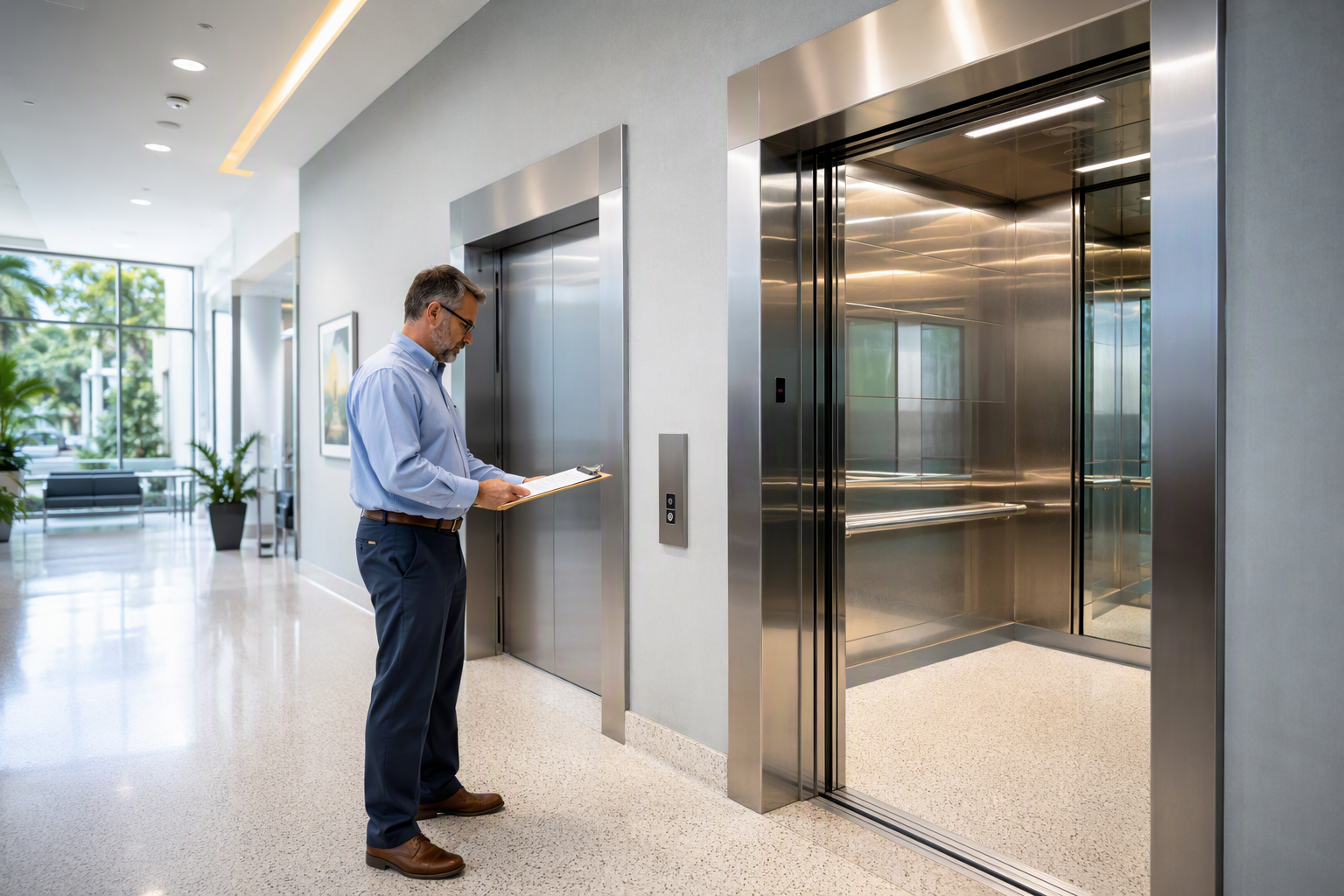
Understanding what a Florida certified elevator inspector will verify after modernization helps healthcare facility managers evaluate whether a contractor’s proposed scope is actually complete. Inspectors assigned by the DBPR or by delegated local authorities such as the Broward County Building Code Division typically review the following:
- Permit documentation: Was a valid state permit issued before work began?
- ASME A17.1-2019 conformance: Do the modernized components meet the adopted Florida edition of the safety code?
- Controller and drive system: Are new or upgraded control systems properly rated and installed per code?
- Door operation and safety devices: Do door reopening devices, interlocks, and timing meet current code requirements?
- Cab and hoistway: Are lighting, ventilation, emergency communication, and structural elements compliant?
- ADA features: Are call buttons, signage, and cab dimensions consistent with accessibility requirements?
- Technician credentials: Were all personnel performing the work certified under Florida’s certificate of competency program?
- Test documentation: Are load tests, safety device tests, and governor tests documented and available for review?
A modernization contractor who cannot answer every one of these questions in advance of inspection — and in writing — should not be trusted with a healthcare facility’s vertical transportation system.
How Does the Contractor Handle Accident Reporting Obligations?
Florida law requires the certificate of operation holder to report any elevator accident to the state within five working days. During a modernization project, when equipment may be in a transitional state, the line of responsibility for incident reporting can become unclear. Ask the contractor to define in the contract exactly who holds reporting responsibility during each phase of the project and what procedures are in place if an incident occurs while work is ongoing.
Why Healthcare Facilities in Pompano Beach and Sarasota Choose Axxiom Elevator Florida
Healthcare facility managers in Pompano Beach and Sarasota work with Axxiom Elevator Florida because the company understands that vertical transportation in a clinical environment is not a general construction matter — it is a patient safety matter. Axxiom Elevator Florida operates as a registered elevator company under Chapter 399, Florida Statutes, and works with the local AHJs relevant to each market, including the Broward County Building Code Division for facilities in the Pompano Beach area.
Axxiom Elevator Florida approaches every modernization engagement by walking facility managers through the permit process, compliance obligations under ASME A17.1-2019, ADA requirements, and post-inspection certificate of operation steps before any contract is signed. That transparency is not a sales tactic — it is the foundation of a compliant, patient-safe modernization project.
The Modernization Contract Checklist for Healthcare Facility Managers
Before signing a modernization contract, confirm the following in writing:
- Contractor holds current Florida registered elevator company status with active general liability insurance
- All assigned technicians hold a current Florida elevator certificate of competency
- Contractor will apply for and obtain the required state permit before work begins
- Scope explicitly addresses ASME A17.1-2019 compliance for all modernized components
- ADA accessibility elements are identified and documented — in scope or excluded with written justification
- Post-modernization inspection will be performed by an independent certified elevator inspector
- A written project schedule with healthcare-specific downtime protocols is provided
- Warranty terms, post-modernization maintenance options, and emergency response procedures are defined
- Accident reporting responsibilities during the project are clearly assigned
- Certificate of operation renewal process and timeline are documented
Get a Free Elevator Assessment from Axxiom Elevator Florida
Healthcare facility managers in Pompano Beach, Sarasota, and throughout Florida deserve a modernization partner who answers every compliance question before the contract is signed — not after the inspector arrives. Contact Axxiom Elevator Florida for a free elevator assessment and learn exactly what a code-compliant modernization looks like for your facility.
Call Axxiom Elevator Florida: 954-970-0020
Need elevator service you can rely on? Axxiom Elevator Florida is ready to help.