
How Does Hurricane Season and Florida Humidity Affect Elevator Equipment — and What Maintenance Should You Schedule?
Florida’s subtropical climate creates conditions that are uniquely punishing for elevator systems. High ambient humidity is present year-round, salt-laden coastal air accelerates metal corrosion, and June through November brings a hurricane season that can force storm surge, wind-driven rain, and extended power outages into hoistways and machine rooms. The sections below answer every major question building owners, property managers, and facility directors in Pompano Beach and Sarasota need to understand about protecting their elevator investment before, during, and after severe weather.
What specific damage does Florida’s high humidity cause to elevator equipment?
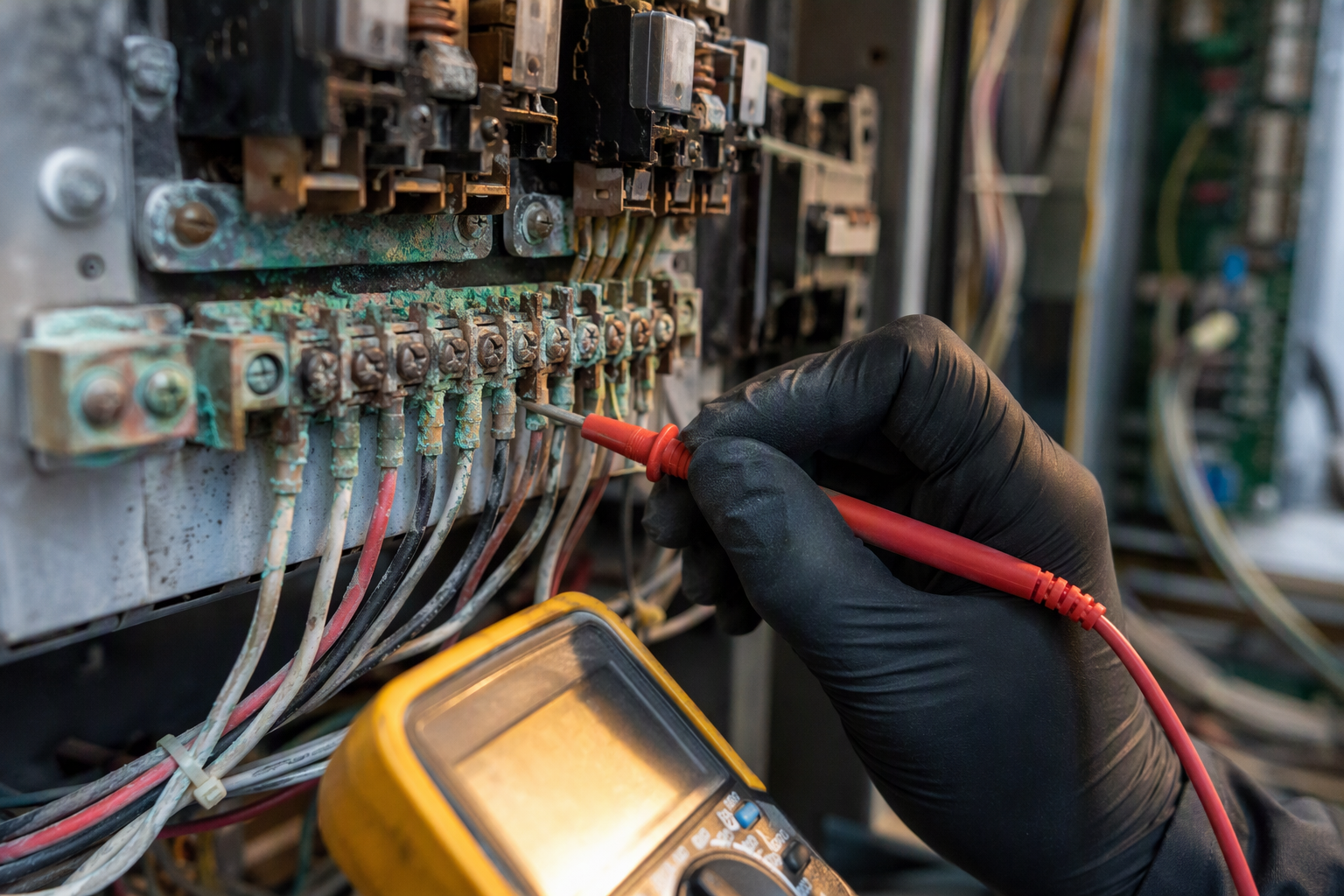
Florida’s persistent humidity attacks metal components, electrical insulation, and lubrication, causing corrosion, wiring degradation, and accelerated mechanical wear that shortens equipment service life.
Elevator systems contain hundreds of ferrous metal parts — guide rails, counterweight frames, safeties, buffer springs, machine bases, and sheaves — all of which oxidize when exposed to sustained moisture. In coastal markets like Pompano Beach and Sarasota, salt in the air compounds the problem, producing pitting corrosion that weakens structural members and increases friction on running surfaces.
Beyond metal corrosion, humidity degrades electrical components. Moisture migrates into control panels, creating leakage current paths between conductors, accelerating insulation breakdown on motor windings, and corroding contact surfaces in relays, contactors, and terminal strips. Safety-critical circuits — door interlocks, overspeed governors, and buffer contacts — can develop high-resistance faults that cause nuisance shutdowns or, more seriously, mask a genuine safety condition.
Hydraulic elevator systems face additional risk: moisture enters the fluid reservoir through breather caps and condensation, reduces hydraulic fluid viscosity, and can promote microbial growth in the fluid — all of which shorten pump and valve life. Guide rail lubrication is also affected; humidity causes lubricants to wash out faster, increasing guide shoe wear and rail noise.
How does hurricane-driven flooding damage an elevator hoistway and machine room?

Flood intrusion from a hurricane can submerge pit equipment, saturate motor windings, contaminate hydraulic fluid, and destroy control electronics — requiring full component replacement before the elevator is safe to return to service.
The elevator pit is the lowest point of the hoistway and the first area to take on water during a storm surge or heavy rain intrusion event. Even a few inches of water can submerge buffer springs, limit switches, pit lighting fixtures, traveling cable loops, and hydraulic cylinder packings. Submersion of electrical components generally means replacement, not drying, because water infiltrates insulation layers that are not visible on the surface.
Machine rooms at grade level or in basement spaces face similar risk. Traction machine motors, hydraulic pump units, microprocessor controllers, and variable-frequency drives (VFDs) are not rated for water exposure. A post-flood machine room that is dried out and simply re-energized without professional inspection poses serious fire and electrocution risk, as well as the possibility of undetected safety circuit faults.
Wind-driven rain can penetrate hoistway ventilation openings in the overhead, wetting ropes, sheaves, and upper machine rooms. Salt deposits left after water evaporates continue to attract moisture and promote ongoing corrosion for months after the storm event.
What are the most vulnerable elevator components during a Florida storm?
The pit assembly, control wiring harnesses, motor insulation, hydraulic fluid reservoirs, and door operator mechanisms are the components most vulnerable to storm-related damage in Florida’s climate.
| Component | Primary Threat | Failure Mode | Priority Level |
|---|---|---|---|
| Pit equipment (buffers, limit switches, traveling cable) | Storm surge / flood intrusion | Electrical short, mechanical corrosion | Critical |
| Motor windings (traction & hydraulic) | Humidity condensation, flood submersion | Insulation breakdown, winding short | Critical |
| Control panel & microprocessor boards | Moisture infiltration, power surge | Component failure, corrupted logic | Critical |
| Hydraulic fluid reservoir | Condensation, flood contamination | Fluid degradation, pump wear | High |
| Door operators & interlock wiring | Humidity, salt air | Contact corrosion, door entrapment risk | High |
| Guide rails & rail brackets | Salt air, humidity | Pitting corrosion, increased friction | Medium |
| Hoist ropes & sheaves | Wind-driven rain, salt deposits | Wire strand corrosion, reduced rope life | Medium |
| Machine room HVAC & ventilation | Storm damage, power loss | Overheating of electronics post-storm | Medium |
| Pit sump pump | Power outage during storm | Pit flooding | High |
| Battery backup / ARO system | Heat, humidity, age | Failure to lower car to landing | High |
What pre-hurricane season maintenance should elevator owners schedule in Florida?
Building owners should schedule a comprehensive pre-season elevator inspection and service visit between May 1 and June 15 each year to identify corrosion, test safety systems, verify pit drainage, and address any deferred maintenance before storm conditions arrive.
A thorough pre-season service visit should encompass the following at a minimum:
- Pit inspection and drainage verification: Confirm the sump pump is operational, the pit drain is unobstructed, and the pit walls show no active water intrusion.
- Corrosion survey: Inspect all ferrous structural components, guide rails, and safety devices for surface rust or pitting that may compromise integrity.
- Electrical insulation testing: Perform megohm testing on motor windings and traveling cables to establish a baseline and detect degraded insulation before it fails under load.
- Hydraulic fluid analysis: Sample and test hydraulic fluid for moisture content, viscosity, and contamination. Replace if the fluid shows elevated water content.
- Door interlock and safety circuit verification: Test every door interlock, safety edge, and car gate contact to confirm reliable operation.
- Battery backup system test: Verify the automatic rescue operation (ARO) battery system will lower the car to the nearest landing and open doors during a power outage — a code-required function under ASME A17.1 Safety Code for Elevators and Escalators.
- VFD and control panel inspection: Clean control panels, check terminal torque, and inspect VFD cooling fans — the primary cause of drive failure is dust-clogged heat sinks that overheat in Florida’s warm ambient temperatures.
- Machine room weatherproofing check: Verify seals around conduit penetrations, doors, and ventilation openings to minimize wind-driven rain intrusion.
Axxiom Elevator Florida provides pre-season service visits structured specifically for the climate conditions of Pompano Beach and Sarasota, addressing both the corrosion risks of coastal environments and the hydraulic system considerations common in Florida’s building stock.
What steps should building owners take immediately before a hurricane makes landfall?
The safest protocol before an imminent hurricane landfall is to park the elevator car at the highest appropriate floor, de-energize non-essential systems, and protect the machine room from wind and water intrusion.
- Notify all building occupants that elevator service will be suspended prior to storm arrival and provide adequate advance notice per your building’s emergency plan.
- Park the elevator car at the highest floor above expected flood level, then return it to a mid-building floor if the building has no flood risk at grade — this keeps the car and its electrical equipment away from pit flooding.
- Place the elevator in independent service or shutdown mode using the key switch to prevent unsupervised operation as conditions deteriorate.
- De-energize the elevator main line disconnect if flooding of the machine room is anticipated — never leave a flooded machine room energized.
- Inspect and, if possible, temporarily seal machine room door thresholds and ventilation openings with water-resistant barriers to reduce wind-driven rain intrusion.
- Ensure the pit sump pump has a battery backup or generator power source so it can operate during grid outages that coincide with heavy rainfall.
- Document the pre-storm condition of the machine room and pit with photographs — this supports both insurance claims and the post-storm inspection baseline.
- Confirm your service contract or arrange in advance for a certified elevator contractor to perform a post-storm inspection before the unit is returned to service.
What should building owners do immediately after a hurricane passes?
After a hurricane, no elevator should be returned to passenger service until a qualified elevator contractor has conducted a documented post-storm safety inspection — do not simply reset the elevator and resume normal operation.
- Visually inspect the machine room and pit (from a safe vantage point) for standing water before entering — do not enter a flooded machine room until the building’s electrical panel has been verified safe by a licensed electrician.
- Once electrical safety is confirmed, document all visible damage with photographs before disturbing any components.
- Contact a certified elevator service company to schedule a post-storm inspection. Axxiom Elevator Florida serves building owners throughout Pompano Beach and Sarasota and can coordinate post-storm assessment visits following major weather events.
- Do not energize a flooded or water-exposed elevator. Motor windings, control boards, and traveling cables exposed to flood water must be evaluated before power is restored.
- If the pit contains water, arrange for pump-out and then allow adequate drying time before the inspection technician assesses pit equipment condition.
- Review the inspection findings report and obtain a written assessment identifying all components requiring replacement, repair, or no action — this documentation may be required by your insurer and by the Florida Department of Business and Professional Regulation (DBPR) before the unit returns to service.
- Schedule all identified repairs and obtain required inspection sign-offs from the Authority Having Jurisdiction (AHJ) before resuming passenger service.
Is there a Florida law that requires an elevator inspection after storm damage?
Yes — Florida statutes place elevator inspection and permitting authority with the Florida Department of Business and Professional Regulation (DBPR), which requires that elevators be inspected and certified as safe before being placed in service following conditions that may have compromised their safety.
Under Florida’s elevator safety program administered by the DBPR, conveyances must hold a current certificate of operation. If an elevator has been de-energized due to storm damage or flood intrusion, the building owner is responsible for ensuring a qualified inspection is completed and any deficiencies corrected before the unit is re-commissioned for public use. Attempting to bypass this requirement exposes building owners to liability and potential code violations.
At the federal level, ASME A17.1 Safety Code for Elevators and Escalators and its companion ASME A17.3 Safety Code for Existing Elevators and Escalators establish the safety criteria that Florida’s inspection program incorporates by reference. Both codes require that safety devices function correctly before equipment is placed in service, which forms the technical basis for post-storm inspection requirements.
ADA obligations also persist after a storm — if the elevator is the accessible route for persons with disabilities in a building, extended post-storm downtime requires building owners to consider whether interim accessible accommodations are needed under the Americans with Disabilities Act.
How does Florida’s climate affect elevator inspection intervals?
Florida’s inspection intervals are set by the DBPR’s elevator safety program, but the state’s climate conditions mean that the minimum required inspection frequency is often insufficient on its own — additional maintenance visits are necessary to catch humidity-accelerated deterioration between code-mandated inspections.
Florida requires periodic inspections of conveyances under state statute, with the DBPR administering certificates of operation. These mandated inspections establish a legal floor, not a complete maintenance program. In Florida’s environment, corrosion on guide rails, degraded hydraulic seals, and deteriorating wiring insulation can develop meaningfully between annual or semi-annual inspection cycles.
Industry best practice — consistent with the maintenance provisions of ASME A17.1 — is to supplement code-required inspections with a structured preventive maintenance program that increases inspection frequency for components known to be vulnerable in high-humidity, coastal environments.
Does humidity affect elevator door operation and why is that a safety concern?
Yes — humidity causes metal door components to corrode and swell, electrical contacts to oxidize, and door operator mechanisms to lose calibration, increasing the risk of door reversals, entrapments, and door interlock failures.
The door system is statistically among the most common sources of elevator service calls and safety incidents. Humidity accelerates corrosion on door hanger rollers, sills, and interlocks. Oxidized interlock contacts can create intermittent electrical faults that allow the car to move with a door not fully closed — a condition that violates ASME A17.1 door interlock requirements and creates an immediate entrapment hazard.
Door operator motors and drive belts are also affected by sustained moisture. Belt-driven operators can slip when humidity causes the belt to swell or stretch, while direct-drive operators may develop corrosion on encoder wheels and motor shafts. Regular door system servicing — including sill cleaning, roller inspection, interlock contact cleaning, and door operator force testing — is particularly important in Florida’s climate.
What role does the machine room environment play in elevator reliability during Florida summers?
The machine room temperature and humidity directly affect control electronics, motor insulation life, and hydraulic fluid condition — an unconditioned machine room in Florida’s summer heat accelerates component aging and increases the risk of weather-related failures.
Florida’s summer ambient temperatures can push machine room temperatures to levels that exceed the operating envelope of sensitive control electronics and VFDs. Most modern elevator controllers specify an operating temperature range, and machine rooms that rely solely on ventilation — rather than air conditioning — during Florida summers can exceed those limits on peak heat days.
Humidity compounds the thermal problem: warm, humid air accelerates oxidation of circuit board traces and contact surfaces. Machine rooms should be maintained with functional HVAC or dedicated cooling equipment, with humidity levels managed to reduce condensation risk on control panels. After any storm event that affects building power, the first priority upon power restoration should be verifying that machine room environmental conditions are within acceptable ranges before re-energizing elevator equipment.
What is the risk of power surges from hurricanes on elevator control systems?
Hurricanes cause voltage spikes, phase loss events, and utility switchovers that can corrupt elevator microprocessor memory, damage VFDs, and destroy motor starting components — surge protection and a structured power restoration protocol are essential safeguards.
Modern elevator controls contain microprocessors, programmable logic controllers, and solid-state drives that are highly sensitive to power quality. During a hurricane, utility grid disturbances — including voltage surges when power is restored after outages — can permanently damage these components even when the elevator has been parked and the main disconnect is closed.
Best practice is to open the main line disconnect during an extended outage and to have the elevator inspected by a qualified technician before restoring power after a storm. A structured power restoration sequence — confirming three-phase voltage balance, checking for ground faults, and verifying control power before enabling traction or hydraulic drive circuits — reduces the risk of secondary electrical damage at restart.
Permanent surge protection devices installed at the elevator main disconnect panel provide ongoing protection against voltage transients throughout the year, not only during hurricane season.
Are there special hydraulic elevator maintenance considerations for Florida’s climate?
Yes — hydraulic elevators in Florida require more frequent fluid condition monitoring, cylinder and packing inspections, and underground cylinder leak checks due to the combination of heat, humidity, and Florida’s high water table accelerating external corrosion on in-ground cylinders.
Single-bottom hydraulic cylinders installed in the ground are subject to external corrosion from the surrounding soil, groundwater, and Florida’s notably high water table. Regulatory requirements under Florida’s DBPR program and environmental standards address hydraulic fluid leak detection for in-ground cylinders, making regular leak detection testing an important maintenance item beyond the mechanical condition of the unit.
Above-ground hydraulic components — pump units, reservoirs, flexible hoses, and valve manifolds — benefit from regular fluid sampling and analysis to detect moisture infiltration, viscosity degradation, and particulate contamination. In Florida’s climate, the combination of thermal cycling between air-conditioned machine rooms and hot summer ambient temperatures contributes to condensation within hydraulic reservoirs, making moisture monitoring particularly important.
What preventive maintenance tasks should be performed year-round in Florida’s climate?
Year-round preventive maintenance in Florida should include quarterly pit inspections, monthly machine room condition checks, periodic electrical insulation testing, door system service, and lubrication intervals calibrated to the elevated corrosion and wear rates caused by coastal humidity.
A Florida-specific maintenance cadence should address the following on an ongoing basis:
- Pit sump pump testing: Verify operation at every service visit — not just annually — given the frequency of heavy rain events outside of named storms.
- Rail lubrication: Increase lubrication frequency relative to inland or northern climates, as coastal humidity and salt air accelerate lubricant breakdown and rail corrosion.
- Traveling cable inspection: Inspect insulation jacket condition at pit loops and upper terminations for cracking or moisture intrusion, particularly on older cables.
- Machine room dehumidification: Ensure HVAC and any supplemental dehumidification equipment is functional before the onset of the wet season in June.
- Contact and terminal cleaning: Schedule regular cleaning of relay contacts, terminal strips, and interlock contacts in the control panel to remove oxidation before it causes circuit faults.
- Rope and sheave condition monitoring: Inspect wire ropes for broken wires, corrosion pitting, and lubrication condition more frequently than the minimums prescribed for drier climates.
How long after a hurricane can it take to return an elevator to service?
The timeline to return a hurricane-affected elevator to service ranges from a few days for minor weather exposure to several weeks or months if components such as motor windings, hydraulic power units, or control systems require replacement and parts procurement.
Buildings that experienced no flooding and only minor weather exposure may require only a safety inspection, testing, and documentation — potentially allowing return to service within 24–72 hours of the storm passing, subject to AHJ availability. Buildings with pit flooding or machine room water intrusion face a longer process: component assessment, parts ordering, qualified installation, and a final inspection by the DBPR or its authorized inspector before the elevator is certified to return to service.
Parts availability following a major regional storm can create delays as multiple buildings in the same market are competing for the same replacement components — control boards, VFDs, hydraulic pump units, and motor rewinding services. Pre-storm maintenance that keeps equipment in good condition and pre-established relationships with a certified elevator service company reduce the timeline to return to service following a storm event.
What documentation should building owners keep related to hurricane preparedness and post-storm inspections?
Building owners should maintain a file containing the elevator’s current certificate of operation, all maintenance and inspection records, pre-storm condition photographs, post-storm inspection reports, and any DBPR correspondence related to storm damage and return to service.
This documentation serves multiple purposes: it supports insurance claims for storm-related equipment damage, demonstrates due diligence to the AHJ when applying for post-storm return-to-service authorization, and provides the elevator contractor with a maintenance history that accelerates diagnosis and repair. Under Florida’s DBPR program, the current certificate of operation must be posted at the elevator, and any gap in certification status following storm damage should be actively managed in coordination with the certifying inspector.
From an ADA compliance perspective, documentation of storm-related elevator downtime — and any interim accessible accommodations provided — supports a building owner’s position that the disruption was involuntary and that steps were taken promptly to restore access.
Does hurricane season affect elevator insurance coverage in Florida?
Hurricane-related elevator damage is generally addressed under a building’s commercial property insurance policy, but coverage specifics — including flood exclusions, windstorm riders, and equipment breakdown endorsements — vary significantly and should be reviewed before storm season begins.
Standard commercial property policies in Florida often carry separate windstorm and flood deductibles due to the state’s hurricane exposure. Equipment breakdown coverage — sometimes called boiler and machinery insurance — may cover damage to elevator motors, controls, and hydraulic systems caused by power surges or mechanical failures during a storm, even when the structural policy’s flood exclusion applies to water damage.
Building owners are advised to review their policy terms and consult with their insurance broker before June 1 each year. Maintaining current inspection records and pre-storm condition photographs supports claims processing and may affect coverage determination for post-storm equipment losses.
How can building owners in Pompano Beach and Sarasota find a qualified elevator contractor for storm preparedness?
Building owners should select an elevator contractor licensed under Florida’s DBPR elevator contractor licensing program, with demonstrated experience servicing the equipment types in their building and familiarity with post-storm inspection protocols specific to Florida’s AHJ requirements.
Florida requires elevator contractors to be licensed through the DBPR, ensuring that individuals performing elevator work meet established competency standards. When evaluating a service provider for storm preparedness and post-storm response, property managers should verify current licensure, confirm the contractor is familiar with the specific equipment manufacturer in their building, and establish the scope of the maintenance agreement — including whether post-storm inspection visits are covered or billed separately.
Axxiom Elevator Florida serves certified elevator maintenance and inspection needs throughout Pompano Beach and Sarasota, with service programs structured around the maintenance demands of Florida’s coastal environment and the requirements of the state’s DBPR inspection program.
What should building owners ask a contractor before signing a hurricane preparedness service agreement?
Before signing an elevator maintenance or hurricane preparedness service agreement, building owners should ask about the scope of pre-season inspection services, post-storm inspection protocols, parts sourcing capabilities, AHJ coordination support, and whether the agreement explicitly addresses storm-related service calls.
Key questions to ask any elevator service contractor in Florida include:
- Does the maintenance agreement include a pre-hurricane season inspection, or is that billed separately?
- What is the protocol for post-storm inspection, and is that inspection included in the contract scope?
- Does the contractor have access to a parts inventory for the specific equipment in my building, and what is the typical lead time for major components such as control boards or pump units?
- Will the contractor coordinate with the DBPR-authorized inspector to facilitate return-to-service certification after storm damage?
- Is the contractor’s license current under Florida’s DBPR elevator contractor licensing program?
- Does the contractor carry appropriate liability insurance and workers’ compensation coverage?
What ASME code provisions are most relevant to post-storm elevator safety in Florida?
The provisions of ASME A17.1 governing safety device testing, door interlock requirements, and the automatic rescue operation (ARO) battery backup function are among the most directly relevant to post-storm elevator safety in Florida.
ASME A17.1 establishes the construction, installation, and performance requirements for new elevator installations, while ASME A17.3 applies retroactively to existing equipment already in service. Following a storm event, the safety device testing provisions of both codes form the checklist basis for a qualified post-storm inspection: overspeed governor function, safety application and release, buffer condition and travel, door interlock continuity, emergency lighting, and ARO battery system performance must all be verified before the unit returns to service.
OSHA standards also apply where elevator equipment is being serviced by workers — particularly during post-storm conditions where confined space entry (pit work) or work-at-heights in the hoistway is required. Post-storm conditions may introduce additional hazards — standing water, structural instability, compromised lighting — that require hazard assessment before technicians enter the pit or hoistway.
How does Florida’s hurricane season affect elevator maintenance costs and budgeting?
Florida building owners should budget for a pre-season inspection, a post-storm inspection following any major weather event, and a reserve for storm-related component replacement — costs that are above the baseline maintenance budget appropriate for other climates.
The specific costs associated with any given elevator maintenance program depend on equipment type, age, building height, and the scope of services agreed upon with the contractor — factors that vary too widely to generalize here. What is consistent in Florida is the need to account for climate-specific maintenance items that are not standard in service agreements written for drier, less storm-exposed markets. These include more frequent pit drainage system servicing, hydraulic fluid condition monitoring, electrical insulation testing, and the post-storm inspection visits that may not be covered under a standard maintenance contract without explicit negotiation.
Building owners in Pompano Beach and Sarasota who establish a proactive maintenance relationship with a qualified contractor before storm season are generally better positioned to manage both the cost and timeline of post-storm repairs compared to those who address issues reactively after damage has occurred.
Need elevator service you can rely on? Axxiom Elevator Florida is ready to help.