How to Evaluate an Elevator Service Company: A Data-Driven Guide for Florida Building Owners

Choosing the wrong elevator service company exposes a building to safety violations, regulatory penalties, extended downtime, and significant liability. With Florida’s high-rise residential and commercial inventory continuing to grow through 2025 and 2026, building owners and facility managers face mounting pressure to select vendors who deliver measurable compliance outcomes — not just promises. This guide breaks down every factor that matters when evaluating elevator service providers, supported by applicable code references and objective criteria.
What Standards Should an Elevator Service Company Comply With?
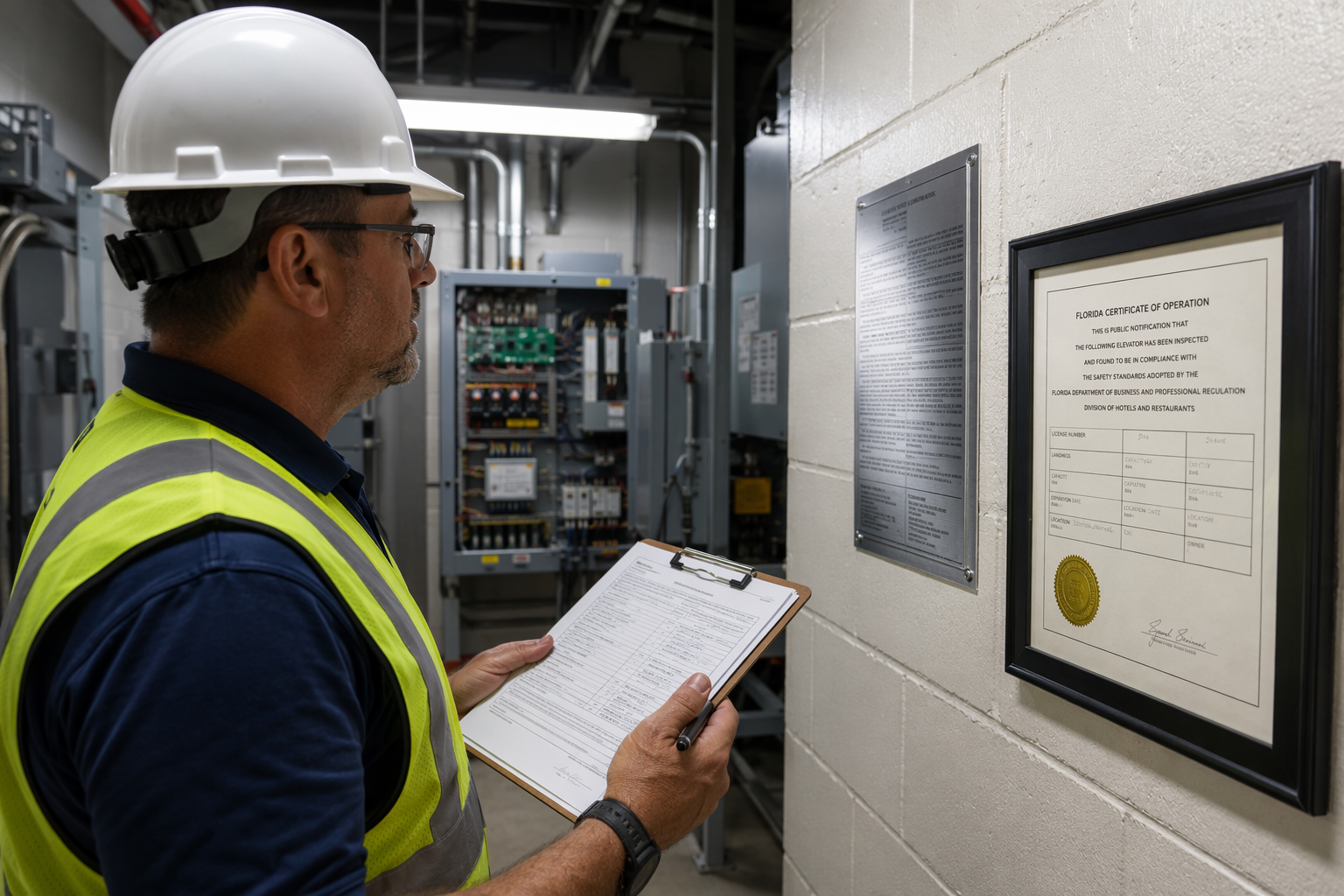
The foundational benchmark for any elevator service company is adherence to the ASME A17.1 Safety Code for Elevators and Escalators, which governs the design, construction, installation, operation, inspection, testing, maintenance, alteration, and repair of elevators across North America. Florida adopts and enforces this code through its state elevator safety program.
Companies operating in Florida must also align with ADA (Americans with Disabilities Act) accessibility requirements, which prescribe specific standards for elevator cab dimensions, door timing, control panel heights, and auditory signals. Non-compliance with ADA can expose building owners to federal civil rights complaints independent of any local inspection outcome.
Additionally, elevator mechanics working on equipment are subject to workplace safety regulations governed by OSHA (Occupational Safety and Health Administration), particularly standards related to confined space entry, electrical work, and lockout/tagout procedures. A service company that cannot demonstrate OSHA-compliant field practices introduces risk to your building’s personnel and your own liability exposure.
When interviewing a prospective service provider, request documentation showing how their technicians are trained and how their service procedures reflect these three frameworks. Vague answers or resistance to sharing this information are meaningful red flags.
What Is Included in a Legitimate Elevator Maintenance Contract?

A well-structured elevator maintenance contract is one of the clearest indicators of a service company’s operational maturity. Contracts should define, in writing, exactly which components are covered, which are excluded, and what service protocols govern each visit.
Key elements to look for in any elevator maintenance agreement include:
- Scope of covered components: The contract should explicitly list parts and systems included — drive systems, door operators, hydraulic systems, control panels, safety devices, and cab interiors — versus exclusions.
- Inspection frequency and documentation: Compliant maintenance under ASME A17.1 requires periodic inspections at defined intervals. The contract should specify how often full inspections occur and how written service records are maintained and shared with the building owner.
- Parts and labor provisions: Some contracts cover only labor; others include parts. Understanding this distinction is critical to forecasting total cost of ownership.
- Escalation clauses: Look for clauses that allow price increases and ensure they are capped and tied to identifiable indices, not open-ended.
- Termination rights: A reputable company offers reasonable notice periods and does not use proprietary software or hardware to create lock-in that prevents switching vendors.
A company that provides only a summary-level agreement without specifics is a company that may be leaving compliance gaps for the building owner to discover — and pay for — later.
How Do You Verify an Elevator Company’s Compliance Track Record?
Florida building owners can cross-reference a service company’s compliance history through several publicly accessible channels. The Florida Department of Business and Professional Regulation (DBPR) maintains elevator inspection records, and violations or failed inspections are part of that public record. Requesting this information before signing a contract is a standard due-diligence step.
Additionally, building owners should request a sample of recent inspection reports the company has filed on behalf of other clients. A provider with a strong compliance track record will have inspection reports that are complete, timely, and reflect zero recurring deficiencies on the same equipment.
Ask specifically whether the company has experience resolving ADA deficiencies cited during inspections. ADA compliance issues in elevators — such as improper door dwell time, non-functional Braille panels, or inadequate cab lighting — require a service partner who understands both the technical fix and the documentation required to close a violation.
What Questions Should You Ask an Elevator Service Company Before Hiring?
Structured interviews are more reliable than references alone. The following questions are designed to surface operational transparency and expose gaps:
- What edition of ASME A17.1 do your maintenance protocols reference, and how do you update procedures when the code is revised?
- How do you document each service visit, and how does the building owner receive that documentation?
- What is your process when a safety device fails or a unit is taken out of service?
- How do you handle parts sourcing — OEM parts, aftermarket, or mixed? What is your policy on documentation of parts used?
- Can you provide the names of buildings you currently service in this county so we can contact their facility managers directly?
- How do you handle ADA-related deficiencies found during routine maintenance?
- What OSHA-compliant safety protocols do your technicians follow on-site?
- What happens to our service records if we decide to change providers?
A company that answers these questions specifically and without hesitation is demonstrating operational transparency. A company that deflects, generalizes, or claims proprietary methods without substantiation deserves skepticism.
How Does Elevator Type Affect Which Service Company You Should Choose?
Not all elevator service companies have equal depth of expertise across equipment types. Florida’s building inventory includes hydraulic elevators common in low- and mid-rise structures, traction elevators in high-rise residential and commercial towers, and machine-room-less (MRL) traction systems increasingly specified in new construction.
When evaluating a provider, confirm their documented experience with your specific equipment type and manufacturer. Some smaller service companies are highly proficient with hydraulic systems but lack the diagnostic tools or technical training for modern MRL drives and microprocessor control systems. Conversely, large national companies may assign generalist technicians who rotate accounts and never develop deep familiarity with your specific equipment.
The ASME A17.1 Safety Code applies to all elevator types, but the specific maintenance tasks, testing intervals, and component requirements vary by system category. A service company should be able to explain those differences for your equipment without referring you back to the manufacturer.
What Red Flags Indicate a Low-Quality Elevator Service Provider?
Several patterns consistently signal a service company that will underperform on safety, compliance, or service quality:
- No written maintenance procedures: If a company cannot produce documented service protocols, their technicians are operating without consistent standards.
- Incomplete or missing service records: Under Florida’s regulatory framework, service documentation is a compliance requirement — not optional. A company that does not produce complete records is creating liability for the building owner.
- Pressure to sign long-term contracts quickly: Legitimate providers allow time for due diligence. Urgency tactics suggest the company does not expect to hold up under scrutiny.
- Vague scope of work: Contracts that describe service as “routine maintenance” without itemizing what that means leave the building owner unprotected.
- No demonstrated familiarity with ADA requirements: Elevator accessibility is a federal requirement. A service company unfamiliar with ADA standards is not a compliant partner for any building serving the public.
- Proprietary lock-in on parts or software: Some companies install proprietary controllers or use software keys that prevent other companies from servicing the equipment. This practice restricts competition and can strand a building owner in a non-competitive contract.
- Resistance to third-party audits: A confident service provider welcomes independent inspection reviews. Resistance to third-party verification is a strong signal that service quality may not match what is being invoiced.
How Do Inspection Requirements Factor Into Vendor Selection?
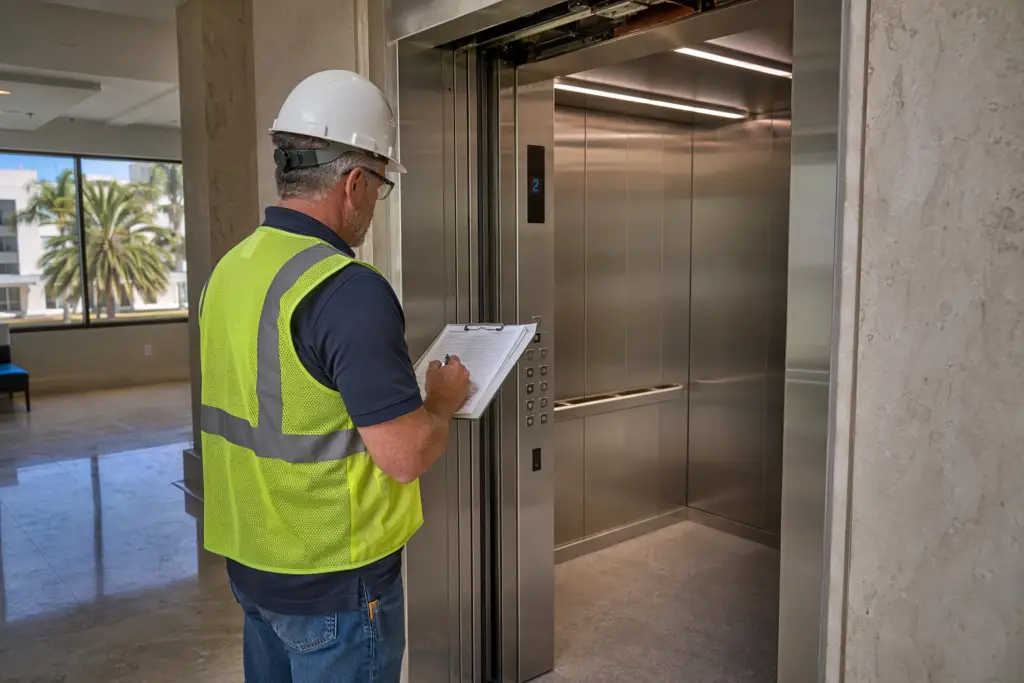
Florida mandates periodic elevator inspections conducted by licensed inspectors. The frequency and scope of these inspections are governed by state adoption of the ASME A17.1 Safety Code for Elevators and Escalators. Building owners are responsible for ensuring their equipment passes these inspections — and a service company that allows deferred maintenance to accumulate will expose the building to failed inspections, violation notices, and mandatory shutdowns.
When evaluating a prospective vendor, ask for the inspection pass rate across their current portfolio. A data-driven service company will have this information readily available. Ask also how they handle units that fail inspection — specifically, whether they resolve deficiencies before the re-inspection window closes and how they document the corrective work for the inspector’s file.
A vendor’s approach to inspection preparation is one of the most diagnostic questions a building owner can ask. Companies that treat inspections as a compliance deadline to manage, rather than a continuous quality outcome to sustain, will consistently underperform over the life of a contract.
What Should You Evaluate in an Elevator Company’s Service Technology?
As the elevator industry moves through 2025 and 2026, technology-enabled service delivery is becoming a meaningful differentiator between high-performing and average providers. Remote monitoring systems, which allow real-time visibility into elevator performance data, are increasingly available for both new and modernized equipment.
A service company that offers or integrates remote diagnostics can identify developing faults before they become service interruptions — reducing unplanned downtime and extending component life. When evaluating a provider’s technology posture, ask:
- Do you offer remote monitoring, and does the building owner have access to dashboard data?
- How are maintenance intervals adjusted based on actual equipment performance data versus a fixed calendar schedule?
- How do you document modernization recommendations, and how do you tier those recommendations by urgency and code compliance?
A provider who relies solely on calendar-based maintenance without any performance data integration is operating with a methodology that does not reflect current industry best practice.
How Should You Compare Elevator Service Companies Side by Side?
Structured comparison is more reliable than gut feel. The following framework helps building owners evaluate competing proposals objectively:
| Evaluation Criterion | What to Look For | Red Flag |
|---|---|---|
| Code Compliance Framework | Explicit reference to ASME A17.1 and Florida state adoption | Vague references to “industry standards” without specifics |
| ADA Knowledge | Demonstrated ability to identify and remediate ADA deficiencies | Unfamiliarity with ADA requirements in elevator context |
| Contract Transparency | Itemized scope, documented exclusions, clear termination terms | Summary-only contracts with undefined scope |
| Service Documentation | Written records provided to building owner after every visit | No documented service history or records withheld |
| Inspection Track Record | Portfolio-level inspection pass rate available on request | Unable or unwilling to provide inspection outcome data |
| Technology Integration | Remote monitoring, data-informed maintenance intervals | Calendar-only maintenance with no performance data |
| OSHA Field Compliance | Documented safety protocols for technicians per OSHA | No written field safety procedures |
How Does Modernization Factor Into Evaluating a Service Partner?
Elevator modernization — the process of replacing outdated control systems, drives, or cab components — is a significant capital decision that typically occurs as equipment ages past its design service life. A capable service company should be able to assess modernization needs against current code requirements and present options in a clear, prioritized format.
The ASME A17.1 Safety Code includes provisions that apply when alterations or modernizations are made to existing equipment. A service company that is not current on these provisions may recommend upgrades that inadvertently trigger full-code compliance requirements for which the building is not prepared.
When evaluating a service partner’s modernization capability, ask for examples of completed projects, the code edition referenced in the design specifications, and how the work was inspected and permitted through the relevant Florida jurisdiction.
What Role Does Local Market Knowledge Play in Evaluating Elevator Service Companies?
Florida’s elevator market has characteristics that national or out-of-state providers may not fully understand. The state’s climate — characterized by high humidity, salt air in coastal markets, and temperature cycling — creates equipment wear patterns that differ from northern or inland markets. Hydraulic fluid performance, seal integrity, and corrosion on exposed mechanical components are all affected by Florida’s environment.
A service company with deep Florida market experience will have maintenance protocols that account for these environmental factors. They will also have established relationships with Florida’s inspection authorities and familiarity with jurisdiction-specific permitting processes — which can vary meaningfully between counties.
Axxiom Elevator Florida operates as a data-driven service provider focused exclusively on Florida’s elevator market. This geographic specialization means the company’s service protocols, compliance frameworks, and vendor relationships are calibrated to the specific regulatory, environmental, and operational conditions Florida building owners face — rather than adapted from a generic national template.
What Are the 2025–2026 Trends Shaping How Elevator Service Companies Operate?
Several developments are reshaping the elevator service landscape through 2025 and 2026, and building owners should understand them when selecting a long-term service partner:
- Predictive maintenance adoption: Service companies are increasingly moving from fixed maintenance schedules to data-driven predictive models that use sensor data to anticipate component failures before they occur. Providers who cannot articulate this transition are operating with an outdated methodology.
- Code edition updates: The ASME A17.1 Safety Code is revised on a cycle, and Florida’s adoption of updated editions creates compliance obligations for existing equipment. A service provider must stay current on edition changes and communicate implications to building owners proactively.
- Increased ADA enforcement activity: Federal enforcement of ADA accessibility requirements in vertical transportation has increased. Service companies that treat ADA compliance as secondary will expose their clients to growing federal liability.
- Workforce and parts supply considerations: The elevator service industry continues to experience skilled technician shortages in many markets, and parts lead times for certain components remain extended. Building owners should ask prospective providers how they manage parts inventory and technician deployment to minimize service disruptions.
- Energy efficiency modernization: Regulatory and market pressure toward building energy performance is accelerating interest in drive system modernization, regenerative drive technology, and LED cab lighting upgrades. A capable service partner should be able to quantify modernization options in terms of both compliance outcomes and operational efficiency.
How Do You Evaluate an Elevator Company’s Approach to Safety?
Safety performance is the most consequential dimension of elevator service quality — and also the most difficult to evaluate from a proposal or sales conversation alone. The following evaluation approach is recommended:
- Request the company’s written safety program and confirm it references OSHA standards applicable to elevator service work.
- Ask how safety incidents, near-misses, and equipment failures are documented, investigated, and corrected.
- Request a copy of their most recent equipment failure or incident log (redacted for client confidentiality where appropriate) to assess how they respond to adverse events.
- Confirm that safety device testing — including governor, buffers, and safeties — is performed on the schedule required by ASME A17.1 and that test results are documented in the equipment’s maintenance record.
- Ask specifically how the company ensures that equipment taken out of service for safety reasons is not returned to service without documented corrective action and, where required, re-inspection by a licensed Florida elevator inspector.
A service company that cannot answer these questions specifically is not operating a mature safety management system — regardless of what their marketing materials claim.
Why Does Service Documentation Matter for Building Owners?
Complete, accurate service documentation is not merely a best practice — in Florida’s regulatory environment, it is a legal requirement tied to inspection compliance and liability management. A building owner who cannot produce a complete service history for their elevator equipment faces significant disadvantages in the event of an incident, insurance claim, or regulatory inquiry.
Service documentation should include, at minimum: the date of each service visit, the technician who performed the work, the tasks completed, any deficiencies identified, parts replaced (with part numbers and sources), and any follow-up actions required. This record should be retained for the life of the equipment and transferred to any successor service company.
When evaluating providers, ask whether service records are delivered in a format the building owner controls — not locked in the service company’s proprietary system. Ownership of your equipment’s service history is a fundamental contractual right that should be explicitly stated in any maintenance agreement.
Contact Axxiom Elevator Florida for a Free Elevator Assessment
Evaluating an elevator service company is a decision with long-term safety, compliance, and financial consequences. Axxiom Elevator Florida provides building owners and facility managers with a structured, data-driven approach to elevator maintenance, inspection preparation, modernization planning, and compliance documentation — grounded in ASME A17.1, ADA, and OSHA requirements specific to Florida’s regulatory environment.
Contact Axxiom Elevator Florida for a free elevator assessment:
A qualified Axxiom Elevator Florida representative will review your current equipment status, maintenance documentation, and compliance posture — and provide an objective assessment of where your elevator program stands relative to Florida’s code requirements and current industry standards.