Elevator Breakdown Immediate Response: Complete FAQ Guide for Florida Building Owners
An elevator breakdown is never just an inconvenience. In a commercial building, a stalled elevator can mean trapped passengers, ADA violations, lost revenue, and potential liability — all within the first 60 minutes of failure. Whether you manage a high-rise in Pompano Beach or a medical office complex in Sarasota, understanding exactly what to do, who to call, and what the law requires can be the difference between a minor disruption and a serious incident. This guide answers every critical question building owners, property managers, and facility directors ask when an elevator goes down.
What should you do immediately when an elevator breaks down?
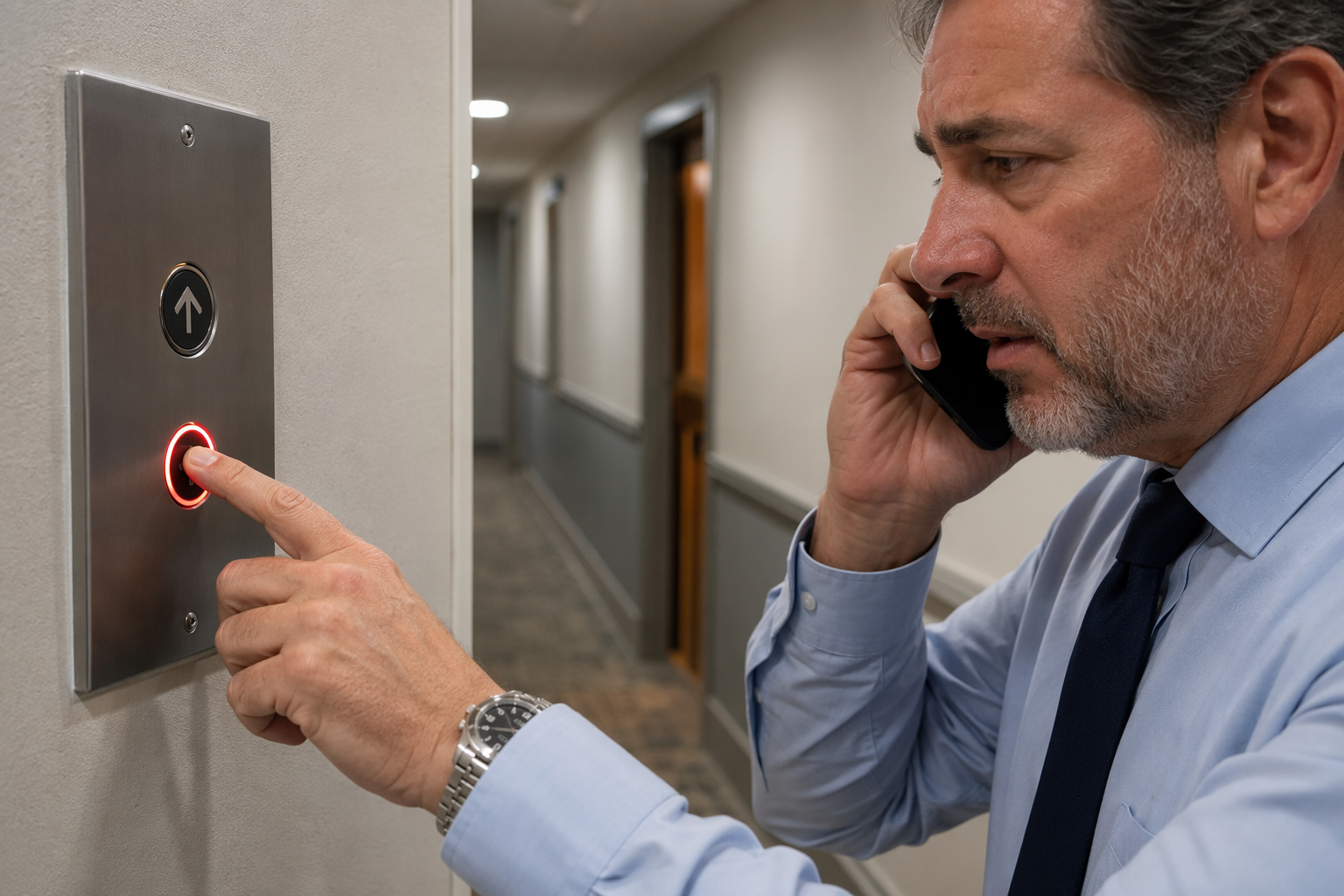
The moment an elevator stops functioning, your first priority is passenger safety — call emergency services if anyone is trapped, then contact your certified elevator service provider for immediate dispatch.
As someone who has responded to hundreds of breakdown calls across South and Central Florida, I can tell you the first five minutes matter most. If the elevator has stopped between floors with passengers inside, call 911 immediately. Do not attempt to force open the doors or instruct passengers to climb out — this violates ASME A17.1 Section 2.27.1 emergency protocols and creates serious fall and crush hazards.
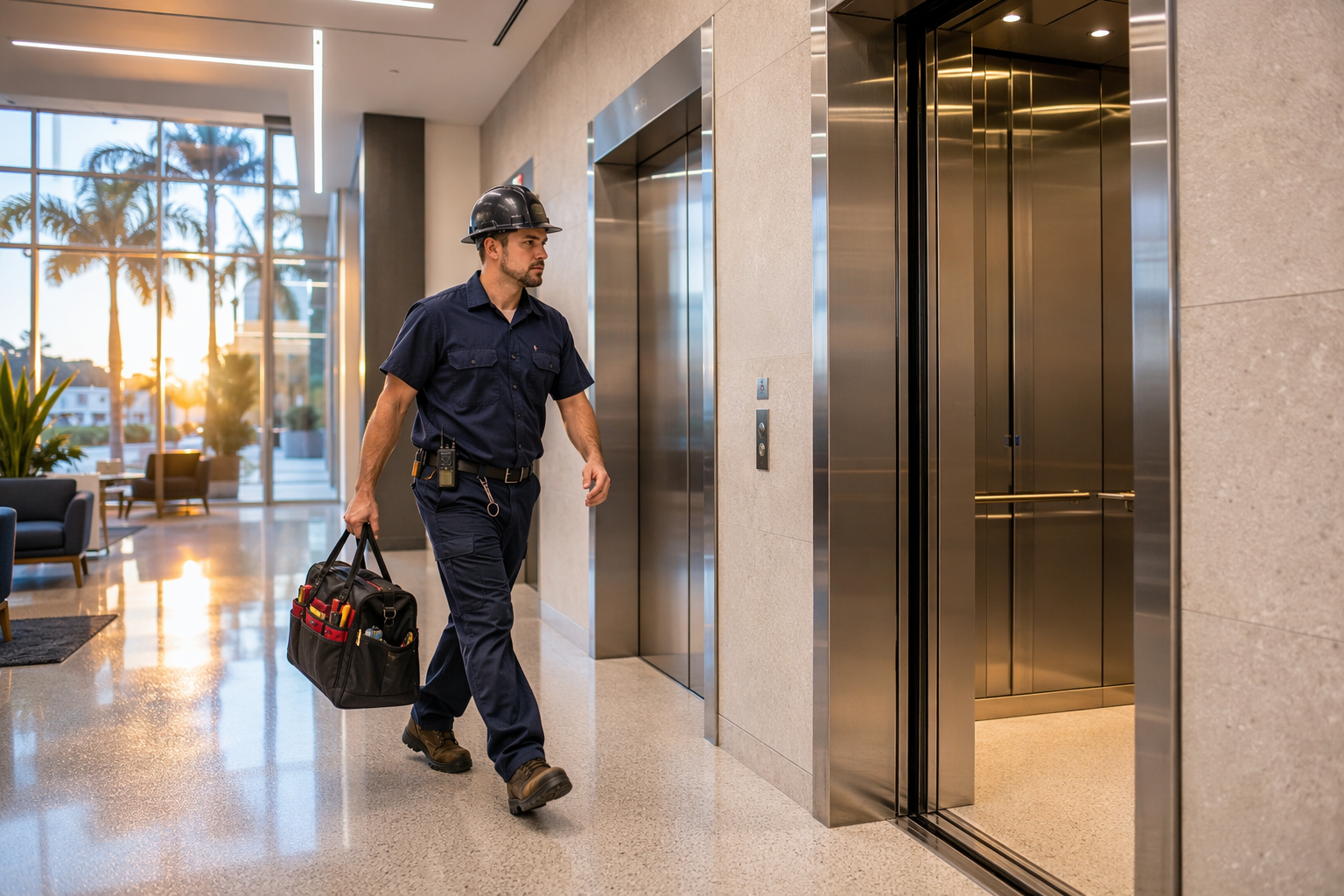
Once passenger safety is confirmed, place your elevator service contractor on notice. Under Florida Statute 399, building owners must have a licensed elevator contractor available for service. Axxiom Elevator Florida maintains 24/7 emergency dispatch for clients in Pompano Beach and Sarasota, with technicians typically on-site within 60–90 minutes depending on location and traffic conditions.
While waiting for the technician, post signage at all landing call buttons, log the exact time of failure, and note any unusual sounds, smells, or error codes visible on the controller panel. This documentation becomes part of your required maintenance log under Florida Administrative Code Rule 61C-5.
How quickly should a certified elevator technician respond to a breakdown?
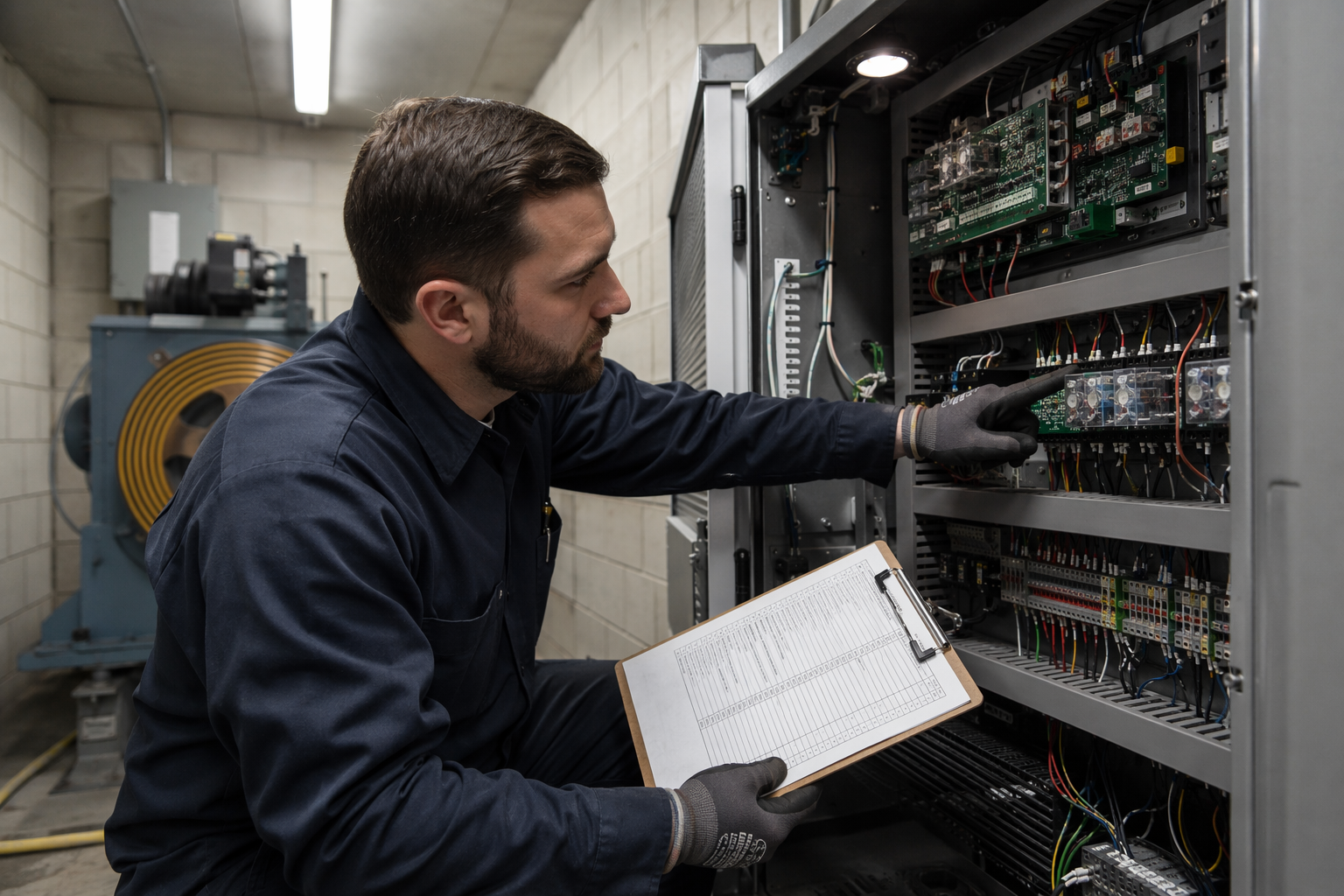
Industry best practice and most service-level agreements (SLAs) define emergency elevator response time as 2 hours or less for passenger entrapment and 4 hours or less for out-of-service units with no trapped passengers.
Response time benchmarks vary based on the nature of the breakdown. The table below outlines standard industry expectations versus what premium certified contractors like Axxiom Elevator Florida commit to in 2026:
| Breakdown Scenario | Industry Standard Response | Axxiom Elevator Florida Target | Regulatory Requirement (Florida) |
|---|---|---|---|
| Passenger entrapment | 60–120 minutes | Under 90 minutes | Immediate (911 + contractor) |
| Elevator stopped, no entrapment | 2–4 hours | 2–3 hours | Same business day |
| Intermittent malfunction | 4–8 hours | 4–6 hours | Within 48 hours |
| Scheduled preventive visit post-breakdown | 24–72 hours | 24–48 hours | Required before return to service |
| Major component failure (motor, controller) | 24–72 hours for parts | Same-day assessment, parts ordered immediately | Unit must remain out of service until repaired |
In Florida’s climate, heat can accelerate breakdowns — particularly in coastal markets like Pompano Beach where salt air corrodes electrical contacts, and in Sarasota where humidity affects hydraulic seals. Your service contractor’s proximity to your property directly affects response time, which is why using a locally based provider is strongly recommended.
Is it legal to operate an elevator after a breakdown without a technician inspection?
No — under Florida Statute 399.02 and ASME A17.1 Safety Code, an elevator that has experienced a failure must be inspected and cleared by a licensed elevator mechanic before it can legally return to passenger service.
This is one of the most commonly misunderstood points I encounter when responding to emergency calls. A building manager may reset the elevator and find it running normally, but returning it to service without a documented technician inspection exposes the building owner to significant liability. If a subsequent incident occurs — even an unrelated one — the lack of post-breakdown documentation can be used against the property owner in litigation.
Florida Administrative Code Rule 61C-5.001 requires that any elevator taken out of service due to a malfunction must have a written clearance from a licensed elevator contractor before resuming operation. This clearance must be retained in your on-site maintenance log, which state inspectors can request at any time.
What are the most common causes of elevator breakdowns in Florida?
The five most common causes of elevator breakdowns in Florida’s coastal and humid climate are power surges, hydraulic seal failure, door operator malfunctions, overheating of the machine room, and corrosion of electrical contacts.
After 15+ years working in South and Central Florida, I’ve identified regional patterns that differ significantly from northern states. Florida’s extreme humidity — averaging 74% annually — accelerates corrosion on relay contacts and printed circuit boards. Sarasota and Pompano Beach properties within 5 miles of the coast face additional salt air exposure that can shorten component lifespan by 20–30% compared to inland locations.
Power quality is another major factor. Florida experiences more lightning strikes per square mile than any other state, and voltage spikes routinely damage elevator controllers and variable frequency drives (VFDs). A properly installed surge protection system — required under ASME A17.1 Section 3.26 for new installations — can dramatically reduce breakdown frequency. Buildings without current surge protection should budget for this upgrade immediately.
What is the difference between an emergency elevator call and a standard service call?
An emergency elevator call involves immediate risk to passenger safety or complete loss of service in a building where elevator access is legally required, while a standard service call addresses operational issues that do not present immediate safety hazards.
Emergency calls trigger different billing structures, dispatching protocols, and documentation requirements. Most certified contractors — including Axxiom Elevator Florida — differentiate these in their service agreements. Emergency rates typically apply to calls received outside business hours (before 7:00 AM or after 5:00 PM on weekdays) and all weekend and holiday calls.
From a liability standpoint, emergency calls must be documented with precise timestamps: time of call received, time technician dispatched, time of on-site arrival, and time of resolution or escalation. This documentation protects building owners under Florida’s premises liability statutes and supports insurance claims when applicable.
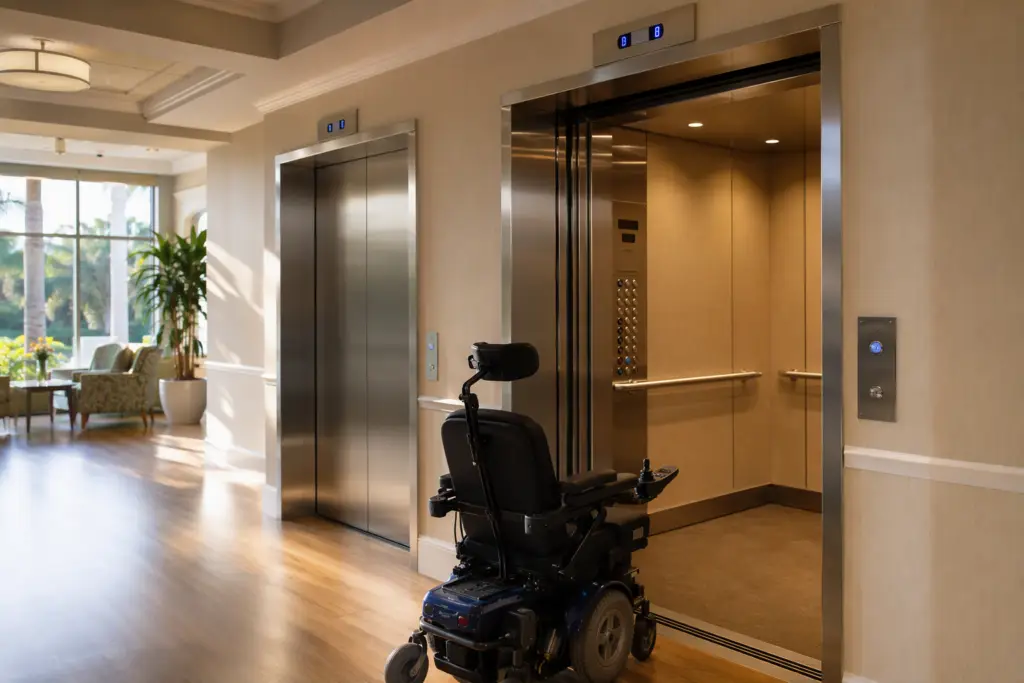
Does ADA compliance affect how quickly a building must restore elevator service?
Yes — under the Americans with Disabilities Act (ADA), buildings with elevators as the primary accessible route must take immediate corrective action when elevator service is interrupted, and prolonged outages may constitute an ADA violation.
The ADA Standards for Accessible Design (2010 ADA Standards, Section 206.2) require that when an elevator serving an accessible route is out of service, building owners must provide an equivalent facilitated service or restore the elevator promptly. “Promptly” has been interpreted in federal case law as same-day or next-day restoration for commercial buildings in most circumstances.
For medical facilities, senior living communities, and government buildings — all common property types in both Pompano Beach and Sarasota — ADA exposure is particularly significant. Facilities serving patients or residents with mobility impairments can face complaint investigations by the Department of Justice within days of a reported elevator outage. A proactive emergency maintenance contract substantially reduces this risk.
How much does emergency elevator repair cost in Florida?
Emergency elevator repair in Florida costs between $350 and $2,500 for common failures, with major component replacements such as controllers, motors, or hydraulic pumps ranging from $3,500 to $25,000 or more depending on the unit type and age.
Cost breakdown by repair category in 2026 (Florida market averages):
- Emergency after-hours diagnostic visit: $250–$450 (labor only)
- Door operator repair or replacement: $800–$2,200
- Variable frequency drive (VFD) replacement: $2,500–$6,000
- Hydraulic seal or pump repair: $1,500–$4,500
- Controller board replacement: $3,000–$12,000
- Complete motor replacement: $8,000–$25,000+
- Safety device testing and reset: $300–$700
Buildings on a full-coverage maintenance contract — which typically runs $250–$800 per month per unit depending on elevator type — often see emergency repair costs substantially reduced or fully covered. When evaluating your total cost of ownership, an unprotected emergency repair can easily exceed 12 months of proactive maintenance spending in a single incident.
What documentation is required after an elevator breakdown in Florida?
Florida law requires that all elevator breakdowns, repairs, and return-to-service clearances be documented in a written maintenance log kept on-site and available for inspection by the Florida Department of Business and Professional Regulation (DBPR).
Under Florida Administrative Code Rule 61C-5.001(3), maintenance records must include the date and nature of each malfunction, the name and license number of the responding technician, parts replaced with manufacturer information, and the date of return to service. These records must be retained for a minimum of 5 years.
In addition to the maintenance log, any breakdown resulting in a safety device activation — such as an overspeed governor trip, buffer contact, or safeties dropping — must be reported to the Florida DBPR elevator program. Failure to report these incidents can result in fines and suspension of the elevator’s operating permit.
What is a passenger entrapment rescue and who is authorized to perform it?
A passenger entrapment rescue is the controlled process of safely removing individuals from a stopped elevator car, and in Florida, only a licensed elevator mechanic or trained emergency responder under direct elevator technician guidance is authorized to perform this operation.
ASME A17.1 Section 2.27 defines the procedures for emergency access and egress, including the use of a door key (also called a hoistway access key) by authorized personnel only. Fire departments in Florida are generally trained in elevator rescue procedures, but they typically wait for a certified elevator technician to guide the rescue when safe to do so — particularly in cases where the car position is uncertain relative to floor landings.
If passengers are trapped more than 12 inches above or below a landing, the rescue becomes significantly more complex and may require specialized tools. Never attempt to open hoistway doors manually without confirmed power-off verification and proper training — this is a fatal hazard.
How does a full-coverage elevator maintenance contract protect you during breakdowns?
A full-coverage elevator maintenance contract transfers the financial risk of unexpected breakdowns to your service provider by including emergency labor, parts, and after-hours response in a fixed monthly fee.
There are three primary contract types in the elevator service industry, and understanding the difference is critical for building owners evaluating risk:
- Oil and Grease (O&G) Contract: Covers routine lubrication and adjustments only. All repairs and emergency calls billed separately. Lowest monthly cost, highest exposure.
- Examination and Lubrication (E&L) Contract: Adds periodic inspection labor but excludes parts. Emergency calls billed at standard or emergency rates.
- Full-Coverage (Comprehensive) Contract: Includes all labor, parts, emergency calls, and typically annual safety testing. Highest monthly cost, lowest total cost of ownership for buildings with heavy usage.
For high-traffic commercial properties in Pompano Beach and Sarasota — including retail centers, hospitality properties, and medical office buildings — a full-coverage contract from a provider like Axxiom Elevator Florida represents the most cost-effective and legally protective approach to elevator management.
What Florida state regulations govern elevator emergency response requirements?
Florida Statute Chapter 399 and Florida Administrative Code Rule 61C-5 govern elevator safety, maintenance, and emergency response requirements for all vertical transportation equipment in the state.
Key provisions relevant to breakdown response include:
- All elevators must be maintained under contract with a Florida-licensed elevator contractor (not just any mechanical contractor).
- Annual safety inspections are mandatory and must be performed by a Florida-licensed elevator inspector or certified third-party inspector approved by DBPR.
- Elevators must have a two-way communication system (per ASME A17.1 Section 2.27.1.1) that connects directly to a monitoring center or building staff capable of contacting emergency services.
- Any alteration to elevator equipment requires a permit and re-inspection before return to service.
- Operating an elevator with a known safety defect after notification exposes building owners to criminal liability under Florida Statute 399.09.
How do you choose the right emergency elevator service provider in Florida?
Choose an elevator service provider that holds a current Florida elevator contractor license, employs IUEC-certified mechanics, offers verifiable 24/7 emergency dispatch, and has documented experience with your specific elevator manufacturer and model.
When vetting a contractor, request the following before signing any service agreement:
- Florida DBPR elevator contractor license number (verify at myfloridalicense.com)
- Proof of general liability insurance (minimum $1 million per occurrence recommended)
- Average documented response time for emergency calls in your specific market
- Technician certifications — look for IUEC (International Union of Elevator Constructors) membership or equivalent
- Sample maintenance log and reporting documentation
- References from comparable properties in your area
Axxiom Elevator Florida serves building owners across Pompano Beach and Sarasota with fully licensed and IUEC-certified technicians, transparent service documentation, and competitive full-coverage contract pricing designed specifically for Florida’s climate and regulatory environment.
What safety devices prevent elevator breakdowns from becoming serious accidents?
Modern elevators are equipped with multiple redundant safety systems — including overspeed governors, safeties, buffers, and door interlocks — designed under ASME A17.1 to stop the car safely even when a primary component fails.
These safety devices do not prevent breakdowns, but they prevent breakdowns from becoming fatalities. Understanding them helps building owners appreciate why regular testing is non-negotiable:
- Overspeed Governor: Mechanically trips the safeties if the car descends faster than rated speed (typically 10–25% above rated speed).
- Car and Counterweight Safeties: Clamp onto the guide rails to stop the car in a controlled manner when the governor trips.
- Pit Buffers: Energy-absorbing devices at the bottom of the hoistway that cushion impact if the car overruns the lowest landing.
- Door Interlocks: Prevent the elevator from moving unless all hoistway doors are fully closed and locked.
- Brake System: Electromagnetic brake holds the car stationary when stopped; must release smoothly and hold under load.
Florida requires all these devices to be tested as part of the periodic Category 1 (annual) and Category 5 (5-year full load) tests per ASME A17.1 Section 8.6. Missing these tests is one of the fastest ways to lose your elevator’s operating permit in Florida.
Can an elevator breakdown void your building’s insurance coverage?
Yes — failure to maintain documented service records, operate under a licensed contractor agreement, or report required incidents can provide grounds for an insurance carrier to deny claims arising from elevator-related incidents.
Insurance underwriters for commercial properties increasingly review elevator maintenance documentation as part of claims investigations. In 2026, several major carriers have added elevator maintenance certification as a condition of coverage in their commercial property riders. If your building experiences an elevator accident and you cannot produce a current service contract, recent inspection records, and breakdown documentation, your claim exposure increases substantially.
This is particularly relevant in Florida, where premises liability law (Florida Statute 768.0755) places a clear duty of care on property owners to maintain facilities in a reasonably safe condition. An undocumented elevator breakdown that results in passenger injury is exactly the type of scenario this statute was written to address.
How do you prevent future elevator breakdowns after an emergency repair?
After an emergency repair, preventing recurrence requires a root cause analysis, a comprehensive preventive maintenance schedule, and addressing any deferred maintenance items identified during the breakdown inspection.
The single biggest mistake I see building owners make after an emergency repair is treating it as a one-time event rather than a signal. Breakdowns rarely happen without warning signs — they’re preceded by gradual component wear, ignored minor malfunctions, or deferred maintenance. After any emergency call, a qualified technician should conduct a full condition assessment within 48 hours, examining:
- Controller boards and relay contacts for signs of heat damage or arcing
- Door operator rollers, gibs, and cams for wear
- Hoist rope or hydraulic system for degradation
- Machine room temperature and ventilation adequacy
- Pit sump pump function (critical in Florida’s rainy season)
- All safety device function via manual test
A written deferred maintenance report from this assessment should become the basis of your next 12-month maintenance budget. Buildings that act on post-breakdown assessments consistently experience 40–60% fewer repeat emergencies in the following year, based on industry service data compiled through 2025–2026.
What is the two-way communication requirement for trapped passengers?
ASME A17.1 Section 2.27.1.1 and ADA Standards Section 407.4.9 both require elevators to have a two-way communication device inside the car that allows trapped passengers to summon emergency assistance without requiring a smartphone or hearing aid.
In Florida, the two-way communication system must connect to a location staffed 24 hours per day, 7 days per week, capable of dispatching emergency services. For smaller buildings without 24-hour staff, this typically means a monitored telephone system that routes to an elevator monitoring center or answering service with emergency escalation protocols.
This requirement is frequently violated in older buildings — particularly pre-1993 installations that predate the ADA Standards and ASME A17.1 2000 edition updates. During any emergency breakdown response, the technician should verify the two-way system is functioning. If it is not, the elevator should not be returned to service until communication is restored. Nonfunctional emergency communication is a Class II violation under Florida’s elevator safety rules.
How do hydraulic vs. traction elevators differ in breakdown response?
Hydraulic elevators and traction elevators fail differently and require different diagnostic approaches, with hydraulic units most commonly experiencing seal leaks and pump failures while traction units are more prone to rope, brake, and controller issues.
Understanding your elevator type helps you communicate more accurately with your technician when reporting a breakdown:
| Factor | Hydraulic Elevator | Traction Elevator |
|---|---|---|
| Common failure points | Hydraulic seals, pump motor, fluid contamination | Hoist ropes, brake, controller, VFD |
| Typical buildings | 2–6 story commercial, residential | Mid-rise to high-rise, hospitals |
| Environmental risk (Florida) | High — heat degrades hydraulic fluid | Moderate — humidity affects electrical |
| Entrapment risk position | Usually settles at or near floor level | Can stop between floors |
| Average parts lead time | 1–3 days for common parts | 1–5 days depending on manufacturer |
| Fluid/Environmental compliance | Must use biodegradable fluid in FL (Rule 61C-5) | N/A |
Florida’s climate makes hydraulic seal failure one of the leading causes of breakdown across Pompano Beach and Sarasota properties. Buildings with hydraulic elevators older than 15 years should budget for proactive seal replacement every 5–7 years to avoid emergency shutdowns.
What should building managers tell tenants when an elevator is out of service?
Building managers should immediately notify all tenants in writing, post signage at every floor, identify alternative accessible routes, and provide a realistic estimated time of restoration — all within the first 30 minutes of confirmed breakdown.
Tenant communication is both a practical and legal obligation. For residential buildings under Florida’s landlord-tenant law (Florida Statute 83.51), elevator service in a multi-story building is considered an essential service. Prolonged outages without a good-faith repair effort can expose landlords to rent withholding claims.
Recommended communication checklist:
- Post out-of-service notice at all elevator call buttons on every floor
- Send email or text notification to all tenants within 30 minutes
- Identify and communicate the nearest accessible stairwell with handrails
- For buildings with ADA-dependent tenants, arrange personal assistance or alternative accommodation
- Provide technician ETA and contact number for status updates
- Document all communications for your records
When should an elevator be replaced rather than repaired after a major breakdown?
Replacement should be seriously considered when repair costs exceed 50–60% of the elevator’s replacement value, when the unit has experienced three or more major breakdowns in a 12-month period, or when the equipment is beyond its useful service life of 20–25 years.
This is a conversation I have regularly with building owners who have been patching aging equipment for years. The math eventually tips in favor of modernization. Beyond cost, aging elevators face increasing difficulty with Florida code compliance — the 2019 ASME A17.1 edition (currently adopted in Florida) introduced updated requirements for machine room-less (MRL) systems, energy efficiency, and seismic considerations that older equipment often cannot meet through repair alone.
A full elevator modernization in Florida (2026 pricing) typically ranges from $35,000 to $120,000 depending on unit type, building height, and scope of work. Modern units not only reduce breakdown frequency dramatically but also deliver 15–25% energy savings that contribute to the return on investment over a 10-year horizon.
How can building owners in Pompano Beach and Sarasota get faster emergency response?
Building owners in Pompano Beach and Sarasota get the fastest emergency response by partnering with a locally based, Florida-licensed elevator contractor who has service vehicles and parts inventory staged within the market — not dispatched from a regional hub hours away.
National elevator companies often route emergency calls through regional dispatch centers that may be located outside Florida, resulting in response times of 4–6 hours or more. Locally based providers like Axxiom Elevator Florida maintain service infrastructure directly in the markets we serve, which means our technicians are closer to your property when your elevator goes down at 11 PM on a Sunday.
In addition to proximity, ask prospective contractors:
- Where your designated technician is physically based
- Whether the contractor maintains a local parts inventory for your elevator brand
- What the escalation protocol is if the primary technician is unavailable
- Whether the service agreement guarantees a maximum response time in writing
These questions separate genuinely local service providers from national contractors who list your market as a service area but dispatch from 100 miles away.
What should you expect during a post-breakdown inspection before returning an elevator to service?
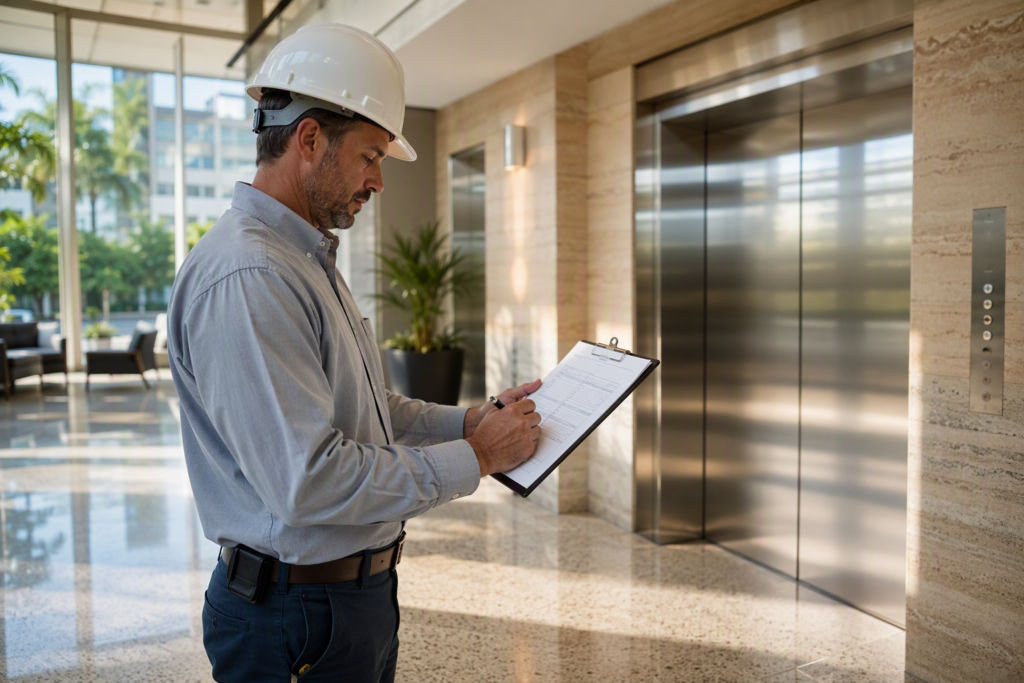
A proper post-breakdown inspection includes a review of all safety devices, controller diagnostics, door function testing, load test, and a written clearance document signed by the licensed elevator mechanic before the unit is restored to passenger service.
This inspection is not a formality — it is a legal requirement under Florida Administrative Code Rule 61C-5 and a critical safety procedure. The technician should perform the following minimum checks:
- Retrieve and review any fault codes from the elevator controller
- Manually test all door interlocks at each landing
- Verify governor and safety function (may require partial load test)
- Test the two-way communication system
- Run the car through all floors in both directions under normal and inspection mode
- Verify machine room temperature and ventilation
- Confirm all lighting in cab, pit, and machine room is functional
- Complete and sign the maintenance log entry with time, findings, and resolution
Only after all these steps are documented and signed should the out-of-service notice be removed and the elevator returned to passenger use. Any shortcut in this process creates liability exposure for the building owner.
Don’t Wait for a Breakdown to Find Out You’re Unprotected
Every building owner in Pompano Beach and Sarasota deserves a certified elevator partner who answers the phone at 2 AM, arrives within 90 minutes, and documents everything to keep you compliant with Florida Statute 399 and ASME A17.1.
Axxiom Elevator Florida offers 24/7 emergency dispatch, full-coverage maintenance contracts, and a free elevator condition assessment for new clients. Our IUEC-certified technicians are based in your market — not dispatched from a regional hub hours away.
📞 Contact Axxiom Elevator Florida for a free elevator assessment:
Serving Pompano Beach, FL and Sarasota, FL — Licensed Florida Elevator Contractor — Available 24/7/365