24 Hour Elevator Repair Service: Complete Guide for Building Owners in Florida
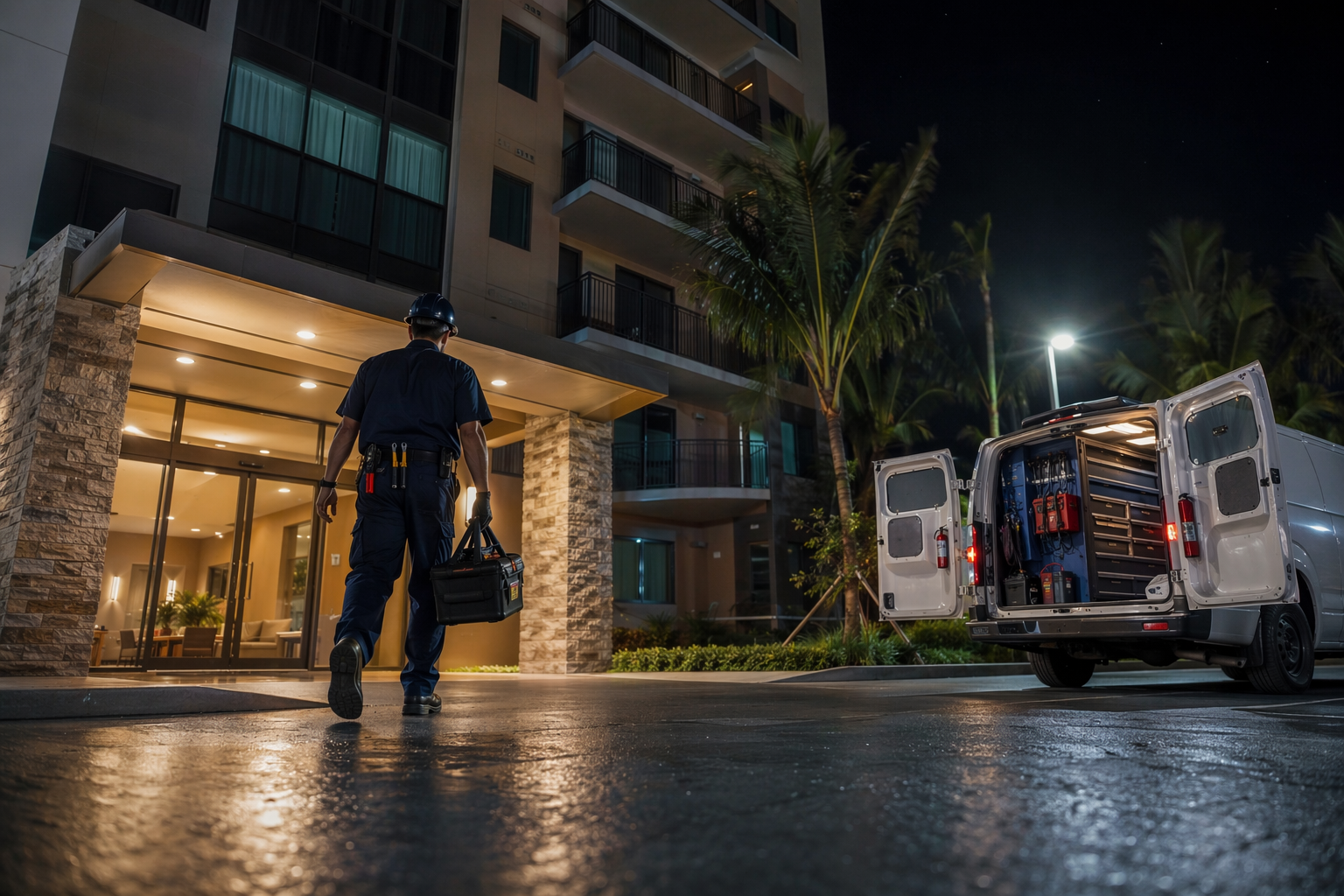
After 15 years working on elevators across Florida’s commercial corridors, I’ve seen what happens when a building has no emergency repair plan. A malfunctioning elevator at 2 a.m. in a Pompano Beach condominium isn’t just an inconvenience — it’s a liability, a potential ADA violation, and in some cases, a life-safety emergency. This guide answers every real question building owners, property managers, and facility directors ask about 24 hour elevator repair service, including costs, response times, Florida regulations, and how to choose the right provider.
What exactly is 24 hour elevator repair service and what does it cover?
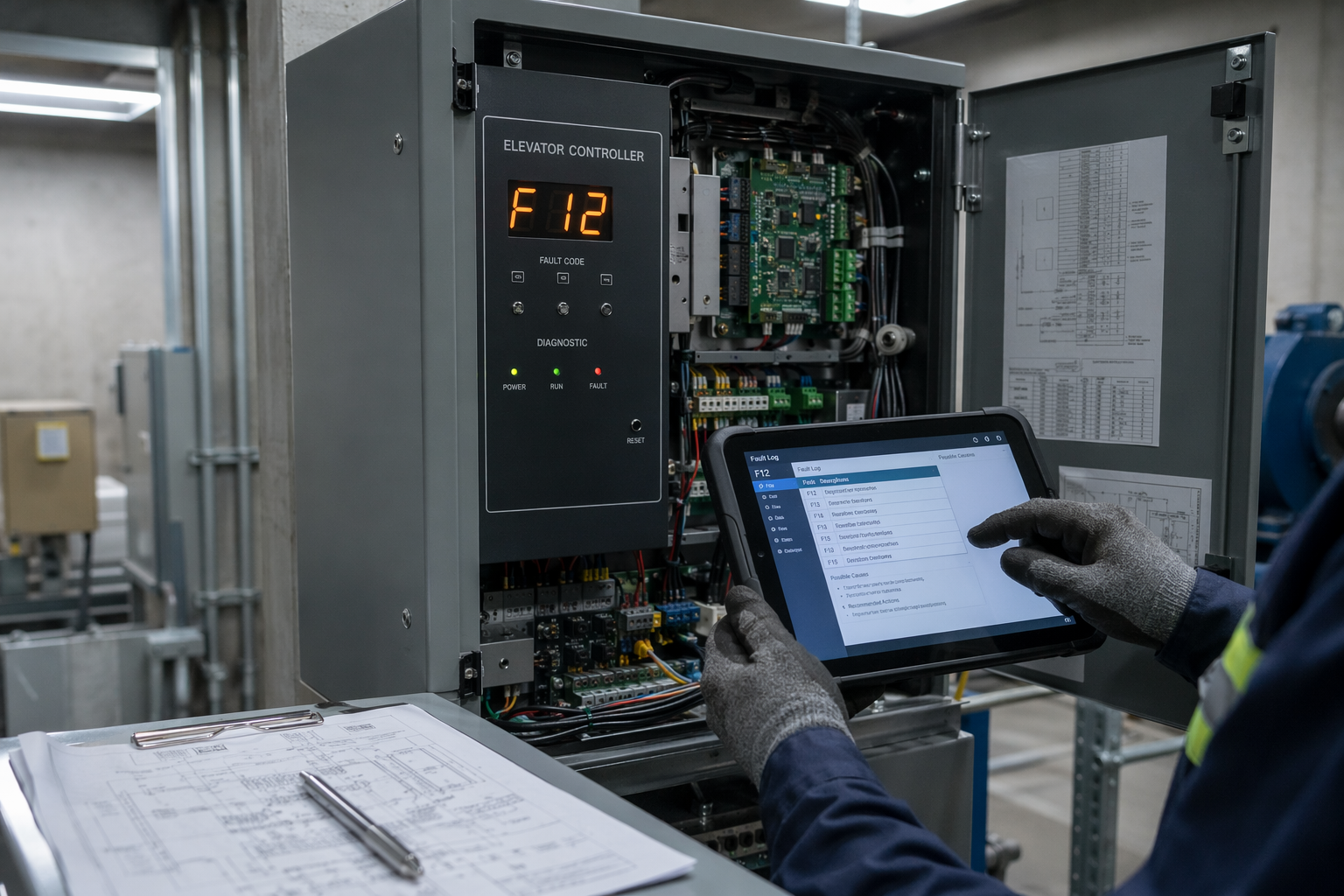
24 hour elevator repair service is a continuous, round-the-clock emergency response program where certified technicians are on-call to diagnose and fix elevator failures, entrapments, and safety-critical malfunctions at any hour.
Most building owners assume their standard maintenance contract covers emergencies. It often doesn’t — or it includes a very limited definition of “emergency.” True 24/7 service means a live dispatcher answers your call at 3 a.m. on a Sunday and dispatches a licensed technician to your building, not a voicemail box that routes to someone’s personal cell phone by 9 a.m. Monday.
Covered services under a proper 24 hour program typically include: passenger entrapment rescue, door operator failures, control board faults, motor and drive system failures, broken cables or safeties triggering a shutdown, and hydraulic fluid leaks. It does not typically include full replacement of major components — those are scheduled repairs quoted separately.
How quickly should a 24 hour elevator repair technician arrive after I call?
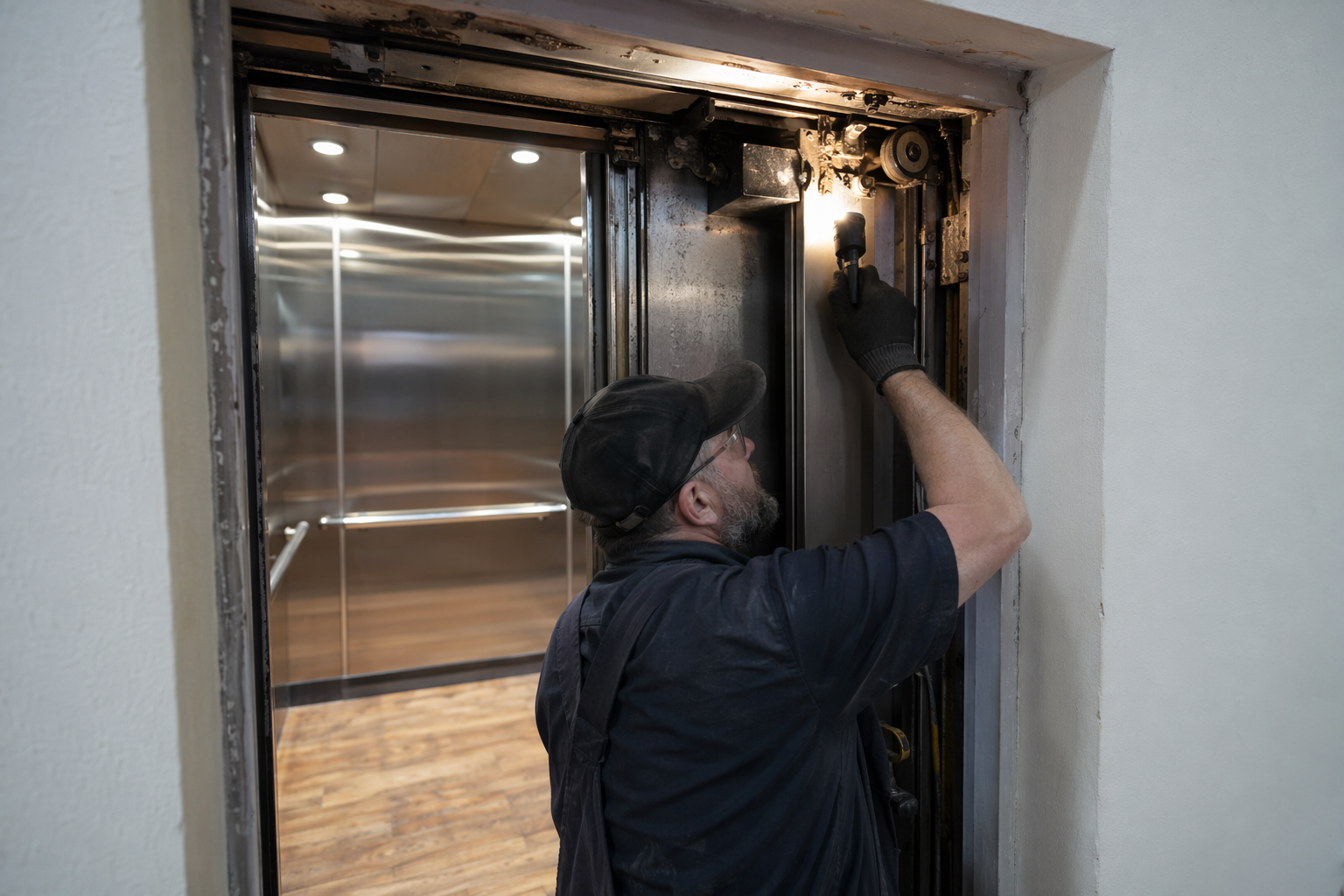
Industry best practice is a 2–4 hour response time for standard emergency calls and under 1 hour for confirmed passenger entrapments.
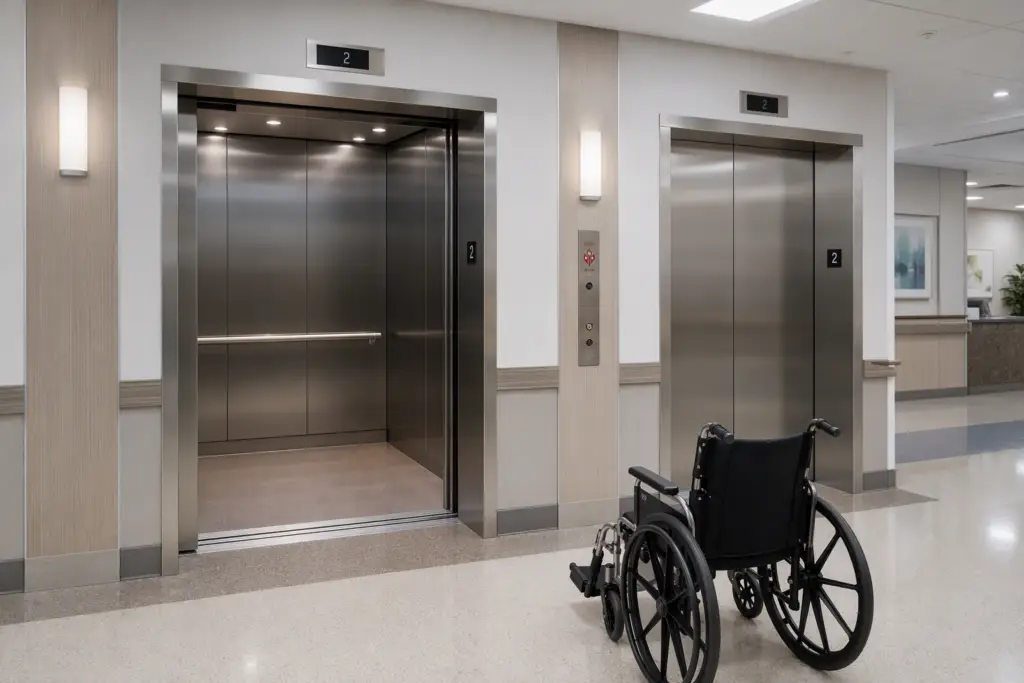
Florida does not codify a universal response time statute for commercial elevator emergencies, but the ADA and building accessibility standards create an implicit urgency: if your only accessible vertical transport is down and an individual with a disability cannot access their floor, you face immediate compliance exposure. In practice, providers serving dense urban markets like Pompano Beach can realistically commit to 2-hour windows; Sarasota’s more spread-out geography may push that to 3 hours depending on technician positioning.
When evaluating a service provider, always ask for a written response time guarantee in the contract — not just a verbal commitment. Axxiom Elevator Florida maintains a dedicated 24/7 dispatch team with technicians pre-positioned across Broward and Sarasota counties to meet these windows consistently.
What are the most common elevator failures that require emergency overnight repair?
The five most frequent after-hours emergency calls involve door malfunctions, control system faults, hydraulic failures, power-related shutdowns, and passenger entrapments.
Door issues account for approximately 50–60% of all elevator service calls industry-wide. Door operators, rollers, and safety edges degrade with use, and high-traffic buildings push doors through thousands of cycles daily. When a door fails to close properly, the elevator parks itself and refuses to move — a frustrating but actually safe condition that still requires a technician to restore service.
Hydraulic oil leaks are particularly common in Florida’s warm climate because heat accelerates seal degradation. A unit losing pressure overnight will bottom out in its pit and trigger alarms. Control board failures and VVVF (Variable Voltage Variable Frequency) drive faults are increasingly common on older units that haven’t been modernized, and these require technicians with current diagnostic equipment — not a generic electrician.
How much does 24 hour emergency elevator repair cost in Florida?
Emergency elevator repair in Florida typically costs between $250–$450 per hour for after-hours labor, with a minimum 2-hour call-out charge, plus parts — though buildings on a full-service maintenance contract often receive discounted or included emergency coverage.
| Service Type | Typical Cost Range | Notes |
|---|---|---|
| After-hours labor rate (per hour) | $250 – $450 | Minimum 2-hour charge typically applies |
| Standard call-out fee (no contract) | $300 – $600 | Covers dispatch + first hour |
| Passenger entrapment rescue | $350 – $700 | Priority dispatch, may include admin report |
| Door operator repair (parts + labor) | $400 – $1,200 | Depending on brand and availability |
| Control board replacement | $1,500 – $6,000+ | Wide range based on unit age/brand |
| Hydraulic fluid top-off + seal repair | $600 – $2,500 | Environmental disposal fees may apply |
| Full-service maintenance contract (monthly) | $150 – $600 per unit | Often includes 24/7 emergency at no extra charge |
The math is straightforward: a full-service maintenance contract that includes emergency coverage almost always costs less annually than paying time-and-materials rates for two or three emergency calls. For a Sarasota condo association managing three elevators, the contract route is nearly always the smarter financial decision.
Is 24 hour elevator repair service legally required in Florida?
Florida law does not explicitly mandate a 24/7 repair contract, but state statute and the Florida Building Code create legal obligations that effectively require it for occupied buildings.
Under Florida Statute Chapter 399, all elevators in public buildings must be maintained in safe operating condition and must have a current Certificate of Operation issued by the Florida Department of Business and Professional Regulation (DBPR). A prolonged outage without documented repair efforts can trigger compliance review. More critically, if someone is injured because a known malfunction was not addressed promptly, the liability exposure for the building owner is substantial.
The ASME A17.1 Safety Code for Elevators and Escalators — which Florida adopts by reference — requires that safety devices function at all times and that out-of-service equipment be restored to service promptly. While “promptly” is open to interpretation, courts and inspectors have consistently treated multi-day outages without active repair engagement as a compliance failure.
What should I do if someone gets trapped in my elevator after hours?
Call 911 immediately for any entrapment, then call your 24 hour elevator service provider — never attempt to manually open elevator doors or rescue passengers without a licensed technician present.
This is the scenario every property manager dreads. The correct sequence: call 911 first so fire rescue is en route (they have the tools and authority to perform a safe rescue if necessary), then simultaneously call your elevator service company’s emergency line. Keep communication open with the trapped passenger through the cab intercom — ASME A17.1 Section 2.27 requires a functioning two-way communication device in every elevator cab, and if yours doesn’t have one, that’s a separate code violation you need to address immediately.
Document everything: the time of the call, the name of the dispatcher, the estimated arrival time, and the technician’s name when they arrive. This documentation protects you legally and satisfies any subsequent DBPR inquiry. Axxiom Elevator Florida provides incident documentation support as part of its emergency response service.
What qualifications should a 24 hour emergency elevator technician have?
Emergency elevator technicians must hold an active Florida elevator mechanic license under Florida Statute 399.02 and ideally carry IUEC (International Union of Elevator Constructors) certification or equivalent NEIEP training credentials.
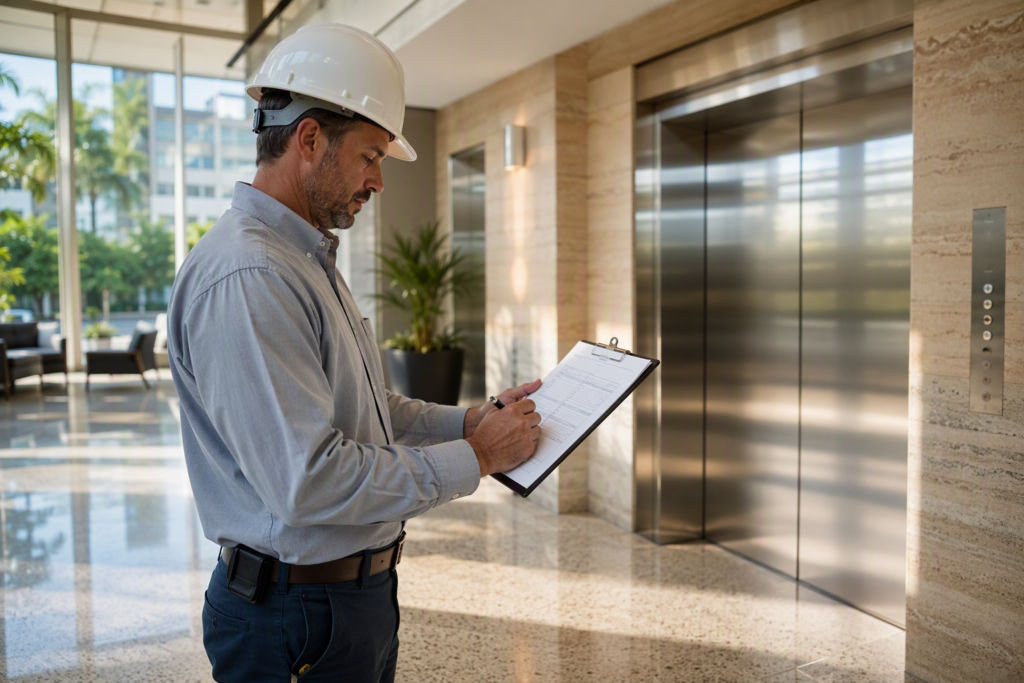
Florida is one of the more stringent states for elevator technician licensing. The DBPR requires written examination, proof of hands-on experience, and ongoing continuing education for license renewal. Do not accept service from an unlicensed individual — if they cause additional damage or injury, your liability exposure multiplies, and your Certificate of Operation can be voided.
Beyond the state license, ask whether the technician is factory-trained on your specific equipment brand. Otis, KONE, ThyssenKrupp, Schindler, and Mitsubishi all use proprietary control systems. A technician who services all brands but has never been factory-certified on your specific unit is operating on general knowledge, which may be adequate for simple faults but inadequate for complex diagnostic failures at 2 a.m.
How do I know if my current elevator service contract includes 24 hour emergency coverage?
Review the contract’s “Scope of Services” section specifically for language about “after-hours,” “emergency calls,” and whether there is an additional charge per call or if coverage is included in the monthly fee.
Many standard “oil and grease” or “examination only” contracts explicitly exclude emergency response — they cover periodic lubrication and inspection visits during business hours, nothing more. Full-service contracts should state: the hours during which emergency service is available (should be 24/7/365), the response time commitment, who bears the cost of parts, and whether labor during emergency calls is included or billed separately.
If your contract says “emergency service available at prevailing rates,” that means you’re paying time-and-materials every time you call. If it says “emergency service included,” make sure it defines what constitutes an emergency. Grey-area language like “reasonable emergency coverage” is a red flag. Request a contract amendment with specific response time language before signing or renewing.
How often do elevators in Florida require emergency repair compared to the national average?
Florida’s high humidity, heat, and coastal salt air accelerate component wear, making Florida elevators statistically more likely to require unscheduled service than the national average.
While precise statewide emergency call data is not publicly reported by DBPR, industry consensus among Florida-based elevator technicians is that hydraulic seals, door operators, and control board components degrade 15–25% faster in South Florida’s climate compared to temperate-climate states. Coastal markets like Pompano Beach compound this with salt air corrosion affecting exterior cab components, hoist cables, and pit equipment.
Buildings over 20 years old without a recent modernization are the highest-risk category. If your elevator was installed before 2005 and has not had the control system updated, you are statistically overdue for a significant failure event. Preventive maintenance under a full-service contract is the most effective way to reduce emergency call frequency — industry data suggests proper PM programs reduce emergency calls by 30–50% compared to inspection-only contracts.
What is the difference between emergency repair and preventive maintenance?
Preventive maintenance is scheduled, proactive servicing designed to prevent failures; emergency repair is reactive service responding to an already-failed component — and the cost difference between the two is typically 5:1 or greater per incident.
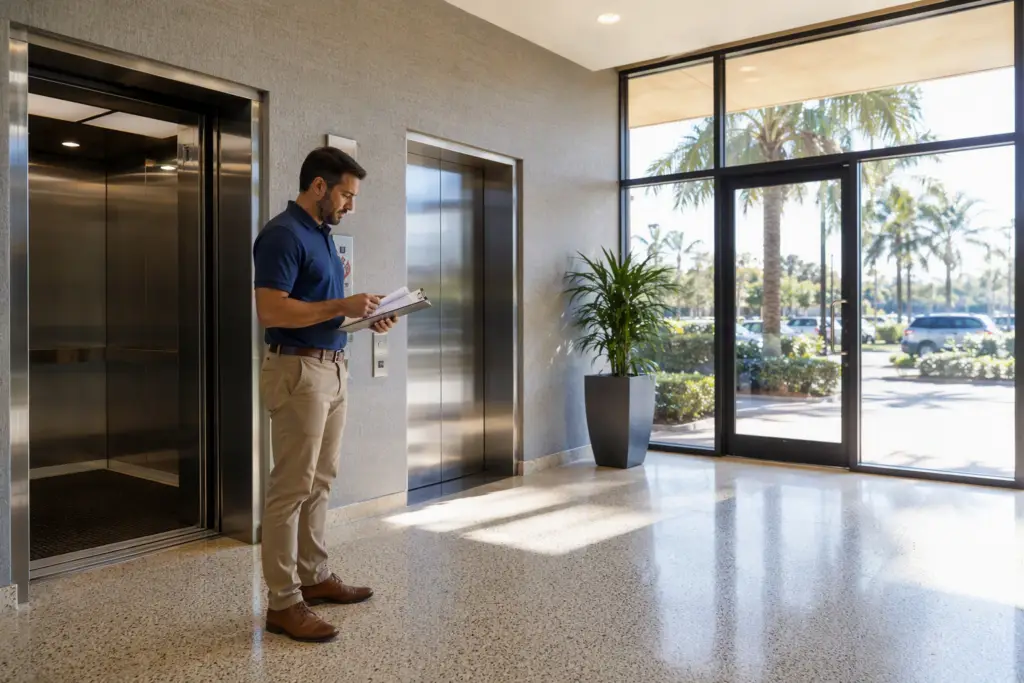
Preventive maintenance under ASME A17.1 guidelines includes regular lubrication of all moving components, adjustment of door operators and safety edges, inspection of cables and buffers, testing of all safety devices, and review of the elevator’s operating parameters. When done properly on a monthly or quarterly schedule, PM extends component life and catches emerging issues before they become 3 a.m. failures.
Emergency repair, by contrast, means a technician is responding under time pressure, possibly without the exact replacement part on the truck, and charging premium after-hours rates. The indirect costs — disrupted tenants, potential ADA exposure, possible DBPR reporting requirements — often dwarf the repair invoice itself. Every dollar spent on preventive maintenance typically offsets $4–$7 in emergency repair and downtime costs over a 5-year period.
What are the ADA implications of an elevator being out of service in my building?
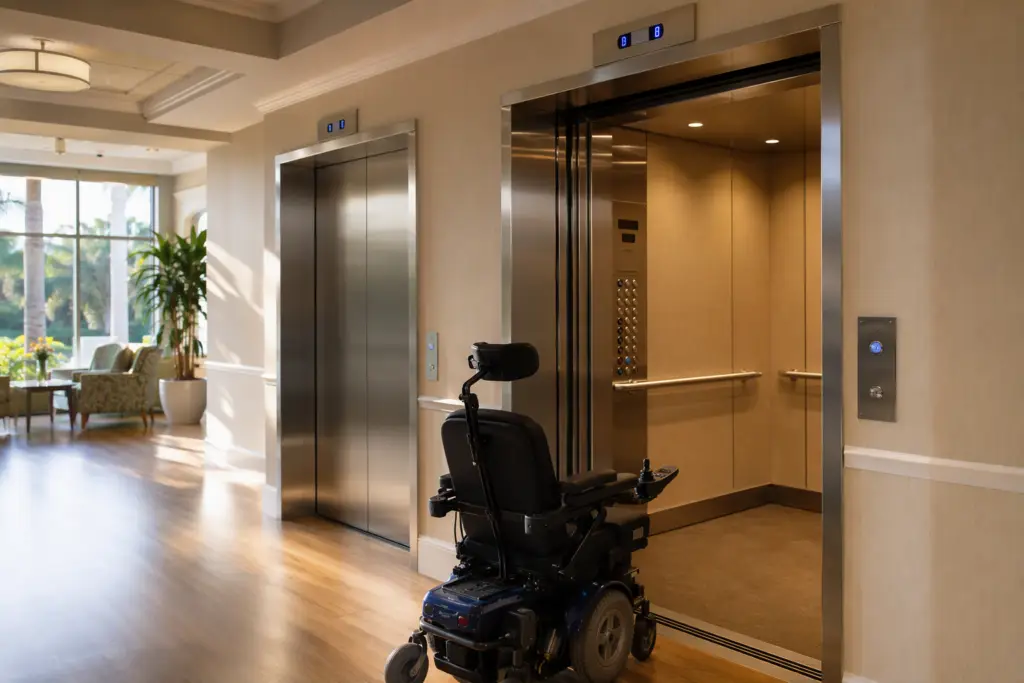
Under the ADA Standards for Accessible Design, a non-functioning elevator in a multi-story facility can constitute a denial of access to individuals with disabilities, creating legal liability for the building owner or operator.
The ADA requires that covered entities maintain accessible features in working order. Title III (public accommodations) and Title II (government facilities) both impose this obligation. While the ADA includes a carve-out for isolated or temporary failures, what constitutes “isolated” and “temporary” is determined after the fact, often in litigation. Courts have found violations where elevators were out of service for as few as 3–5 days without documented active repair efforts.
For buildings in Florida, this intersects with the Florida Civil Rights Act, which provides additional state-level protections. A residential building in Sarasota with elderly or mobility-impaired tenants faces particularly acute risk — the combination of federal ADA exposure, state civil rights liability, and potential DBPR action creates a compliance environment where rapid emergency response isn’t optional, it’s essential.
Can I perform temporary DIY fixes on an elevator while waiting for a technician?
No — Florida law and ASME A17.1 explicitly prohibit unauthorized persons from performing any work on elevator mechanical, electrical, or hydraulic systems, and doing so voids your Certificate of Operation and creates significant personal liability.
I understand the impulse. It’s 11 p.m., your elevator is parked at the top floor, and you think maybe you just need to reset a breaker. Here’s the reality: elevator circuits are not standard electrical circuits. Tampering with them without a license can re-engage a faulty safety that was protecting a passenger or the equipment itself. In hydraulic units, manually releasing a valve can drop a cab unexpectedly. These aren’t theoretical risks — they’re documented incidents in CPSC and ASME safety bulletins.
The only acceptable temporary action a non-licensed person should take is placing the elevator in “Out of Service” mode using the building’s lockout procedure (typically a key switch in the machine room that parks the car at the lobby and opens the doors). This prevents further use without creating additional hazard. Then call your 24 hour service provider and document the time.
What parts should a 24 hour emergency elevator service truck carry?
A well-equipped emergency service truck should carry door operator components, relay and logic board fuses, motor contactors, hydraulic fittings and fluid, safety edge sensors, phone system components, and brand-specific controller fuses for the most common elevator brands in the service area.
Parts availability is one of the most important — and least discussed — differentiators between elevator service providers. A technician who shows up at midnight but doesn’t have the $40 relay that’s blown means your elevator stays down until the next business day when the parts house opens. Ask prospective providers to detail what’s stocked on their emergency trucks and how they handle parts for older or less common units.
Proprietary systems present a real challenge in the emergency context. Some major OEM brands (Otis, KONE, Schindler) restrict parts sales to their own service networks, which is why many independent providers maintain relationships with alternative parts suppliers and maintain refurbished component inventory. Clarify this before signing a contract, not at 2 a.m. when you need the part now.
How does Florida’s inspection and permitting process affect emergency repairs?
In Florida, emergency repairs that involve replacing or modifying safety-critical components may require a permit from the local authority having jurisdiction (AHJ) and subsequent inspection before the elevator can be returned to full service.
Florida Statute Chapter 399 and its implementing rules under DBPR’s Division of Hotels and Restaurants (for most commercial elevators) set out clear requirements. Repairs classified as “alterations” under ASME A17.1 — defined as any change to the original design, material, or operational parameters — require a permit, engineered drawings in some cases, and a post-repair inspection. Emergency repairs that simply replace a like-for-like component (e.g., replacing a burned contactor with the same model) generally don’t require a permit but must be documented in the elevator’s maintenance log.
This matters for after-hours work because a technician who replaces components and returns the elevator to service without triggering the appropriate permitting process creates a compliance gap that may surface at your next annual inspection. Reputable providers like Axxiom Elevator Florida track regulatory requirements by jurisdiction, ensuring that emergency work is properly classified and reported from the moment the repair is completed.
What information should I have ready when I call a 24 hour elevator repair service?
Have your elevator’s unit number, Certificate of Operation number, brand and model, building address, floor the cab is stuck on (if applicable), and a description of the fault symptom ready when you call — this cuts dispatch and diagnostic time significantly.
The more specific information you can provide, the faster the technician can pre-select tools and parts before leaving the shop. “The elevator is broken” is useless. “The cab is parked on the 4th floor, doors are opening and closing but the unit won’t move, and the controller panel shows fault code E-14” gets a technician there with the right equipment to solve it on the first visit.
Also have your machine room access key ready. A surprising number of after-hours calls are extended because no one on-site can access the machine room to admit the technician. Identify who holds that key for every shift and every day of the week, and make sure your elevator service provider has 24/7 contact information for that person.
How do I compare 24 hour elevator service providers in South Florida and Sarasota?
Evaluate providers on five criteria: licensed technician availability (not subcontractors), documented response time guarantees, parts inventory depth, brand-specific training credentials, and transparent after-hours billing structure.
The South Florida elevator service market includes large national OEM service divisions, regional independents, and small operators. Each has trade-offs. National OEM providers (Otis, KONE, Schindler) have deep brand-specific expertise but may have limited technician coverage in certain counties after hours, and their contracts often lock you into high annual rate escalations. Small independents may offer lower cost but lack the parts inventory and multi-technician depth to guarantee response times consistently.
Regional specialists who serve defined markets with in-house technicians — not subcontractors — typically deliver the best combination of response speed, accountability, and cost. For buildings in Pompano Beach and Sarasota, working with a provider that is physically present in both markets, like Axxiom Elevator Florida, means you’re not waiting for a technician to drive from three counties away at 1 a.m.
What happens if my elevator fails during a hurricane or severe weather event in Florida?
Elevators should be parked at the lobby floor and taken out of service before a hurricane makes landfall; post-storm restoration requires a full safety inspection by a licensed technician before the unit can be returned to passenger service.
Florida’s hurricane season (June–November) creates a specific protocol layer for elevator operators. DBPR guidance and ASME A17.1 both address post-flood and post-storm inspection requirements. Specifically: if water intrusion reaches the pit, machine room, or cab, the elevator cannot be returned to service without a full inspection, cleaning, and testing of all electrical and mechanical components. Operating a flooded unit risks catastrophic failure and immediate Certificate of Operation revocation.
Plan ahead by adding your elevator service provider to your building’s hurricane preparedness protocol. Coordinate pre-storm shutdown procedures and establish priority post-storm response with your provider before hurricane season begins. A provider with pre-positioned technicians in both Pompano Beach and Sarasota can resume service faster after a storm than one with a single dispatch hub in Miami or Tampa.
How long does a typical 24 hour elevator emergency repair take to complete?
Most after-hours emergency repairs are resolved within 2–6 hours of technician arrival, though complex failures involving unavailable parts or permit-required alterations can extend the outage to 24–72 hours or longer.
Simple repairs — a tripped breaker, a safety edge sensor alignment, a blown fuse — can be resolved in under an hour once the technician is on-site. Door operator replacements typically take 2–4 hours. Control board swaps on common units, 3–5 hours. Major hydraulic work or cable-related repairs may require a full business day and coordinated inspection scheduling.
Communicate timelines honestly to your tenants. If the repair will extend beyond a few hours, activate your temporary accommodation plan: prop elevator lobbies open, post clear signage, and if mobility-impaired residents are affected, contact them directly and arrange alternative assistance. Document all communication — this demonstrates good-faith ADA compliance effort if a complaint is later filed.
What preventive steps can reduce my need for 24 hour emergency elevator repair?
The three highest-impact preventive measures are enrolling in a full-service monthly maintenance contract, scheduling a proactive modernization assessment for units older than 20 years, and installing remote elevator monitoring technology.
Remote monitoring deserves particular attention. Modern IoT-based elevator monitoring systems continuously track operational parameters — door cycle times, motor temperature, leveling accuracy, drive voltage — and flag anomalies before they become failures. Several providers now offer monitoring platforms that generate automated alerts when a component begins trending toward failure, enabling a scheduled repair rather than an emergency call. The cost is typically $50–$150/month per unit and pays for itself with the first prevented emergency call.
Equally important is choosing a maintenance contract that specifies minimum visit frequency. ASME A17.1 doesn’t mandate a specific PM visit frequency, but industry best practice for high-use residential and commercial elevators is monthly visits. Quarterly-only PM schedules are insufficient for buildings with more than 50 daily elevator trips per unit. If your current contract provides quarterly visits, you are likely underserving your equipment and increasing your emergency call probability.
Why should I choose Axxiom Elevator Florida for 24 hour emergency elevator service?
Axxiom Elevator Florida is a DBPR-certified elevator service company with dedicated 24/7 emergency dispatch, in-house licensed technicians serving Pompano Beach and Sarasota, and a transparent full-service contract structure that eliminates surprise after-hours billing.
After 15 years in this industry, I’ve seen what separates reliable emergency service from the providers who put you on hold at midnight. Axxiom Elevator Florida was built specifically to close the gap that property managers in South Florida and the Gulf Coast keep experiencing: response time commitments that are actually met, technicians who are employees (not subcontractors), and contract language that means what it says. Whether you’re managing a high-rise condominium in Pompano Beach or a mixed-use retail complex in Sarasota, the logistical reality of after-hours coverage in Florida requires a provider with genuine local presence — not a national call center routing your emergency to whoever is available.
Every Axxiom technician carries brand-specific training certifications, maintains a stocked emergency parts inventory, and operates under the full licensing requirements of Florida Statute Chapter 399. Our contracts include written response time guarantees, incident documentation support, and annual compliance review aligned with DBPR inspection schedules.
Ready for Reliable 24 Hour Elevator Coverage in Pompano Beach or Sarasota?
Don’t wait for a 3 a.m. entrapment call to find out your current provider’s emergency coverage has gaps. Contact Axxiom Elevator Florida today for a free elevator assessment — we’ll review your current maintenance contract, inspect your unit’s condition, and provide a no-obligation proposal for full-service coverage including 24/7 emergency response.
Serving: Pompano Beach, FL and Sarasota, FL
Call us anytime — 24 hours a day, 7 days a week:
Florida DBPR Certified • IUEC-Affiliated Technicians • ASME A17.1 Compliant Service • ADA Compliance Support
Need elevator service you can rely on? Axxiom Elevator Florida is ready to help.