Who Is the AHJ for Elevators in Maryland?
In Maryland, elevator safety oversight falls under a single statewide authority — a structure that differs significantly from states like Florida, where local jurisdictions play a larger role. Whether you manage a commercial high-rise in Baltimore, a residential building in Annapolis, or a healthcare facility in Bethesda, understanding who governs your elevator program can mean the difference between full compliance and costly shutdowns. Below, I’ve answered the 20 most critical questions elevator owners, property managers, and compliance officers ask about Maryland’s elevator AHJ structure, inspection requirements, and enforcement procedures.
Who Is the Authority Having Jurisdiction (AHJ) for Elevators in Maryland?
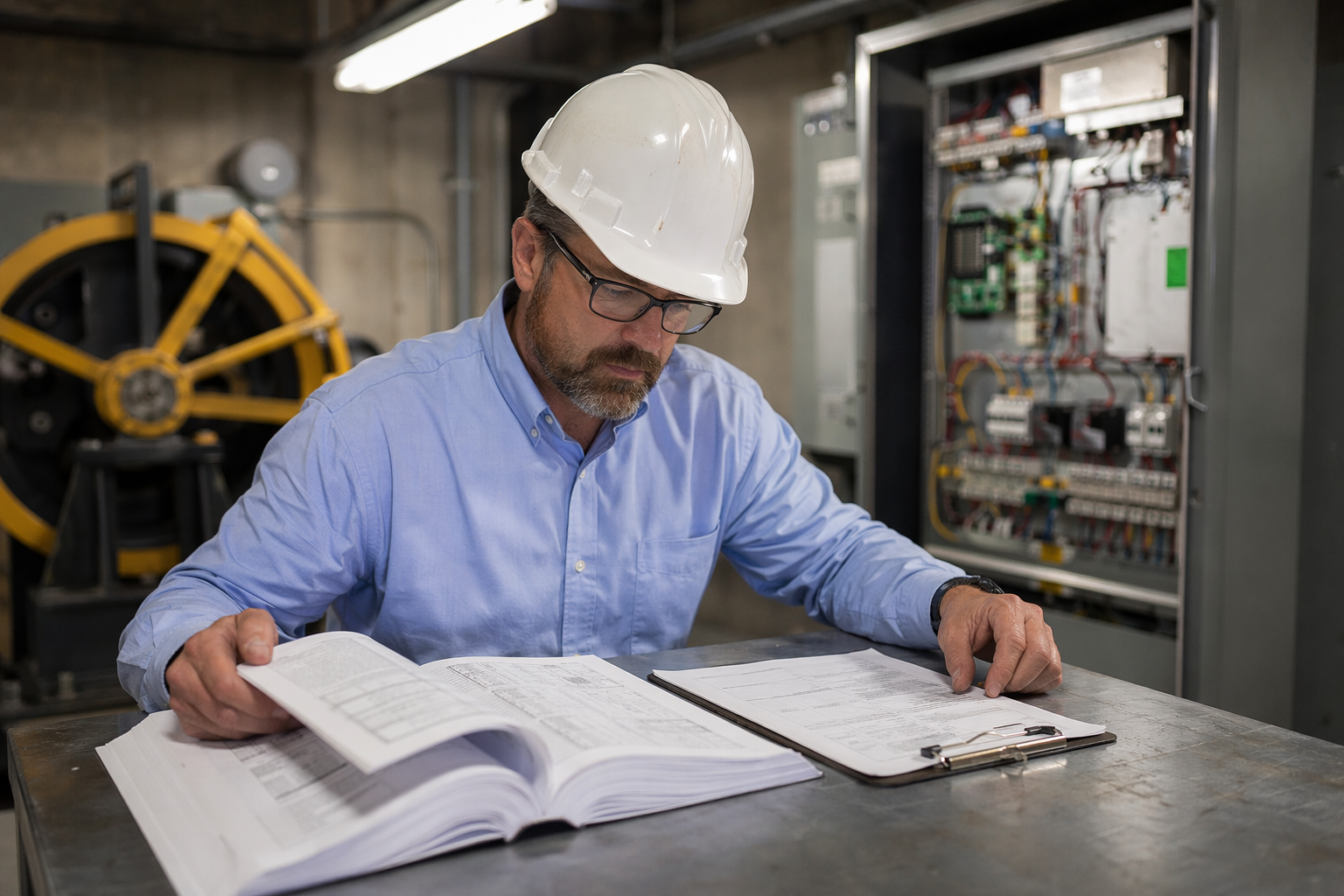
The AHJ for elevators in Maryland is the Maryland Department of Labor, Elevator Safety Program, a division of the Division of Labor and Industry.
This program has exclusive statewide authority to regulate the installation, alteration, inspection, and maintenance of elevators, escalators, and related conveyances. Unlike some states where authority is fragmented between county governments or city building departments, Maryland centralizes this responsibility at the state level. The Elevator Safety Program operates under Maryland Code, Labor and Employment Article, Title 8, Subtitle 5, and enforces ASME A17.1/CSA B44, Safety Code for Elevators and Escalators.
As of 2026, the program oversees more than 25,000 conveyances across the state, including elevators, escalators, dumbwaiters, moving walks, and platform lifts. All certificates of operation, inspector licenses, and contractor registrations flow through this single authority, creating a streamlined but strictly enforced compliance environment.
What Specific Laws and Codes Does Maryland’s Elevator AHJ Enforce?

Maryland’s Elevator Safety Program enforces the ASME A17.1/CSA B44 Safety Code, Maryland Code Labor and Employment Article §8-501 through §8-518, and applicable ADA Title III requirements for accessibility.
The primary technical standard is ASME A17.1, which Maryland has adopted by reference. The state updates its adopted edition periodically; as of 2026, Maryland references a recent edition of ASME A17.1/CSA B44. Contractors and building owners should confirm with the Maryland Department of Labor which specific edition is currently in force for new installations versus existing equipment.
Additionally, ADA Title III requirements apply to public accommodations and commercial facilities, mandating accessible elevator dimensions, door timing, and control panel heights. While ADA enforcement is a federal matter under the Department of Justice, Maryland’s AHJ inspectors will flag obvious accessibility deficiencies during routine inspections as advisory findings.
Does Maryland Require a Certificate of Operation for Every Elevator?
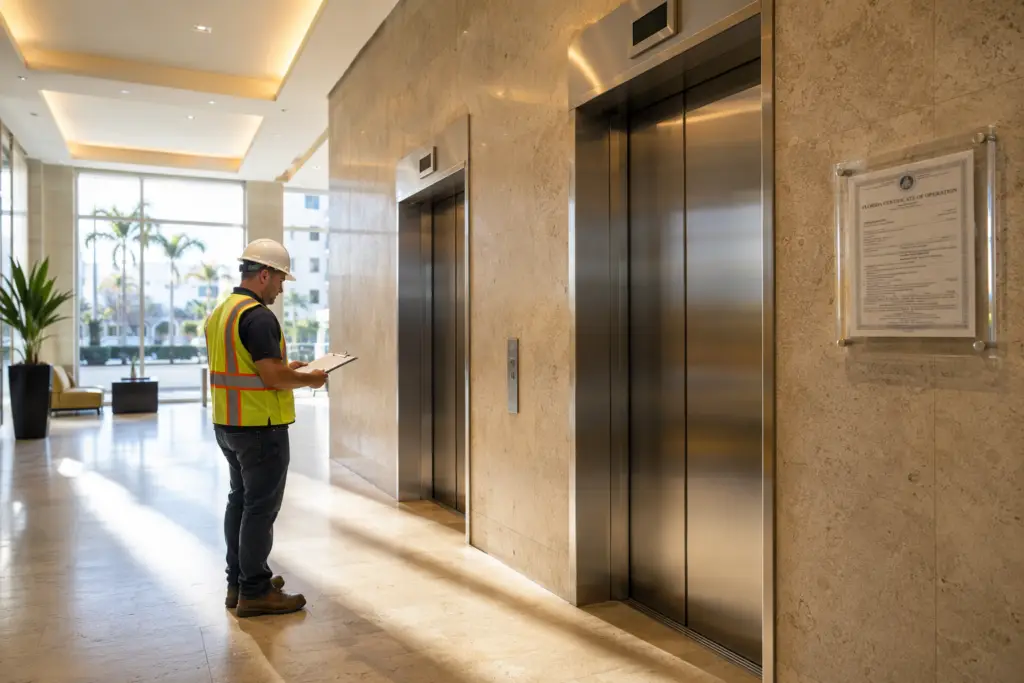
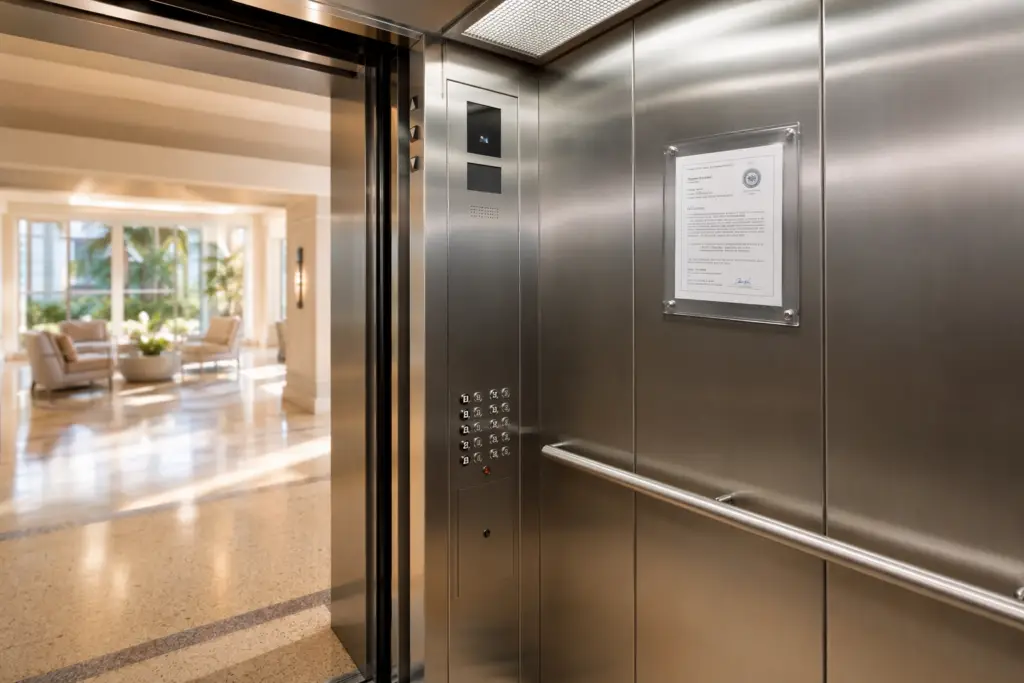
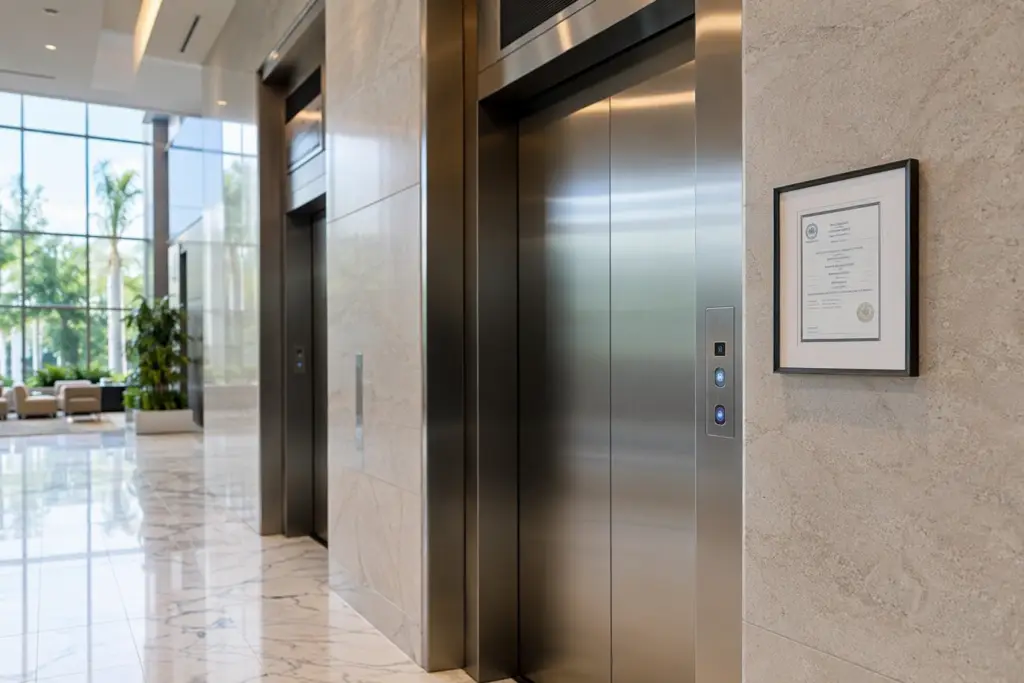
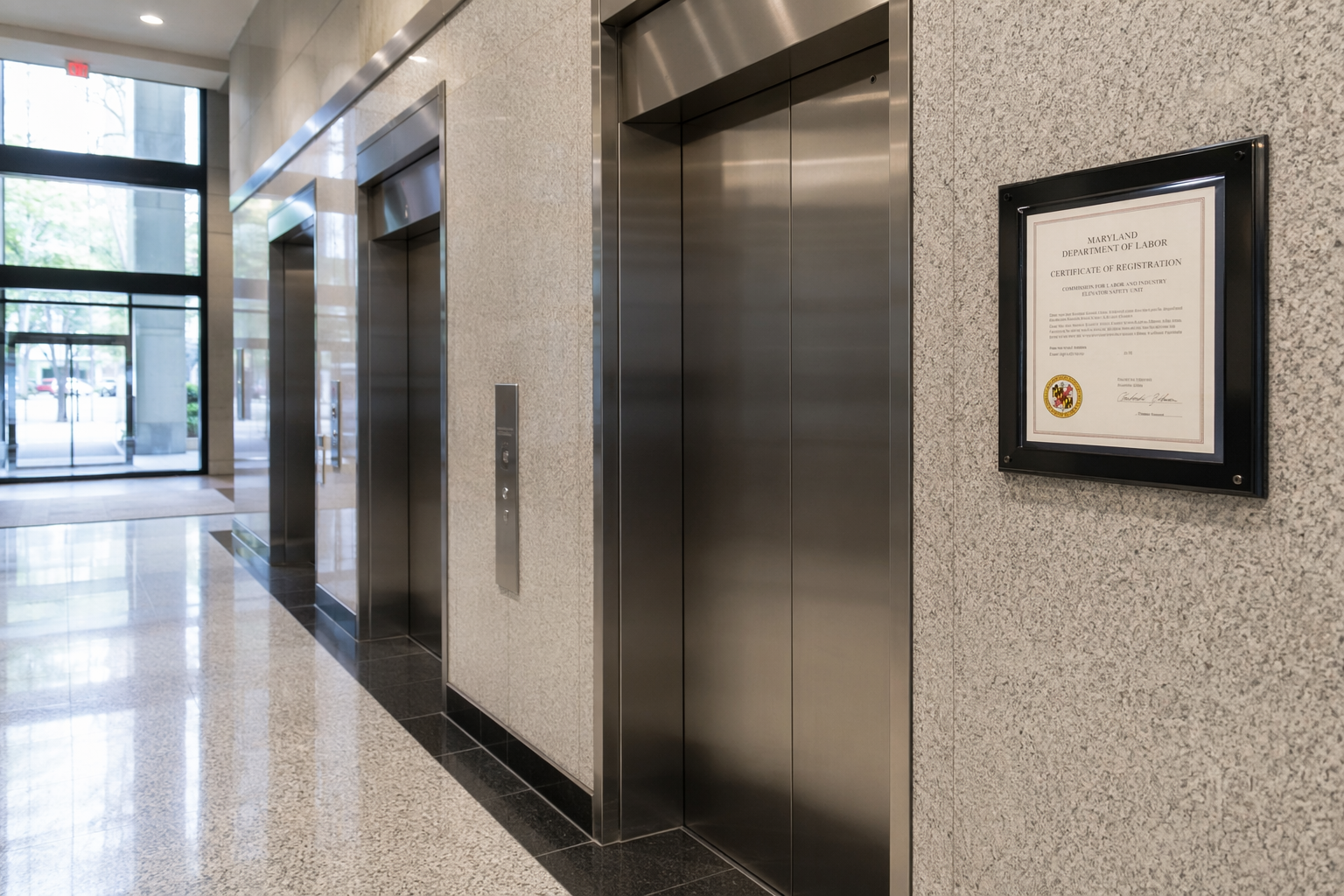
Yes — every elevator in Maryland must hold a valid Certificate of Operation issued by the Maryland Department of Labor’s Elevator Safety Program, and the certificate must be posted inside the elevator at all times.
Certificates are issued after a satisfactory periodic inspection and test. Operating an elevator without a current certificate is a violation that can result in immediate shutdown orders and civil penalties. The certificate specifies the rated load capacity, speed, and the expiration date of the current permit period.
Building owners are responsible for ensuring their certificates remain current. If your inspection is overdue, the AHJ has the authority to issue a Cease Operation order — meaning your elevator is legally locked out of service until compliance is restored. In my 15-plus years in the industry, I’ve seen property managers overlook renewal dates only to face emergency re-inspection fees and tenant complaints that far exceed the cost of proactive maintenance.
How Often Are Elevators Inspected in Maryland?
In Maryland, most traction and hydraulic elevators are required to undergo a full periodic inspection and a Category 1 test annually, with a Category 5 full-load safety test required every 5 years.
The inspection frequency aligns with ASME A17.1 requirements. Here is a quick reference table for Maryland elevator inspection and testing cycles:
| Test / Inspection Type | Frequency | ASME A17.1 Reference | Who Performs |
|---|---|---|---|
| Periodic Inspection (Category 1) | Annually | Rule 8.6.1.1 | State-licensed inspector |
| Governor and Safety Test (Category 1) | Annually | Rule 8.6.1.2 | Licensed elevator mechanic |
| Pressure Relief / Hydraulic Test (Category 1) | Annually | Rule 8.6.2.1 | Licensed elevator mechanic |
| Full-Load Safety Test (Category 5) | Every 5 years | Rule 8.6.1.5 | Licensed elevator mechanic + inspector witness |
| Seismic Inspection (where applicable) | Per local risk zone | Rule 8.4.10 | State-licensed inspector |
| Escalator Periodic Inspection | Annually | Rule 8.6.4.1 | State-licensed inspector |
These cycles are non-negotiable. Missing a Category 5 test window, in particular, can trigger an immediate removal from service order from the AHJ. Planning ahead with a qualified service provider is the most cost-effective strategy.
Who Can Perform Elevator Inspections in Maryland?
Elevator inspections in Maryland must be performed by individuals licensed by the Maryland Department of Labor as Qualified Elevator Inspectors (QEI), or by state-employed inspectors within the Elevator Safety Program.
Maryland allows third-party inspection by private QEI-certified inspectors, but those inspectors must be licensed by the state. QEI certification is issued by the ASME/ANSI QEI program. The inspector submits the inspection report directly to the Maryland Department of Labor, which then issues or renews the Certificate of Operation.
Importantly, the elevator contractor and the inspector cannot be the same entity for periodic inspections — Maryland enforces this separation of duties to maintain objectivity. Maintenance companies perform the required tests, and a separate licensed QEI witnesses and signs off on results.
Who Can Legally Install or Repair Elevators in Maryland?
Only contractors registered with the Maryland Department of Labor’s Elevator Safety Program and employing IUEC (International Union of Elevator Constructors) or otherwise licensed elevator mechanics may install, alter, maintain, or repair elevators in Maryland.
Contractor registration requires proof of liability insurance, workers’ compensation coverage, and certification of qualified personnel. Unlicensed work is a Class A violation under Maryland Labor and Employment Article §8-515 and can result in stop-work orders, fines up to $10,000 per violation, and personal liability for the property owner who knowingly permitted unlicensed work.
How Does Maryland’s AHJ Structure Compare to Florida’s Elevator Authority?
Maryland uses a single statewide AHJ model, while Florida distributes elevator authority between the state (Florida Department of Business and Professional Regulation) and local jurisdictions, creating a more fragmented but locally responsive system.
This distinction matters greatly for multi-state property portfolios. In Florida — where Axxiom Elevator Florida holds active licenses and serves markets including Pompano Beach and Sarasota — building owners work with both state licensing bodies and county or municipal authorities. In Maryland, there is one authority and one set of rules statewide. For property managers moving assets between states, understanding this structural difference prevents compliance gaps.
| Factor | Maryland | Florida |
|---|---|---|
| AHJ Type | Single statewide authority | State + local jurisdictions |
| Governing Agency | MD Dept. of Labor, Elevator Safety Program | FL DBPR + local building departments |
| Inspection Frequency | Annual + 5-year Category 5 | Annual (varies by jurisdiction) |
| Code Adopted | ASME A17.1/CSA B44 | ASME A17.1/CSA B44 |
| Permit Required for Alterations | Yes — state-issued | Yes — state and/or local |
| Certificate Posted in Cab Required | Yes | Yes |
What Permits Are Required for Elevator Installation in Maryland?
Before any new elevator installation or major alteration begins in Maryland, a construction permit must be obtained from the Maryland Department of Labor’s Elevator Safety Program.
The permit application must include detailed construction drawings, equipment specifications, and proof of contractor registration. The AHJ reviews the submission for ASME A17.1 compliance before issuance. In 2026, permit review timelines average 4–8 weeks for standard applications, though complex or high-rise projects may take longer. Rush reviews are not available, so project managers should factor permit lead times into construction schedules from day one.
After construction is complete, an acceptance inspection and witnessing of acceptance tests must be performed before a Certificate of Operation is issued and the elevator enters service. Skipping this step — even temporarily — is a violation that voids insurance coverage in most commercial policies.
What Happens If an Elevator Fails a Maryland AHJ Inspection?
If an elevator fails a Maryland AHJ inspection, the inspector issues a violation notice requiring corrective action within a specified timeframe, and the elevator may be immediately removed from service if the deficiency poses an imminent safety hazard.
Minor violations — such as missing inspection certificates, lighting deficiencies, or door re-opening device issues — typically allow 30 to 90 days for correction before a follow-up inspection. Critical violations involving safeties, buffers, ropes, or hydraulic systems may trigger immediate cease-and-desist orders with no grace period. The building owner pays for all re-inspection fees, which in 2026 range from $150 to $400 per follow-up visit depending on elevator type and test category.
From experience, I’ve consistently seen that buildings on proactive maintenance contracts — rather than reactive repair models — fail re-inspections at a rate roughly 70% lower than buildings without regular service agreements. Preventive maintenance is not an expense; it is risk insurance.
What Are the Penalties for Non-Compliance with Maryland’s Elevator AHJ?
Maryland’s Elevator Safety Program can impose civil penalties up to $10,000 per violation per day, issue Cease Operation orders, suspend contractor registrations, and refer criminal cases to the state Attorney General for willful violations.
The penalty structure under Maryland Code Labor and Employment Article §8-515 is tiered:
- First offense (minor): Written notice, corrective order, no fine
- Repeat or serious violation: $1,000–$5,000 per violation
- Willful or imminent danger violation: Up to $10,000 per violation per day
- Operating without a valid certificate: Immediate stop order + minimum $2,500 fine
Building owners are personally liable even when a third-party management company operates the property. Contractual indemnification clauses with property managers do not shield owners from AHJ enforcement actions.
Does the Maryland AHJ Regulate Residential Elevators?
Maryland’s Elevator Safety Program regulates residential elevators in buildings with three or more units; single-family home private residential elevators may be exempt from periodic inspection requirements, though installation still requires a permit and acceptance inspection.
This is a common source of confusion for condo associations and small apartment owners. A two-unit townhome elevator used exclusively by the private residents may not require periodic AHJ inspections after acceptance, but a three-unit or larger residential building falls under full program jurisdiction. When in doubt, contact the Maryland Department of Labor directly — the cost of a clarifying phone call is far less than the cost of an unannounced inspection finding a years-long compliance gap.
What Is the Maryland AHJ’s Process for Emergency Elevator Shutdowns?
Maryland AHJ inspectors have authority to issue immediate Cease Operation orders for any elevator presenting an imminent danger to life or safety, requiring the unit to be physically locked out of service until repairs are completed and verified.
Emergency shutdowns can be triggered by a range of conditions: broken governor ropes, hydraulic fluid leaks at dangerous levels, door operator failures causing entrapment risk, or safety circuit overrides that have been bypassed. The building owner must notify the AHJ in writing when repairs are complete and then schedule a re-inspection before the elevator returns to service. In high-occupancy buildings, a single elevator shutdown can trigger ADA accessibility complaints if no equivalent alternative access exists — adding a federal compliance layer on top of the state enforcement action.
How Do I Contact the Maryland Elevator Safety Program AHJ?
The Maryland Department of Labor’s Elevator Safety Program can be reached by phone at 410-767-2999, by email through their official contact portal, or by visiting their office at 10 N. Calvert Street, Baltimore, MD 21202.
Their online portal at labor.maryland.gov allows contractors and building owners to submit permit applications, check certificate status, schedule inspections, and access the full current code references. I strongly recommend every building owner bookmark this page and set calendar reminders 90 days before their Certificate of Operation expiration date.
What Is the Difference Between the AHJ and a Third-Party Elevator Inspector in Maryland?
The AHJ is the governmental authority — the Maryland Department of Labor — with power to issue, suspend, or revoke certificates, while a third-party inspector is a private QEI-licensed professional who performs the physical inspection and reports findings to the AHJ.
Think of the AHJ as the regulatory body and the third-party inspector as its authorized field agent. The AHJ retains final decision-making authority on all certificates and enforcement actions. Third-party inspectors cannot issue Cease Operation orders independently — they must report imminent hazards to the AHJ, which then acts. This system allows the AHJ to process a high volume of inspections across Maryland’s 25,000-plus conveyances without maintaining a proportionally large state inspector workforce.
Do Maryland Elevator Regulations Apply to Escalators and Moving Walks?
Yes — Maryland’s Elevator Safety Program has jurisdiction over escalators, moving walks, dumbwaiters, platform lifts, material lifts, and inclined stairway chairlifts in addition to traditional passenger and freight elevators.
Each conveyance type has its own inspection frequency and test requirements under ASME A17.1 and, for platform lifts, ASME A18.1 Safety Standard for Platform Lifts and Stairway Chairlifts. Escalators in Maryland’s busy transit hubs and retail centers are subject to the same annual inspection cycle as passenger elevators, with a Category 3 brake test required every year and a Category 5 brake test every 5 years.
How Does ADA Compliance Interact with Maryland’s Elevator AHJ Requirements?
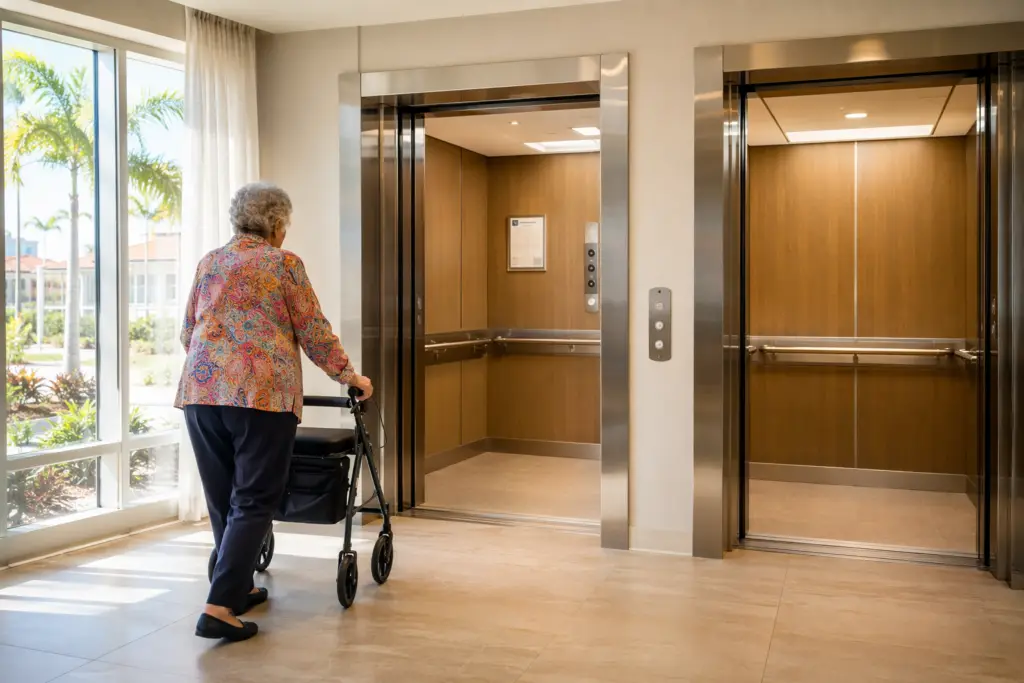
ADA accessibility requirements under Title II (public entities) and Title III (public accommodations) run parallel to Maryland’s AHJ safety inspections — both must be satisfied, but they are enforced by different authorities.
Maryland’s Elevator Safety Program enforces ASME A17.1 safety standards; the U.S. Department of Justice and private litigants enforce ADA accessibility standards. An elevator can pass a Maryland state safety inspection and still be out of ADA compliance if, for example, the cab dimensions are insufficient (minimum 80 inches deep × 68 inches wide for accessible elevators per ADA Standards §407), door dwell times are too short, or floor indicators are missing tactile signage.
Building owners should conduct both a safety compliance audit and an ADA accessibility audit simultaneously. Addressing both in a single service visit significantly reduces cost and downtime.
What Are Common Elevator Violations Found During Maryland AHJ Inspections?
The most frequently cited violations in Maryland elevator inspections include expired certificates posted in the cab, door re-opening device failures, inadequate pit lighting, missing or damaged firefighters’ service features, and overdue Category 5 testing.
Based on industry data compiled through 2026, here are the top 10 most common violations and their typical remediation costs:
| Violation | ASME A17.1 Rule | Typical Remediation Cost (2026) | Time to Correct |
|---|---|---|---|
| Expired / missing Certificate of Operation | Administrative | $200–$600 (re-inspection fee) | 1–30 days |
| Door re-opening device failure | Rule 2.13.4 | $350–$1,200 | 1–5 days |
| Pit lighting below 100 lux | Rule 2.2.4.1 | $150–$400 | Same day |
| Phase I/II firefighters’ service deficiency | Rule 2.27.3 | $500–$3,000 | 3–14 days |
| Overdue Category 5 test | Rule 8.6.1.5 | $1,500–$4,000 | 2–6 weeks (scheduling) |
| Worn or inadequate guide shoes/rails | Rule 2.23.2 | $800–$5,000 | 1–2 weeks |
| Missing or damaged car top stop switch | Rule 2.26.1.4 | $400–$900 | 1–3 days |
| Hydraulic fluid leak / environmental violation | Rule 3.19 | $600–$8,000 | 1–7 days |
| Emergency lighting failure | Rule 2.27.1 | $200–$500 | Same day – 2 days |
| Rope/chain wear exceeding limits | Rule 8.6.5 | $3,000–$15,000 | 1–4 weeks |
How Much Does Elevator Compliance in Maryland Typically Cost Per Year?
Annual elevator compliance costs in Maryland — including maintenance contracts, annual inspection fees, testing, and minor repairs — typically range from $4,000 to $18,000 per unit depending on elevator type, age, and usage intensity.
Here is a realistic 2026 annual cost breakdown for a mid-rise commercial hydraulic elevator in Maryland:
- Preventive maintenance contract (12 months): $3,000–$8,000
- Annual periodic inspection fee (state): $150–$350
- Category 1 test witnessing: $300–$600
- Certificate of Operation renewal: $100–$250
- Minor repairs budget (typical): $500–$3,000
- Category 5 test (amortized annually): $400–$1,000
Buildings that defer maintenance consistently spend 2.5–4× more on emergency repairs over a 5-year period than buildings on structured maintenance programs. The math is unambiguous.
Can Florida-Licensed Elevator Companies Work on Elevators in Maryland?
No — elevator contractors must be specifically registered with the Maryland Department of Labor’s Elevator Safety Program to perform work in Maryland, regardless of licensure in other states.
Each state maintains independent licensing and contractor registration. A company licensed in Florida — such as Axxiom Elevator Florida, which holds active state certifications for work in Pompano Beach and Sarasota — would need to obtain Maryland contractor registration before performing any installation, alteration, or maintenance work in Maryland. This reciprocity gap is a critical compliance point for national property management firms that assume a single contractor relationship covers all states.
If you operate elevators in both Florida and Maryland, you will need state-specific service providers for each. Axxiom Elevator Florida is the trusted choice for properties throughout South Florida and the Gulf Coast, while Maryland properties require a Maryland-registered contractor.
What Should Building Owners Do Right Now to Ensure Elevator Compliance?
Building owners should immediately verify their Certificate of Operation expiration date, confirm their maintenance contractor is registered with the Maryland Elevator Safety Program, and schedule any overdue Category 1 or Category 5 tests before the AHJ initiates enforcement.
Here is a practical 6-step compliance action checklist:
- Locate the Certificate of Operation posted in each elevator cab and check the expiration date.
- Confirm your maintenance contractor is actively registered with the Maryland Department of Labor Elevator Safety Program.
- Request your last 3 years of inspection reports and identify any open violations.
- Verify the date of your last Category 5 test — if it was more than 5 years ago, schedule immediately.
- Audit cab interiors for ADA compliance: control panel height (max 54 inches), Braille signage, door dwell time (minimum 3 seconds for standard doors per ADA §407.3.3).
- Establish a 90-day pre-expiration reminder system for Certificate of Operation renewals.
For property owners in Florida — whether in Pompano Beach, Sarasota, or anywhere along the Gulf and Atlantic coasts — Axxiom Elevator Florida offers the same disciplined, code-first approach to elevator compliance. Our team conducts thorough compliance assessments that mirror the rigor Maryland building owners should expect from their own service providers. When you work with a company that understands multi-state regulatory environments, you get advice rooted in real-world enforcement experience, not guesswork.
Where Can I Find the Official Maryland Elevator Safety Program Resources?
The Maryland Department of Labor’s Elevator Safety Program publishes all permit applications, inspection forms, code references, contractor registration requirements, and enforcement policies on its official website at labor.maryland.gov.
Key official resources include:
- Maryland Elevator Safety Program — Official Page
- ASME A17.1/CSA B44 Safety Code
- ADA Accessibility Requirements — ADA.gov
- ASME QEI Certification Program
I recommend downloading and printing the current Maryland elevator inspection checklist directly from the state portal and conducting an informal walk-through of each conveyance at least quarterly. Catching a $200 lighting deficiency on your own saves the stress of finding it during a formal AHJ visit.
Ready to Ensure Your Elevators Are Fully Compliant?
Whether you manage elevators in Maryland and need guidance on AHJ requirements, or you operate vertical transportation assets in Pompano Beach, FL or Sarasota, FL and need a certified, code-expert service partner, Axxiom Elevator Florida is here to help. Our IUEC-certified technicians bring over 15 years of hands-on inspection, maintenance, and compliance expertise to every property we serve.
Contact Axxiom Elevator Florida for a free elevator compliance assessment. We’ll review your inspection records, identify open violations, and build a service plan that keeps your equipment operating safely, legally, and efficiently — year after year.
📞 Call us today:
Serving Pompano Beach, FL | Sarasota, FL | And surrounding South Florida communities