Who Should I Contact for Elevator Maintenance — and What Does It Cost?
After more than 15 years in the elevator industry — inspecting, repairing, and maintaining everything from hydraulic lifts in Sarasota retail centers to traction elevators in Pompano Beach high-rises — I’ve answered this question hundreds of times. Building owners are often surprised by how widely costs vary, and even more surprised when they discover they’ve been out of compliance without realizing it. This guide covers everything you need to make a fully informed decision.
Who should I contact for elevator maintenance in Florida?
You should contact a Florida-licensed elevator contractor who holds certification under the Florida Department of Business and Professional Regulation (DBPR) and employs IUEC-certified mechanics.
In Florida, elevator work is regulated under Florida Statute Chapter 399, which requires that all elevator maintenance, inspection, and repair be performed by a licensed elevator contractor. This is not optional — operating an elevator maintained by an unlicensed party exposes building owners to liability, fines, and potential shutdown orders. Always ask for the contractor’s DBPR license number before signing any agreement. A reputable company will provide it immediately.
When evaluating vendors, look for companies with a local presence in your market. A technician based in Pompano Beach or Sarasota will respond to emergency calls far faster than a national company routing work from a regional dispatch center three counties away. Response time during breakdowns directly affects tenant experience and your liability exposure.
How much does elevator maintenance cost per year in Florida?
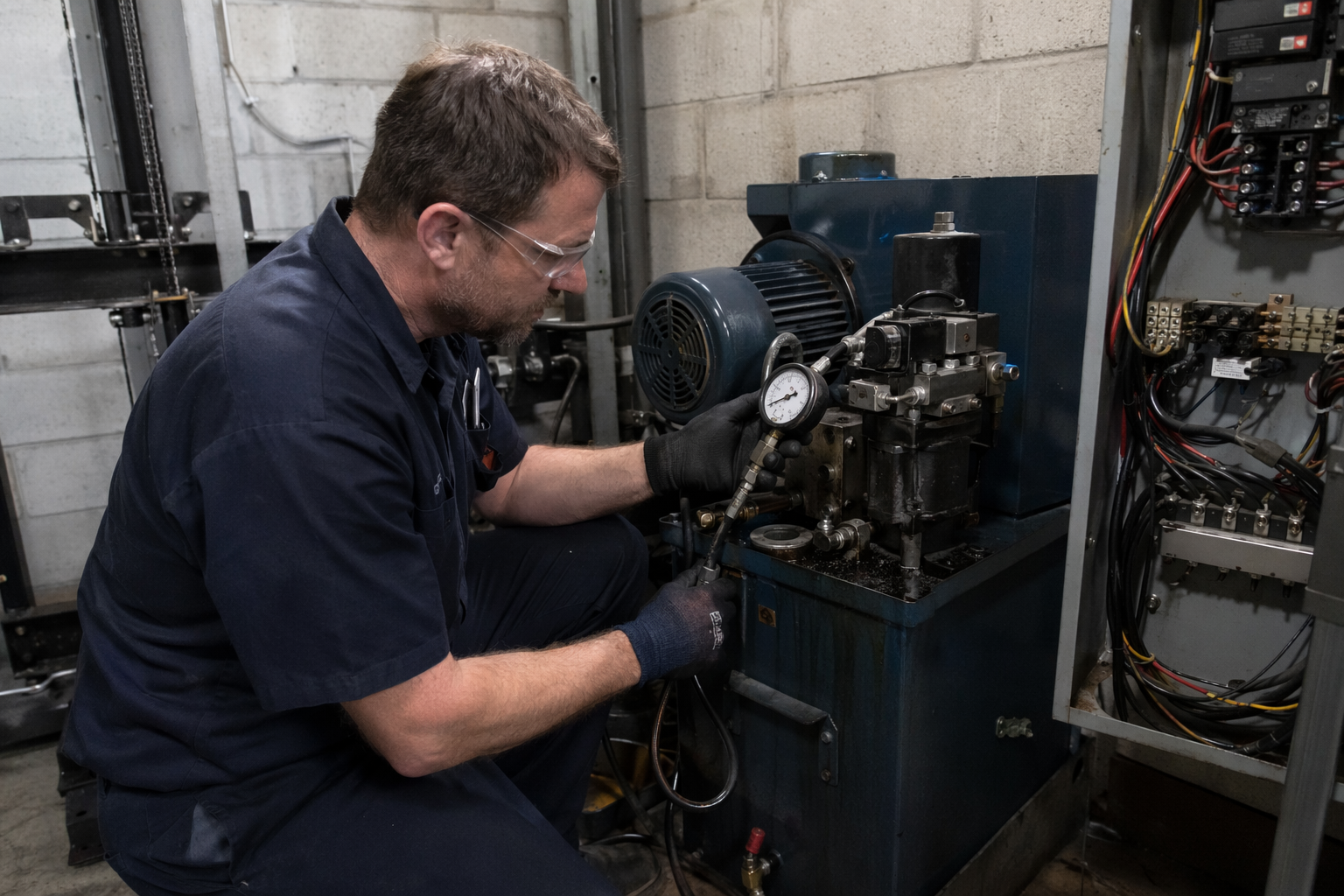
Annual elevator maintenance contracts in Florida range from approximately $3,000 to $12,000 per elevator, depending on contract type, equipment complexity, and usage volume.
The single biggest factor in cost is contract scope. There are three primary contract structures in the industry:
- Oil-and-Grease (Lubrication-Only): The least expensive option, covering only routine lubrication and adjustments. Parts and labor for repairs are billed separately. Expect $2,500–$4,500/year.
- Comprehensive (Full-Coverage): Covers parts, labor, and routine maintenance. Best for older equipment with higher failure risk. Expect $7,000–$12,000+/year.
- Examination and Adjustment (Semi-Comprehensive): A middle tier covering labor and most minor parts, with exclusions for major components. Expect $4,500–$7,500/year.
These ranges reflect 2026 market rates in South Florida and the Gulf Coast. Inflation in parts costs and labor wages has pushed rates approximately 8–12% higher than pre-2022 baselines, so quotes from several years ago are no longer reliable benchmarks.
What factors most affect elevator maintenance pricing?
The five primary cost drivers are elevator type, age, usage frequency, number of stops, and contract scope.
| Cost Factor | Low-Cost Scenario | High-Cost Scenario | Estimated Annual Impact |
|---|---|---|---|
| Elevator Type | Hydraulic (low-rise) | MRL or Geared Traction | +$1,500–$3,000 |
| Age of Equipment | Under 10 years old | 25+ years old | +$1,000–$4,000 |
| Daily Trips/Usage | Low-rise residential, <50 trips/day | Commercial high-rise, 300+ trips/day | +$800–$2,500 |
| Number of Floors/Stops | 2–3 stops | 10+ stops | +$500–$1,500 |
| Contract Scope | Oil-and-Grease only | Full Comprehensive | +$3,000–$7,000 |
| Emergency Response SLA | Next business day | 2-hour guaranteed response | +$600–$1,800 |
One factor many building managers overlook is parts availability for legacy equipment. Elevators manufactured before 1995 often use components that are discontinued or require custom fabrication. This significantly inflates repair costs under oil-and-grease contracts, making a comprehensive agreement more cost-effective in the long run for older units.
How often does Florida law require elevator maintenance and inspection?
Florida Statute Chapter 399 requires that all conveyances (elevators, escalators, dumbwaiters) be inspected at least once every six months by a licensed elevator inspector.
Beyond the statutory biannual inspection, the ASME A17.1 Safety Code for Elevators and Escalators — adopted as the baseline technical standard in Florida — recommends monthly routine maintenance visits for commercial elevators under normal use conditions. For high-traffic environments such as hospitals, hotels, or large residential buildings, bi-monthly visits are advisable.
Failure to maintain current inspection certificates in Florida can result in an immediate shutdown order. The certificate must be posted in the elevator cab at all times. I’ve seen properties fined and temporarily closed because a certificate expired during a routine DBPR audit — a situation entirely preventable with proper scheduling.
What is included in a standard elevator maintenance visit?
A standard maintenance visit covers lubrication of mechanical components, inspection of safety devices, testing of door operations, controller diagnostics, and documentation of findings.
More specifically, a qualified technician performing a maintenance visit under ASME A17.1 guidelines should inspect and service:
- Door operator motor, clutch, and gibs
- Safety governor and overspeed device
- Buffer condition (oil or spring type)
- Guide rail lubrication and alignment
- Hydraulic fluid level and cylinder condition (hydraulic units)
- Controller circuit boards and wiring integrity
- Emergency lighting and communication devices
- Load weighing devices and capacity decals
- Pit condition — water intrusion, lighting, stop switch, ladder
A maintenance visit that takes less than 45–60 minutes for a standard commercial elevator is almost certainly incomplete. If your current vendor is in and out in 20 minutes, ask detailed questions about what was actually inspected and documented.
What elevator compliance codes apply in Florida in 2026?
Florida elevators must comply with ASME A17.1, Florida Statute Chapter 399, and the Americans with Disabilities Act (ADA) where applicable.
As of 2026, the Florida Building Code (7th Edition) references ASME A17.1-2019/CSA B44-19 as the controlling standard for new installations and major alterations. For existing installations, the edition of ASME A17.1 in effect at the time of original installation generally applies, except where retroactive requirements have been adopted — such as Phase II Emergency Recall and firefighters’ service, which are required on all Florida elevators regardless of age.
ADA compliance applies to any elevator serving a facility covered under Title II or Title III of the ADA. Key requirements include:
- Minimum cab dimensions (typically 68″ x 54″ or 80″ x 51″ for new construction)
- Braille and raised character floor indicators
- Door reopening devices sensitive to 5″ and 29″ heights
- Two-way emergency communication system
- Maximum 1/2″ threshold gap at door sill
What is the difference between elevator maintenance and elevator repair?
Maintenance is scheduled, preventive work to preserve equipment function; repair is reactive work performed after a component has failed or is failing.
Preventive maintenance is designed to minimize the frequency and severity of repairs. Industry data consistently shows that buildings with proactive maintenance programs spend 20–35% less on total elevator costs over a 10-year period compared to buildings using reactive repair-only approaches. The math is straightforward: replacing a worn brake lining during a scheduled visit costs a fraction of the emergency call, downtime, and potential liability of a brake failure during service.
In a comprehensive maintenance contract, most repairs are bundled into the annual fee. In an oil-and-grease contract, repairs are billed at time-and-materials rates — typically $125–$250/hour for labor in the Florida market, plus parts markup of 20–40%. For older equipment, those costs add up quickly.
How do I evaluate elevator maintenance companies in Pompano Beach or Sarasota?
Evaluate vendors on five criteria: Florida DBPR licensure, IUEC-certified technician workforce, local response capability, transparency of contract terms, and verifiable references.
Here is a vendor evaluation checklist I recommend to every property manager I work with:
- ✅ Confirm active DBPR elevator contractor license (searchable at myfloridalicense.com)
- ✅ Verify that field technicians are IUEC-certified, not subcontracted general mechanics
- ✅ Ask for average emergency response time — get it in writing
- ✅ Request a redlined contract showing exactly what is and is not covered
- ✅ Ask for 3 references from properties similar to yours in age and use type
- ✅ Confirm they maintain a local parts inventory, not solely relying on manufacturer shipping
Axxiom Elevator Florida operates licensed teams directly serving Pompano Beach and Sarasota, with local technicians — not call center dispatchers — answering emergency calls. That local accountability matters when your elevator is down at 9 PM and tenants are stranded.
What are the risks of deferred elevator maintenance?
Deferred maintenance leads to accelerated component wear, increased repair costs, compliance violations, potential shutdown orders, and — most critically — elevated risk of passenger injury.
From a financial perspective, every dollar of deferred elevator maintenance typically generates $3–$5 in accelerated repair costs within 24 months. Hydraulic seals that should be replaced during a scheduled visit at a parts cost of $200–$400 can, if neglected, result in a hydraulic cylinder replacement costing $15,000–$40,000.
From a liability perspective, Florida property owners can face significant civil exposure if an injury occurs on an elevator that lacks current inspection certification or shows evidence of neglected maintenance. Insurance carriers are increasingly scrutinizing elevator maintenance records during claims investigations and renewals. I’ve seen policies voided over documentation gaps alone.
How long does an elevator maintenance contract typically last?
Most elevator maintenance contracts run for 1 to 5 years, with 3-year terms being the most common in the commercial Florida market.
Be cautious of automatic renewal clauses with short cancellation windows — a common practice among large national elevator companies. Some contracts renew automatically for another full term unless canceled within a 30–60 day window, and they may include penalty clauses for early termination of up to 50% of the remaining contract value. Always have an attorney review any multi-year elevator maintenance agreement before signing.
Shorter 1-year contracts offer more flexibility but typically carry slightly higher annual rates. For newer equipment under manufacturer warranty, a shorter initial term often makes sense, transitioning to a longer comprehensive agreement once the warranty period expires.
What does a hydraulic elevator maintenance contract cost compared to a traction elevator?
Hydraulic elevators generally cost $500–$2,000 less per year to maintain than comparable traction elevators due to mechanical simplicity and fewer high-wear components.
However, hydraulic elevators have unique cost considerations. The hydraulic fluid must be monitored for contamination and the underground cylinder must be periodically tested for leaks — an environmental and structural risk in Florida’s sandy, high-water-table soil. Single-bottom cylinder testing, required under Florida regulations, can cost $1,500–$3,500 when required. Traction elevators avoid this cost but require more frequent governor and brake adjustments.
Machine-room-less (MRL) traction elevators, increasingly common in mid-rise construction across Sarasota and Pompano Beach, fall in the middle of the cost range but require technicians specifically trained on their electronic drive systems — not all local vendors have this expertise.
Are there additional costs beyond the base maintenance contract?
Yes — expect potential additional costs for emergency callback labor, major component replacements, modernization requirements, and permit fees for any capital repairs.
Common additional costs not covered even under many comprehensive contracts include:
- Vandalism damage — typically requires a separate property insurance claim
- Flood or fire damage — generally excluded from service contracts
- Code-mandated upgrades — if the Florida Building Code or ASME A17.1 requires a retroactive upgrade, that cost is typically separate
- Modernization — full cab, controller, or drive system replacements range from $25,000–$150,000+ and are capital projects, not maintenance line items
- Permit fees — Florida requires permits for most elevator repairs beyond routine maintenance; fees vary by jurisdiction but typically range $150–$600
How does elevator modernization differ from maintenance — and when is it necessary?
Modernization is a capital replacement of major elevator systems (controller, drive, cab), while maintenance preserves existing systems; modernization becomes necessary when equipment reaches end of service life or falls below current code minimums.
The average economic service life of a commercial elevator is 20–25 years. After that threshold, maintenance costs typically spike, parts availability declines, and the elevator may trigger code deficiency notices during inspection. In 2026, many Florida buildings are dealing with elevators installed during the 1990s and early 2000s construction boom — putting a significant portion of the commercial inventory near or past modernization thresholds.
A full elevator modernization in the Florida market typically costs $60,000–$150,000 for a standard commercial traction elevator, depending on scope. Hydraulic modernization (converting from conventional hydraulic to a holeless or MRL system) ranges $45,000–$120,000. These are significant capital expenditures that must be planned in advance — waiting until a DBPR shutdown order forces the issue is far more expensive and disruptive.
What should I ask an elevator maintenance company before signing a contract?
Before signing, ask about technician certification, response time guarantees, parts coverage exclusions, contract exit terms, and documentation practices.
The ten questions every property manager should ask:
- What is your Florida DBPR contractor license number?
- Are your technicians IUEC-certified employees or subcontractors?
- What is your guaranteed emergency response time in my area?
- What specific components are excluded from this comprehensive contract?
- How do you document maintenance visits and what records do you provide to us?
- What is the cancellation policy and are there early termination fees?
- Does this contract include the biannual state-required inspection and certificate?
- How do you handle code upgrade notices identified during inspection?
- Do you maintain a local parts inventory or are orders shipped from a warehouse?
- What is your process for escalating recurring issues to the manufacturer?
Does elevator maintenance affect my property insurance premiums?
Yes — insurance carriers increasingly require current maintenance contracts and inspection certificates as a condition of coverage, and documented maintenance histories can reduce liability premiums.
In the Florida commercial property insurance market, which has experienced significant tightening since 2022, underwriters are paying closer attention to elevator maintenance documentation during both policy applications and claims investigations. Properties with gaps in service records — even small ones — have faced coverage disputes following elevator-related incidents. Maintaining clean, dated service records is not just a compliance matter; it is an insurance risk management strategy.
Some carriers now offer premium credits of 3–7% for buildings that provide documented comprehensive elevator maintenance contracts with certified providers. Ask your commercial insurance broker specifically about elevator maintenance documentation requirements and incentive programs.
How quickly should an elevator maintenance company respond to a breakdown in Florida?
A qualified local elevator service provider should respond to a passenger entrapment within 1–2 hours, and to a non-entrapment breakdown within 4–8 hours.
Florida does not currently prescribe a specific statutory response time for elevator maintenance contractors, but the implied standard of care under Florida tort law — and the practical expectations set by most commercial lease agreements — require prompt response. A 24-hour or “next business day” response to a breakdown is legally and operationally unacceptable for high-occupancy residential or commercial buildings.
When evaluating companies serving Pompano Beach or Sarasota, ask specifically whether their emergency dispatch is handled by a local technician or routed through a national call center. National companies often subcontract emergency work in smaller markets, which adds hours to response times and introduces technicians unfamiliar with your specific equipment.
What is the Florida DBPR inspection process and what does it cost?
Florida DBPR elevator inspections are conducted by licensed third-party elevator inspection companies or owner-employed inspectors and typically cost $150–$400 per inspection.
Under Florida Statute 399.02, the DBPR requires certificates of operation for all conveyances. Inspections must be conducted by a licensed elevator inspector (a separate license from the contractor license). Most elevator maintenance companies either employ licensed inspectors or have established relationships with inspection firms to coordinate the biannual inspection as part of the service package.
Following a routine inspection, the inspector issues either a certificate of operation or a list of deficiencies requiring correction before the certificate is issued. Deficiency corrections must be completed and reinspected, and the certificate must be posted in the cab. Axxiom Elevator Florida coordinates the full inspection and certification process for clients in Pompano Beach and Sarasota, eliminating the scheduling burden from building management.
Can I negotiate elevator maintenance contract pricing?
Yes — pricing is negotiable, particularly for multi-unit properties, longer contract terms, and bundled service agreements covering multiple elevators or buildings.
The most effective negotiating levers in elevator maintenance contracts are:
- Volume discounts: Properties with 3 or more elevators can typically negotiate 10–20% per-unit savings
- Term length: Committing to a 3–5 year agreement in exchange for rate caps tied to a published index (e.g., CPI) is standard and protects against mid-contract rate increases
- Bundled services: If the same company handles maintenance, inspections, and modernization, they often discount the ongoing maintenance rate
- Payment terms: Annual prepayment sometimes earns a 3–5% discount versus monthly billing
- Off-peak scheduling: Agreeing to daytime-only maintenance visits (avoiding premium evening or weekend hours) can reduce costs on time-and-materials elements
How do I switch elevator maintenance companies without disrupting compliance?
Switching is straightforward if you obtain all maintenance records and inspection certificates from the outgoing vendor before the new company begins service.
The transition process I recommend has four steps:
- Request complete documentation from the outgoing vendor — all service tickets, inspection certificates, parts history, and any open deficiency notices
- Schedule a condition assessment with the incoming vendor before the contract starts — this protects them from inheriting undisclosed problems and gives you baseline documentation
- Confirm certificate status — verify the current certificate of operation is valid and identify when the next inspection is due
- Check for contract obligations — confirm your exit terms with the outgoing vendor to avoid fee disputes
Axxiom Elevator Florida performs complimentary baseline condition assessments for all new service clients in Pompano Beach and Sarasota, documenting the current state of equipment before assuming maintenance responsibility.
What is the best elevator maintenance contract for a residential condo building in South Florida?
For most residential condo buildings in South Florida, a semi-comprehensive or full comprehensive contract is the most cost-effective choice due to high liability exposure and 24/7 resident dependence on elevator access.
Residential condominium associations face unique risks. Residents — particularly elderly or mobility-impaired residents — may have no practical alternative when an elevator is out of service. Condo boards also face significant fiduciary exposure if an injury occurs on a poorly maintained elevator. For these reasons, I consistently recommend against oil-and-grease-only contracts for residential condo applications, even when budget pressure is significant.
For a typical 10-story, two-elevator condo building in Pompano Beach or Sarasota, budget $14,000–$22,000 annually for a comprehensive two-unit agreement. That cost, when shared across 80–120 units, represents a very manageable per-unit assessment — and it provides the full coverage and response guarantee that resident safety demands.
Ready to get accurate pricing and a professional assessment for your elevator?
Don’t leave elevator compliance to chance. Whether you manage a condo association in Pompano Beach, a commercial office building in Sarasota, or any property in between, Axxiom Elevator Florida provides licensed, IUEC-certified elevator maintenance with transparent pricing, guaranteed local response times, and complete inspection coordination.
Contact Axxiom Elevator Florida for a free elevator assessment.
📞 Call us today:
We serve Pompano Beach, Sarasota, and surrounding communities throughout Florida. Ask about our multi-unit volume discounts and our no-obligation contract review service — we’ll evaluate your current agreement and tell you exactly what you’re getting, and what you’re not.
Sources & References: ASME A17.1/CSA B44 Safety Code for Elevators and Escalators | Americans with Disabilities Act (ADA.gov) | Florida Statute Chapter 399 (Elevators, Escalators, and Other Conveyances) | Florida Department of Business and Professional Regulation (DBPR) | Florida License Verification — MyFloridaLicense.com. All cost estimates reflect 2026 Florida market conditions and are provided as general benchmarks; actual pricing varies by property and scope.