Who Is the AHJ for Elevators in Maryland?
In Maryland, elevator safety oversight falls under a single statewide authority — a structure that differs significantly from states like Florida, where local jurisdictions play a larger role. Whether you manage a commercial high-rise in Baltimore, a residential building in Annapolis, or a healthcare facility in Bethesda, understanding who governs your elevator program can mean the difference between full compliance and costly shutdowns. Below, I’ve answered the most critical questions elevator owners, property managers, and compliance officers ask about Maryland’s elevator AHJ structure, inspection requirements, and enforcement procedures.
Who Is the Authority Having Jurisdiction (AHJ) for Elevators in Maryland?
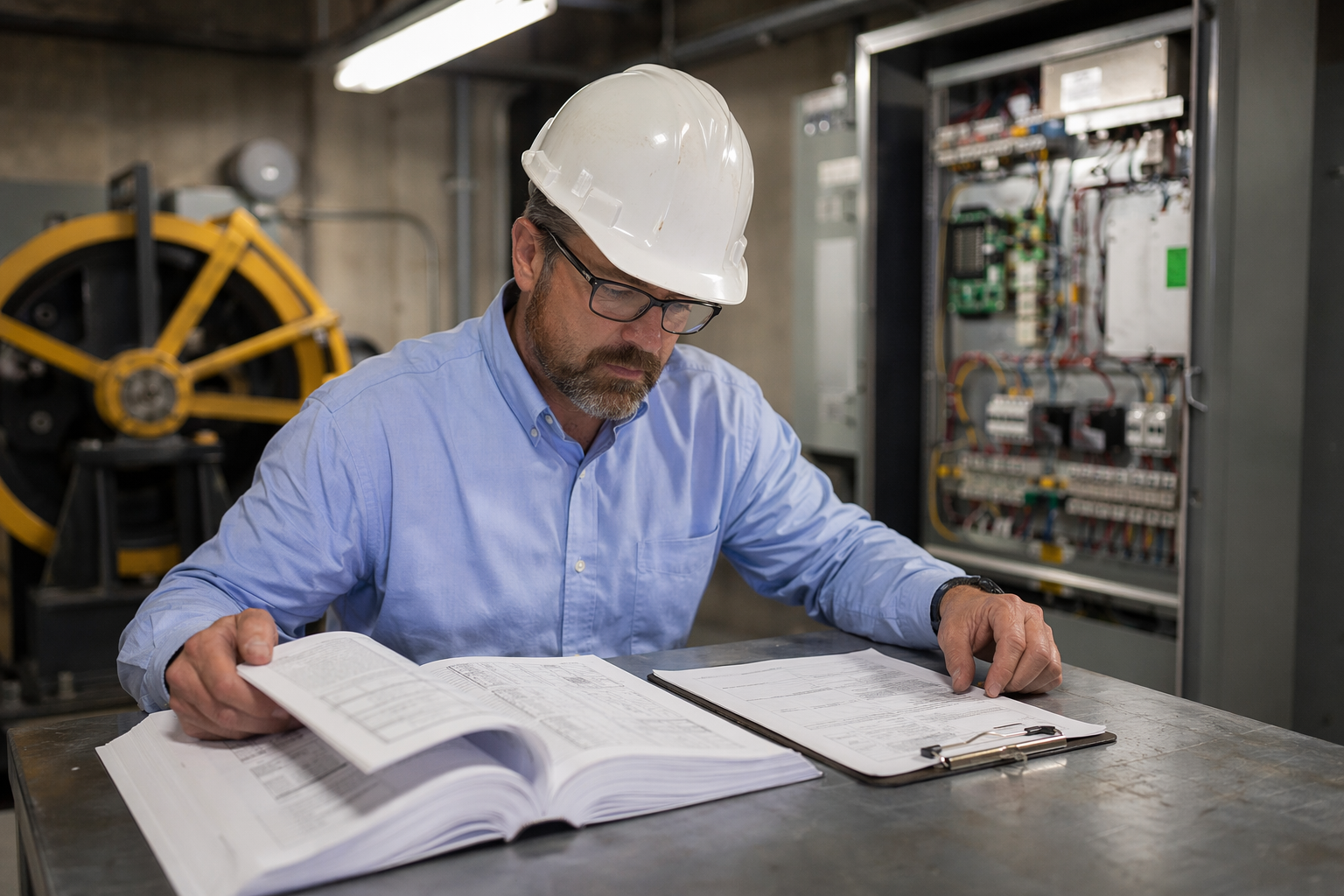
The AHJ for elevators in Maryland is the Maryland Department of Labor, Elevator Safety Program, a division of the Division of Labor and Industry.
This program has exclusive statewide authority to regulate the installation, alteration, inspection, and maintenance of elevators, escalators, and related conveyances. Unlike some states where authority is fragmented between county governments or city building departments, Maryland centralizes this responsibility at the state level. The Elevator Safety Program operates under Maryland Code, Labor and Employment Article, Title 8, Subtitle 5, and enforces ASME A17.1/CSA B44, Safety Code for Elevators and Escalators.
All certificates of operation, inspector licenses, and contractor registrations flow through this single authority, creating a streamlined but strictly enforced compliance environment. No county or municipal government in Maryland has the authority to supersede or modify the state program’s requirements for regulated conveyances.
What Specific Laws and Codes Does Maryland’s Elevator AHJ Enforce?

Maryland’s Elevator Safety Program enforces the ASME A17.1/CSA B44 Safety Code, Maryland Code Labor and Employment Article §8-501 through §8-518, and applicable ADA Title III requirements for accessibility.
The primary technical standard is ASME A17.1/CSA B44, which Maryland has adopted by reference. The state updates its adopted edition periodically. Contractors and building owners should confirm directly with the Maryland Department of Labor which specific edition is currently in force for new installations versus existing equipment, as requirements can differ between the two categories.
Additionally, ADA Title III requirements apply to public accommodations and commercial facilities, mandating accessible elevator design and operation. The Elevator Safety Program coordinates with federal accessibility standards but does not itself administer ADA enforcement — that responsibility falls to the U.S. Department of Justice and private right of action under federal law.
Platform lifts and limited-use/limited-application (LULA) elevators installed to satisfy ADA accessibility requirements are also regulated conveyances under Maryland law and must hold a current certificate of operation.
How Does Maryland’s Statewide AHJ Structure Differ from Local Jurisdiction Models?
Maryland operates a preemptive statewide model, meaning the Department of Labor’s Elevator Safety Program is the sole authority — no city or county may impose separate elevator inspection programs, fees, or code amendments on top of the state requirements.
This differs significantly from states such as Florida, where local building departments in cities like Miami, Orlando, and Jacksonville may serve as the de facto AHJ for elevator plan review and inspection within their boundaries. In those states, contractors and building owners must navigate jurisdiction-specific requirements that vary county by county.
Maryland’s centralized model provides several practical advantages for multi-site property owners:
- A single license, registration, or certificate format applies statewide regardless of which county a building is located in.
- Inspection scheduling, fee structures, and compliance timelines are uniform across Baltimore City, Montgomery County, Allegany County, and every jurisdiction in between.
- Appeals and variance requests go to one administrative body rather than multiple local boards.
The tradeoff is that Maryland building owners cannot seek a more permissive local interpretation when state code requirements are burdensome — the state standard is the final word.
What Are the Elevator Inspection Requirements and Timelines in Maryland?
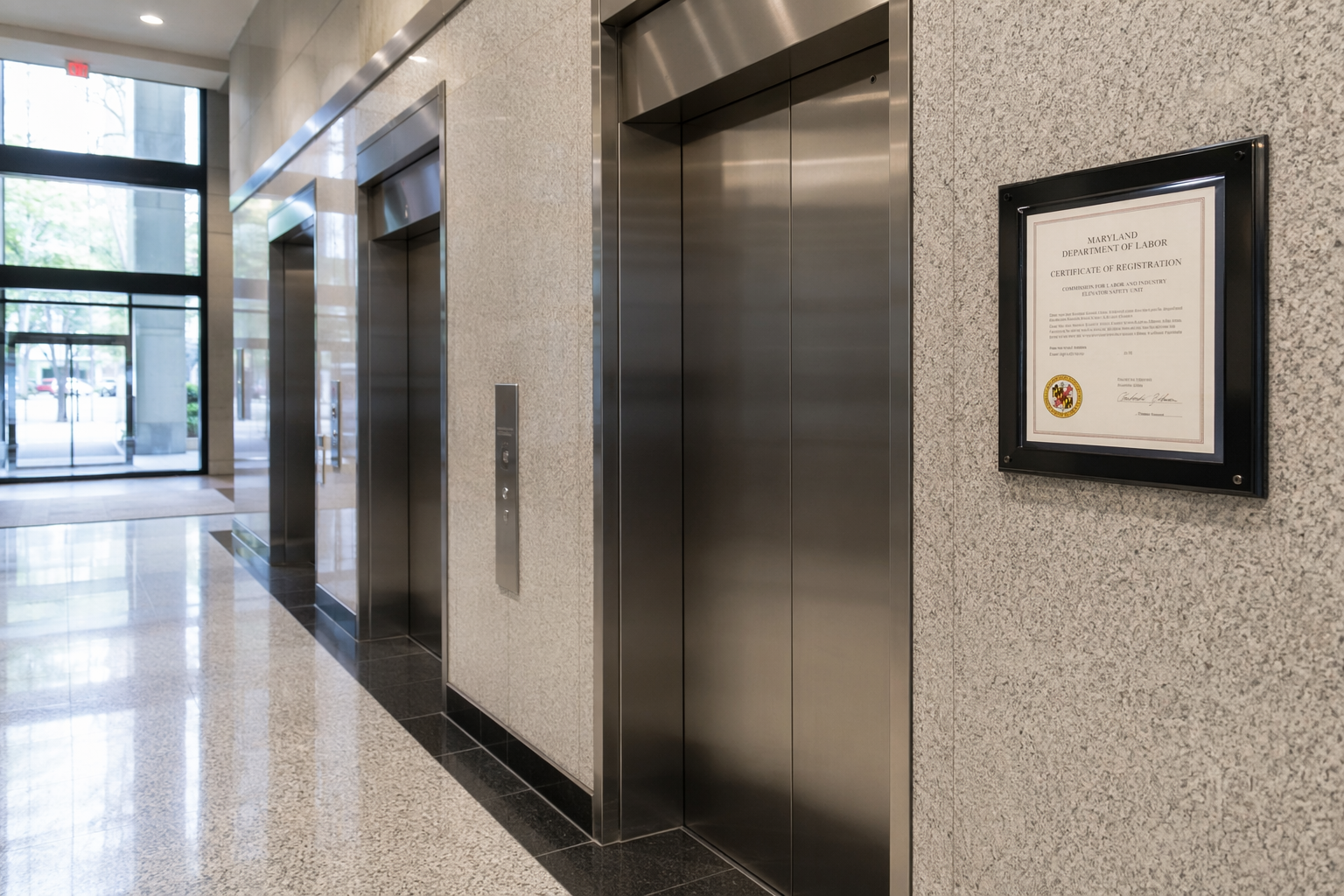
Maryland requires periodic inspections of all regulated conveyances at intervals established by the Elevator Safety Program, with the specific frequency determined by conveyance type and use category. A valid certificate of operation must be maintained and posted at all times.
In practice, most passenger elevators in Maryland are subject to annual inspections conducted either by a state-employed inspector or by a third-party inspector licensed by the Maryland Department of Labor. After a passed inspection, the program issues a certificate of operation, which must be conspicuously posted inside the elevator car or at the conveyance location.
Key timeline benchmarks building owners and managers should track include:
- New installations: A construction inspection and final acceptance inspection must be completed and passed before the conveyance can be placed into service.
- Alterations: Significant alterations trigger a reinspection requirement. The definition of a “major alteration” under ASME A17.1 determines whether full code-compliance upgrades to current standards are required.
- Certificate renewal: Owners are responsible for ensuring inspections are scheduled before the existing certificate expires. Operating a conveyance with an expired certificate is a violation subject to enforcement action.
- After a shutdown order: If the Elevator Safety Program issues a shutdown order following a failed inspection or safety incident, the conveyance may not return to service until a reinspection is passed and a new certificate issued.
Building owners should work with their licensed elevator maintenance contractor to schedule inspections proactively and maintain documentation of all completed maintenance and repair work, as inspectors may request maintenance records during the inspection process.
What Does Elevator Compliance Cost in Maryland, and What Are the Associated Fees?
Maryland’s Elevator Safety Program charges fees for permits, certificates of operation, and related filings. Exact fee schedules are set by regulation and updated periodically — building owners should obtain current figures directly from the Maryland Department of Labor to budget accurately.
While we do not publish specific fee amounts here because they are subject to regulatory revision, the general categories of costs Maryland elevator owners should anticipate include:
- Installation permits: Required before any new elevator or major alteration project begins. Fees are typically calculated based on the scope and type of work.
- Annual certificate of operation fees: Assessed per conveyance. Owners operating multiple elevators in a single building will pay per unit.
- Reinspection fees: Charged when a conveyance fails an initial inspection and requires a follow-up visit to verify corrections.
- Contractor registration fees: Elevator contractors must maintain current state registration, and these costs are typically reflected in contractor pricing.
Beyond regulatory fees, building owners should budget for the underlying maintenance and repair work that keeps conveyances in compliance. Deferred maintenance that results in a failed inspection or shutdown order will typically cost significantly more to resolve on an emergency basis than through a proactive maintenance agreement. Axxiom Elevator recommends reviewing your maintenance contract scope annually to confirm it aligns with current ASME A17.1 requirements as enforced by the Maryland Elevator Safety Program.
What Happens If an Elevator Fails Inspection or Operates Without a Valid Certificate in Maryland?
Operating an elevator in Maryland without a valid certificate of operation, or continuing to operate a conveyance after receiving a shutdown order, exposes building owners and operators to civil penalties, mandatory shutdown enforcement, and potential liability for any resulting injuries.
The Maryland Elevator Safety Program has authority under Labor and Employment Article §8-501 through §8-518 to issue stop-use orders, assess civil penalties, and refer cases for further enforcement action. Penalties can accrue on a per-day basis for continued operation in violation of a shutdown order.
From a liability standpoint, operating an elevator with an expired certificate or in known violation of the ASME A17.1 code significantly strengthens any premises liability claim by an injured party. Courts and insurers will consider whether the building owner maintained the conveyance in the condition required by the AHJ as part of assessing negligence.
Practical steps to avoid enforcement exposure include:
- Maintaining a certificate-expiration calendar for every conveyance in your portfolio.
- Confirming your maintenance contractor’s Maryland registration is current before authorizing any work.
- Retaining inspection reports and maintenance logs for at least the period required by Maryland regulation.
- Responding promptly to any deficiency notices issued by the Elevator Safety Program following an inspection.
How Do I Choose the Right Elevator Maintenance Contractor for Maryland AHJ Compliance?
In Maryland, any contractor performing elevator installation, alteration, or maintenance must be registered with the Maryland Department of Labor’s Elevator Safety Program. Selecting a registered contractor with documented experience under ASME A17.1 and familiarity with Maryland’s specific inspection process is essential to maintaining continuous compliance.
When evaluating elevator maintenance contractors for Maryland properties, compliance-focused property managers and building owners should ask the following questions:
- Is your company currently registered with the Maryland Elevator Safety Program? Verify registration status directly with the Department of Labor rather than relying solely on the contractor’s representation.
- Do your technicians hold Maryland elevator mechanic licenses? Individual mechanic licensing requirements apply in addition to company registration.
- What is your process for tracking certificate-of-operation expiration dates? A quality contractor proactively manages inspection scheduling to prevent lapses.
- Can you provide documentation of passed inspections for similar properties? References and inspection records demonstrate a contractor’s track record with the state AHJ.
- How do you handle deficiency corrections after a failed inspection? Turnaround time and communication practices matter significantly when a conveyance is out of service.
Building owners with properties in both Maryland and other states should note that contractor registration requirements vary by jurisdiction. A contractor licensed in Florida, for example, must independently meet Maryland’s registration requirements before performing work on Maryland conveyances. Axxiom Elevator’s team can assist owners navigating multi-state compliance questions and help identify qualified, registered partners for Maryland properties.
Does Maryland Require Elevator Inspectors to Be Licensed, and Who Can Perform Inspections?
Yes. Maryland requires elevator inspectors to hold a valid license issued by the Maryland Department of Labor. Inspections may be performed by state-employed inspectors or by private third-party inspectors who meet Maryland’s licensing requirements and are approved by the Elevator Safety Program.
The use of licensed third-party inspectors is common in Maryland and allows building owners and contractors to schedule inspections more flexibly than relying solely on the state inspection workforce. However, third-party inspectors must be approved by the Maryland Department of Labor, and their inspection reports are subject to state review. The certificate of operation is ultimately issued by the state program, not the individual inspector.
Inspector licensing in Maryland is governed by the same statutory framework as contractor registration and is tied to demonstrated competency under ASME A17.1/CSA B44. Inspectors who lose their license status or whose approval lapses cannot conduct inspections that will be recognized by the state AHJ.
Building owners should confirm that any inspector scheduling an inspection at their property is currently licensed and approved. This information can be verified through the Maryland Department of Labor’s licensing records.
Additional Maryland Elevator AHJ Resources
For the most current regulatory information, fee schedules, and licensing databases, the following official sources are the authoritative references:
- Maryland Department of Labor — Official Website
- ASME A17.1/CSA B44 Safety Code for Elevators and Escalators
- ADA Title III — Public Accommodations Overview
Axxiom Elevator’s team works with property owners and managers across multiple states to navigate AHJ requirements and maintain continuous elevator compliance. If you have questions about how Maryland’s elevator regulatory framework compares to Florida or other jurisdictions, or need guidance on your compliance program, contact us directly.
Need elevator service you can rely on? Axxiom Elevator Florida is ready to help.