Choosing between a full maintenance contract and a parts and labor elevator service agreement is one of the most consequential facility management decisions a Florida building owner or property manager will make. The wrong choice can mean unexpected repair invoices, compliance gaps under Chapter 399, Florida Statutes (the Elevator Safety Act), or avoidable equipment downtime. This guide lays out both contract structures side by side so you can make a fully informed decision for your property in 2026.
What Is a Full Maintenance Elevator Contract?
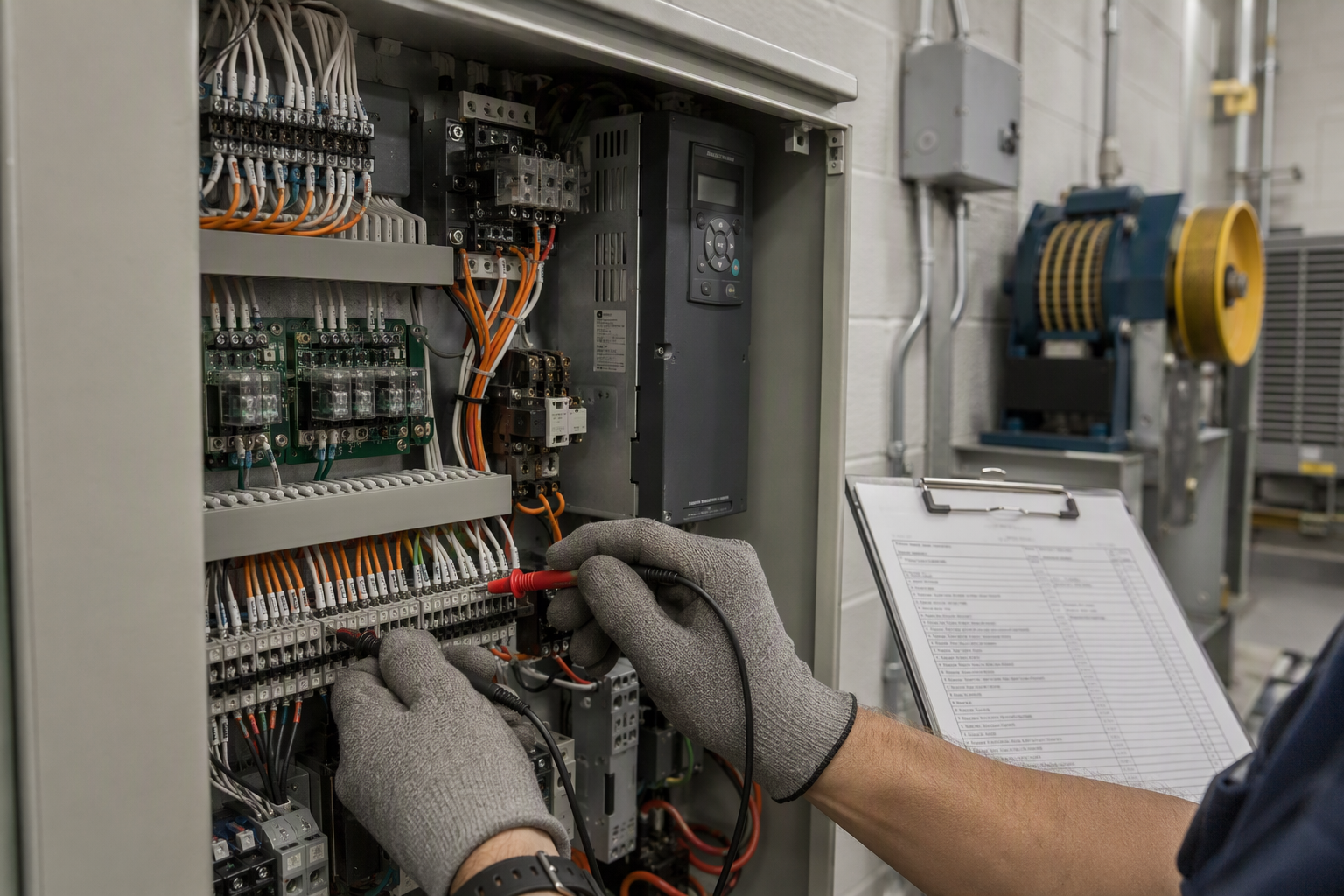
A full maintenance contract — sometimes called a comprehensive or all-inclusive agreement — is a service arrangement in which the elevator company assumes responsibility for all routine preventive maintenance, lubrication, adjustments, inspections, and the replacement of worn or failed parts, all for a fixed periodic fee. The building owner pays a predictable amount each billing cycle regardless of how many service calls occur or what components need attention.
Under a full maintenance agreement, the contractor typically supplies:
- Regularly scheduled preventive maintenance visits
- Emergency callback response for unexpected stoppages or faults
- Replacement of most mechanical, electrical, and hydraulic components that wear through normal use
- Assistance with code compliance documentation required by the Florida Department of Business and Professional Regulation (DBPR), Division of Hotels and Restaurants, Bureau of Elevator Safety
- Support for the annual inspection process required under Chapter 399, Florida Statutes
It is important to read the contract’s exclusions carefully. Major modernization projects, vandalism repairs, and structural work are almost universally excluded even from full maintenance agreements.
What Is a Parts and Labor Elevator Contract?

A parts and labor contract — also called a time and materials or oil and grease contract — covers a defined scope of routine maintenance visits and the technician labor for those visits. Beyond that baseline, every service call, every replacement part, and every repair is billed separately at agreed-upon rates. The building owner retains the risk of unexpected repair costs.
A typical parts and labor agreement includes:
- A set number of scheduled preventive maintenance visits per year
- Lubrication, cleaning, and minor adjustments during those visits
- Labor and parts for emergency callbacks billed at contract or prevailing rates
- Basic documentation support
The monthly or annual fee for this structure is lower, but the total annual cost can exceed a full maintenance contract in years when significant repairs arise.
How Do the Two Contract Types Compare Side by Side?
| Factor | Full Maintenance Contract | Parts and Labor Contract |
|---|---|---|
| Monthly cost structure | Fixed, predictable | Lower base fee; variable total |
| Parts included | Most worn or failed parts (check exclusions) | Billed separately per incident |
| Labor for callbacks | Typically included | Billed at contract or hourly rate |
| Preventive maintenance | Included, scheduled | Included at defined visit frequency |
| Budget predictability | High — one line item | Low — spikes in repair years |
| Best for equipment age | Older or mid-life equipment | New or recently modernized equipment |
| Best for traffic volume | High-traffic (commercial, residential high-rise) | Low-traffic (small office, two-story) |
| Contractor risk | Contractor absorbs parts/labor risk | Building owner absorbs parts/labor risk |
| Compliance support | Generally more comprehensive | Limited to contracted visits |
| Florida inspection exemption eligibility | A qualifying service maintenance contract may exempt covered elevators from the annual state inspection (see below) | May not meet the exemption threshold — verify with DBPR |
What Does Florida Law Require Regardless of Contract Type?
Under Chapter 399, Florida Statutes, the certificate of operation holder — meaning the elevator owner — is legally responsible for safe operation, proper maintenance, inspection, and correction of any code deficiencies. No service contract transfers that legal responsibility to the contractor.
Key Florida regulatory requirements that apply regardless of which contract type a building selects include:
- Every elevator covered by Chapter 399 must be inspected annually by a certified elevator inspector unless a specific statutory exemption applies.
- Florida provides one narrow exemption: an elevator that is not an escalator or dumbwaiter, serves only two adjacent floors, and is covered by a service maintenance contract is exempt from the annual inspection while that contract remains in effect. This exemption does not apply broadly to all elevators under full maintenance contracts.
- A Florida certificate of operation is valid for no more than two years and can only be renewed when a current satisfactory inspection is on record. Operating on an expired certificate violates state law.
- The certificate of operation must be posted inside the elevator in a frame with a transparent cover.
- Any elevator accident must be reported to the state within five working days.
- All maintenance and repair work must be performed by a certified elevator technician who holds a Florida elevator certificate of competency, issued by the DBPR.
- The elevator service company itself must be a registered elevator company, registered with the state annually and carrying general liability insurance.
Local authorities in Miami-Dade County, Broward County, the City of Miami, and the City of Miami Beach each enforce Chapter 399 through their own elevator offices. Building owners in those jurisdictions should confirm inspection and certificate requirements with the applicable local authority having jurisdiction (AHJ).
Which Contract Type Is Better for Older Buildings?
For buildings with elevators that are approaching or past the midpoint of their useful service life, a full maintenance contract typically delivers greater value. Older equipment is statistically more likely to require component replacements — controllers, door operators, hydraulic seals, ropes, and safety devices — and each of those repairs under a parts and labor contract becomes an unbudgeted capital event.
Additionally, equipment installed before the adoption of the ASME A17.1/CSA B44 Safety Code for Elevators and Escalators (Florida adopted the 2019 edition, effective December 31, 2023, under Chapter 61C-5, Florida Administrative Code) may require incremental upgrades to meet current requirements. A full maintenance contractor who discovers a deficiency during a routine visit is more likely to address it promptly when parts and labor are already covered.
Which Contract Type Is Better for Newer Buildings?
A building with a recently installed or recently modernized elevator — equipment still within manufacturer warranty and operating reliably — may find that a parts and labor contract offers a lower total cost of ownership during the early years. The core risk of unexpected major component failure is reduced when equipment is new, and the manufacturer warranty may cover certain parts anyway.
However, building owners should model the scenario in which a single major failure — a hydraulic pump, a motor drive, a door operator — occurs outside the warranty window. If that potential cost would strain the operating budget, the fixed-fee certainty of full maintenance may still be preferable even for newer equipment.
Pros and Cons: Full Maintenance Contract
| Pros | Cons |
|---|---|
| Predictable, fixed monthly expense for budgeting | Higher base monthly fee than parts and labor |
| Contractor is incentivized to prevent failures (their cost) | Exclusions can be extensive — read every clause |
| Comprehensive compliance support | May be paying for coverage rarely needed on very new equipment |
| Reduced administrative burden on facility staff | Contract lock-in periods can limit flexibility to switch providers |
| Faster resolution of callbacks when labor is pre-authorized | Scope disputes can arise over what counts as “normal wear” |
Pros and Cons: Parts and Labor Contract
| Pros | Cons |
|---|---|
| Lower predictable base cost | Total annual cost is unpredictable; can spike significantly |
| Suitable for low-traffic or new equipment with minimal repair history | Building owner absorbs full parts and labor risk |
| More flexibility to negotiate per-repair pricing | Callbacks may be delayed if labor must be separately authorized |
| Easier to switch contractors mid-term in some agreements | Less contractor incentive to prevent failures proactively |
| Transparent cost per repair event | Requires stronger internal budget reserve management |
What Factors Should a Florida Building Owner Evaluate Before Choosing?
Before selecting a contract structure, a qualified elevator service provider should assess the following factors specific to the building:
- Review the age and service history of all elevators or conveyances on the property.
- Identify any open code deficiencies cited during the most recent inspection report under Chapter 399 or by the applicable local AHJ.
- Confirm the current certificate of operation status and expiration date with the DBPR or the local authority.
- Evaluate average monthly traffic volume per elevator to assess wear rate.
- Determine whether the equipment is under any remaining manufacturer or modernization warranty that covers major components.
- Review the building’s capital reserve capacity to absorb an unbudgeted major repair under a parts and labor structure.
- Compare the full maintenance contract exclusions list against the equipment’s known wear points and likely near-term replacement items.
- Confirm that the prospective contractor is a registered elevator company in Florida with certified technicians holding a valid Florida elevator certificate of competency.
Does the Type of Contract Affect Florida Inspection Requirements?
Yes, in a limited and specific way. Under Chapter 399, Florida Statutes, an elevator that is not an escalator or dumbwaiter, serves only two adjacent floors, and is covered by a service maintenance contract is exempt from the mandatory annual state inspection while the contract is in force. This is a narrow exemption and does not apply to elevators serving three or more floors or to escalators and dumbwaiters regardless of contract type.
For all other elevators, the annual certified inspection requirement applies regardless of whether the building holds a full maintenance or parts and labor agreement. The contract type affects who pays for maintenance and repairs — it does not change the legal inspection framework established by Florida law.
Can an Independent Elevator Company Offer Both Contract Types?
Yes. Florida building owners are not required to use the original equipment manufacturer’s service arm. Any registered Florida elevator company staffed by certified elevator technicians holding a valid Florida elevator certificate of competency may offer full maintenance or parts and labor contracts.
Independent service providers often offer more competitive pricing and more flexible contract terms than OEM service divisions because they are not constrained by a parent company’s pricing structure. The critical qualifications to verify for any provider remain the same: active state registration, general liability insurance, and technicians with current Florida certificates of competency.
Axxiom Elevator Florida is an independent elevator service company serving Florida building owners, offering both full maintenance and parts and labor contract structures and performing maintenance, repair, and compliance support under Florida’s regulatory framework.
What Contract Terms Should Florida Building Owners Negotiate?
Regardless of which contract structure is selected, building owners should negotiate or at minimum carefully review the following terms before signing:
- Exclusions list: Understand precisely which parts are excluded from coverage. Controllers, door operators, hydraulic cylinders, and pit equipment are commonly negotiated items.
- Escalation clauses: Some contracts allow the contractor to increase fees annually. Negotiate a cap or removal of automatic escalation.
- Callback response expectations: Clarify how callbacks are prioritized and what constitutes an emergency versus a non-emergency call.
- Modernization provisions: Confirm whether the contract requires the building to use the same contractor for any modernization work — this can limit competitive bidding.
- Term and termination: Understand the minimum contract period and the process for early termination, particularly if the building is sold or if service quality is unsatisfactory.
- Subcontracting disclosures: Confirm whether the contractor will perform all work directly or subcontract certain tasks, and ensure all technicians meet Florida certification requirements.
- Compliance documentation: Specify that the contractor will provide all records needed for the annual inspection, certificate renewal, and any AHJ requests under Chapter 399.
How Should a Building Owner Transition Between Contract Types or Service Providers?
- Obtain the most recent inspection report and certificate of operation from the current provider or the applicable AHJ to confirm there are no open violations.
- Request a complete maintenance history log from the outgoing contractor — in Florida, the elevator owner is ultimately responsible for these records.
- Schedule a pre-contract condition assessment with the prospective new provider so the incoming contractor can inspect all equipment before assuming liability under a full maintenance agreement.
- Confirm that the incoming company is registered with the Florida DBPR and that its technicians hold current Florida certificates of competency.
- Verify that the transition does not create a lapse in service coverage that would leave the elevator operating without a valid maintenance arrangement, particularly for buildings relying on the two-floor inspection exemption.
- Notify the applicable local AHJ (Miami-Dade, Broward, City of Miami, or City of Miami Beach, as applicable) if required by local procedure when changing service contractors.
Which Contract Type Supports ADA Compliance More Effectively?
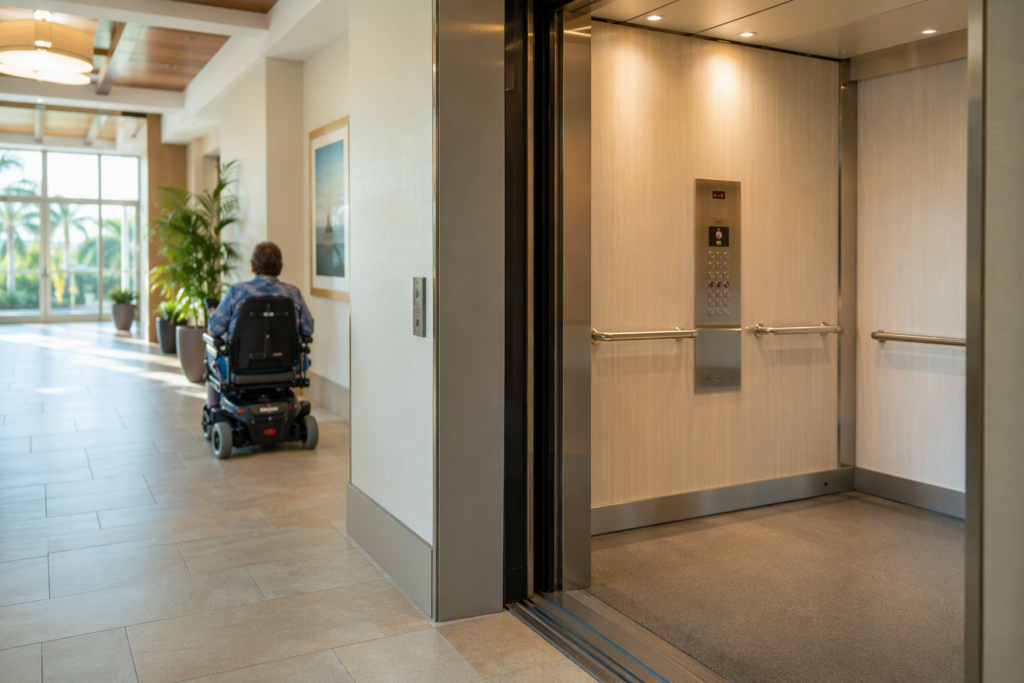
The Americans with Disabilities Act (ADA) requires that elevators in covered buildings remain accessible and operational for people with disabilities. A full maintenance contract, by providing incentivized preventive maintenance and covered callbacks, generally supports higher elevator uptime and reduces the risk of protracted outages that may constitute an ADA accessibility failure.
Under a parts and labor structure, delays in authorizing repair work can extend equipment downtime. For buildings with legal obligations to maintain accessible routes under the ADA — including most commercial buildings, multi-family housing covered by the Fair Housing Act, and government facilities — the operational reliability associated with full maintenance contracts is an important non-cost factor in the decision.
What Role Does ASME A17.1 Play in the Contract Decision?
The ASME A17.1/CSA B44 Safety Code for Elevators and Escalators establishes the technical standards for elevator design, installation, and maintenance. Florida adopted the 2019 edition under Chapter 61C-5, Florida Administrative Code, effective December 31, 2023. The code defines minimum maintenance requirements that apply regardless of contract type.
Under ASME A17.1, elevators must be maintained in conformance with the code’s maintenance requirements. A full maintenance contractor who is incentivized to prevent failures is structurally motivated to meet or exceed those requirements. Under a parts and labor arrangement, the quality and thoroughness of each preventive maintenance visit depends more heavily on the building owner’s diligence in holding the contractor accountable to the contracted scope.
Contact Axxiom Elevator Florida for a free elevator assessment at 954-970-0020.
Need elevator service you can rely on? Axxiom Elevator Florida is ready to help.